Judge Herman Thomas Denied All 15 Counts in Judicial Ethics Complaint
The Mobile County circuit judge filed a one-page answer denying every count of a complaint accusing him of letting family, social and political relationships influence his conduct in three criminal matters.
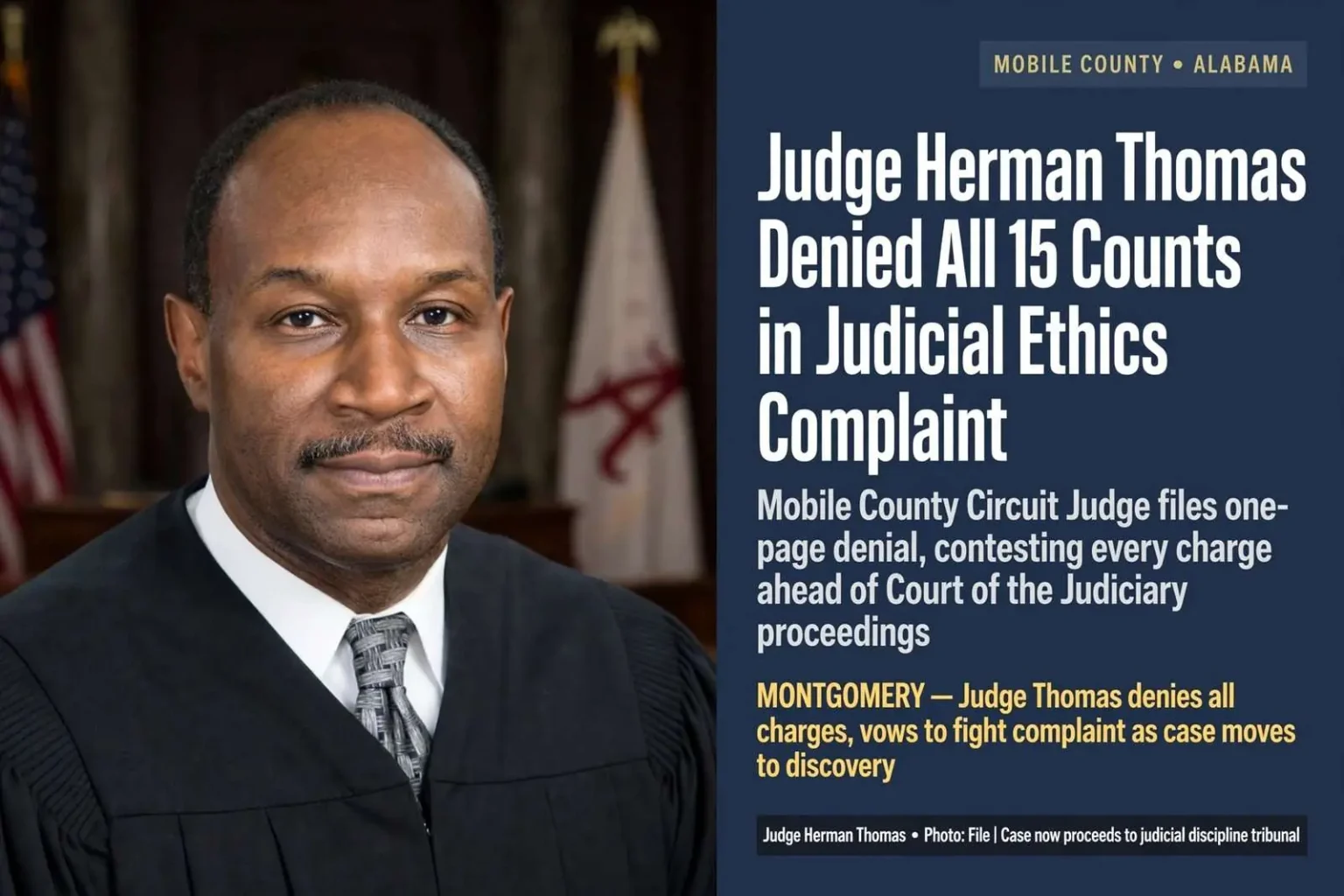
Mobile County Circuit Judge Herman Thomas flatly denied all charges in a 15-count complaint accusing him of violating the Alabama Canon of Judicial Ethics, filing a one-page answer that conceded nothing. “Judge Thomas denies charges One through Fifteen … and denies any violations of the Alabama Canon of Judicial Ethics,” the response stated. He “otherwise denies the material allegations of these paragraphs of the complaint.”
The filing was brief, but its significance was not. A one-page answer of general denial meant every count would have to be proven, count by count, before the tribunal that disciplines Alabama judges. Nothing would be resolved by stipulation, and the case would proceed through the machinery of judicial discipline rather than ending at the pleading stage.
The allegations
The Alabama Judicial Inquiry Commission had lodged the 15-count complaint, later amended, alleging judicial misconduct by the veteran Mobile jurist in criminal matters involving three individuals: his cousin, ousted Mobile County School Board member David Thomas; former professional, Auburn and Shaw football star Leonardo Carson; and Akil Figures, son of state Sen. Vivian Figures and the late Michael Figures.
“Judge Thomas, while serving as Circuit Court Judge of Mobile County, Alabama, did willfully allow his family, social, political, or other relationships to influence his judicial conduct or judgment,” the complaint stated. Some of the charges involved communications with his fellow judges.
The core of the accusation was a familiar one in judicial ethics law: that relationships outranked the robe. Canons of judicial ethics in Alabama, as in every state, require judges to avoid even the appearance that family ties, friendships or political debts shape outcomes in criminal cases. Prosecutors pursuing such complaints must connect specific dockets and specific communications to specific acts of influence, which is why complaints of this kind tend to run to many counts, each describing a separate alleged instance.
For the individuals named in the underlying criminal matters, the case drew attention well beyond legal circles. David Thomas had been a sitting member of the county school board before his removal, Leonardo Carson had been a celebrated defensive lineman at Auburn University and at Shaw High School in Mobile before a professional career, and Akil Figures carried one of the most recognizable surnames in Mobile County politics as the son of two of its most prominent Democratic figures.
How the process works
The 11-page complaint was presented for prosecution before the Alabama Court of the Judiciary, the tribunal that tries charges against Alabama judges. Deputy Attorney General Bill Lisenby Jr. headed the prosecution. David R. Boyd of Balch & Bingham led Thomas’s defense; Boyd, who had previously handled matters before the court, had not responded to attempts for comment.
The Court of the Judiciary occupies a distinctive place in Alabama government. It is not an appellate court and does not review rulings; it judges conduct. The Alabama Supreme Court has general superintendence over it, and its decisions can strip a sitting judge of office, suspend, censure or reprimand — sanctions that no other body in the state can impose on a member of the bench.
The court is a nine-member panel made up of five judges, two lawyers and two lay members. Removing a judge from office requires a unanimous vote. Lesser sanctions, including censure or suspension, require six votes. The supermajority requirements reflect a deliberate design: Alabama’s system was built to make removal difficult, insulating the elected judiciary from politically convenient discipline while still providing a forum for serious misconduct.
At the time, two lay seats sat vacant. Gov. Bob Riley had not named replacements for Mobile Mayor Sam Jones and Sue McInnish of Montgomery, whose terms had expired in January and February of 2006. The vacancies mattered arithmetically. Until they were filled, the full nine-member complement was not available, which narrowed the panel’s margin for dissent in any contested case and underscored how dependent the process is on appointments being made on time.
The Alabama Supreme Court had recently tapped Criminal Appeals Judge Greg Shaw to serve as presiding judge over the court, with Criminal Appeals Judge Bucky McMillan continuing as alternate presiding judge. The presiding judge sets the course of proceedings, rules on motions and, in practice, carries much of the responsibility for keeping a high-profile case moving.
With Thomas’s answer filed, the case moved into discovery. The defendant would receive 30 days notice of a trial date unless he waived the requirement, according to court clerk John H. Wilkerson Jr. Mediation remained available until 10 days before trial.
That timeline gave both sides room to maneuver. A settlement short of trial — a consented sanction of some kind — is how many judicial discipline cases end nationally, sparing the judge a public hearing and the commission the burden of proof. The 10-day cutoff meant that any serious negotiation had to begin early, while discovery was still unfolding. If no agreement emerged, the case would be tried in open proceedings, a rarity for a sitting judge of Thomas’s tenure.
Thomas had been sidelined from his duties on the bench while the case was pending. The suspension, pending resolution of the charges, meant his docket had been reassigned and his courtroom stood idle, a visible daily reminder in the Mobile County courthouse of the case unfolding in Montgomery. A call to his home was not immediately returned.
The judge’s path to the bench
Thomas, a graduate of the Florida State University School of Law, was approaching his 20th anniversary as a member of the Alabama State Bar. He had worked as a prosecutor under former Mobile County District Attorney Chris Galanos before becoming a district judge and later moving up to circuit court. He also chaired Mobile County’s judicial nominating committee, which plays a leading role in filling vacancies on the local bench.
That career arc — prosecutor, district judge, circuit judge, chairman of the body that screens candidates for the bench — traced the standard ladder of a successful legal career in Mobile County, and it explains why the charges landed with such force among local lawyers. A judge facing the Court of the Judiciary after nearly two decades in public office draws scrutiny not only to the specific counts but to the whole record that preceded them.
His arrival on that bench roughly 17 years earlier came about through one of the odder maneuvers in modern Alabama politics. The judicial nominating committee, then dominated by Democrats, sent Gov. Guy Hunt, the state’s first Republican governor since Reconstruction, a slate of three names for a district court vacancy. All three were Democrats: Thomas and two politically active attorneys, Beth Marietta Lyons and Merceria Ludgood.
Hunt’s appointments secretary, Chuck Spurlock, weighed Thomas’s background as a prosecutor and his general conservatism and deemed him acceptable. And so a Republican governor appointed a Black Democrat to a district judgeship in Mobile County.
The episode illustrated the peculiar arithmetic of Alabama judicial selection in that era. Under the state’s merit selection process for vacancies, a governor must choose from names submitted by the local nominating committee, whatever the partisan mix. Hunt, a Republican who won office in 1982 in a race no one expected him to carry, routinely confronted nominating panels dominated by the opposite party, and his office developed a practice of combing the slates for candidates whose records suggested they could live with a Republican administration’s expectations.
The following year, the legal community rallied to secure Thomas’s election to a full term, in part to demonstrate that Mobile County’s at-large election of judges did not prevent Black candidates from winning. Almost all of the county’s judges at the time lived in Spring Hill, and the prospect of carving the county into judicial districts, or of judges challenging one another in a Spring Hill free-for-all, held little appeal for the bench.
At-large judicial elections were already controversial across Alabama by then. Voting rights advocates argued that countywide races diluted the strength of Black voters in districts where they were concentrated, and litigation over the practice ran for years in Alabama and across the South. The rally behind Thomas was, in effect, a political argument that the system could produce Black judges on its own terms — an argument that also served the sitting judges, who preferred at-large races with few challengers to district races that might invite them.
Thomas won. The at-large system survived, for a time at least, without the subdivision its critics had sought.
The career that began with that improbable appointment now hung on the outcome of proceedings in Montgomery. Whatever the Court of the Judiciary decided, the case had already reshaped the conversation about judicial ethics in Mobile County, where lawyers who had practiced before Thomas for two decades were sorting through what the 15 counts said — and did not say — about the judge they had known.
For now, the file in Montgomery was thick with the routine papers of a contested case: an 11-page complaint, a one-page answer, discovery requests and a trial calendar waiting 30 days out. The veteran jurist who had once been the compromise choice of a Republican governor and a Democratic committee was, by his own filing, contesting every count of the case that could end his career.