Fifteen Ethics Counts Filed Against Mobile Circuit Judge Herman Thomas
The Alabama Judicial Inquiry Commission lodged a 15-count complaint in March 2007 against Mobile County Circuit Judge Herman Thomas, sidelining him from the bench while the case proceeded.
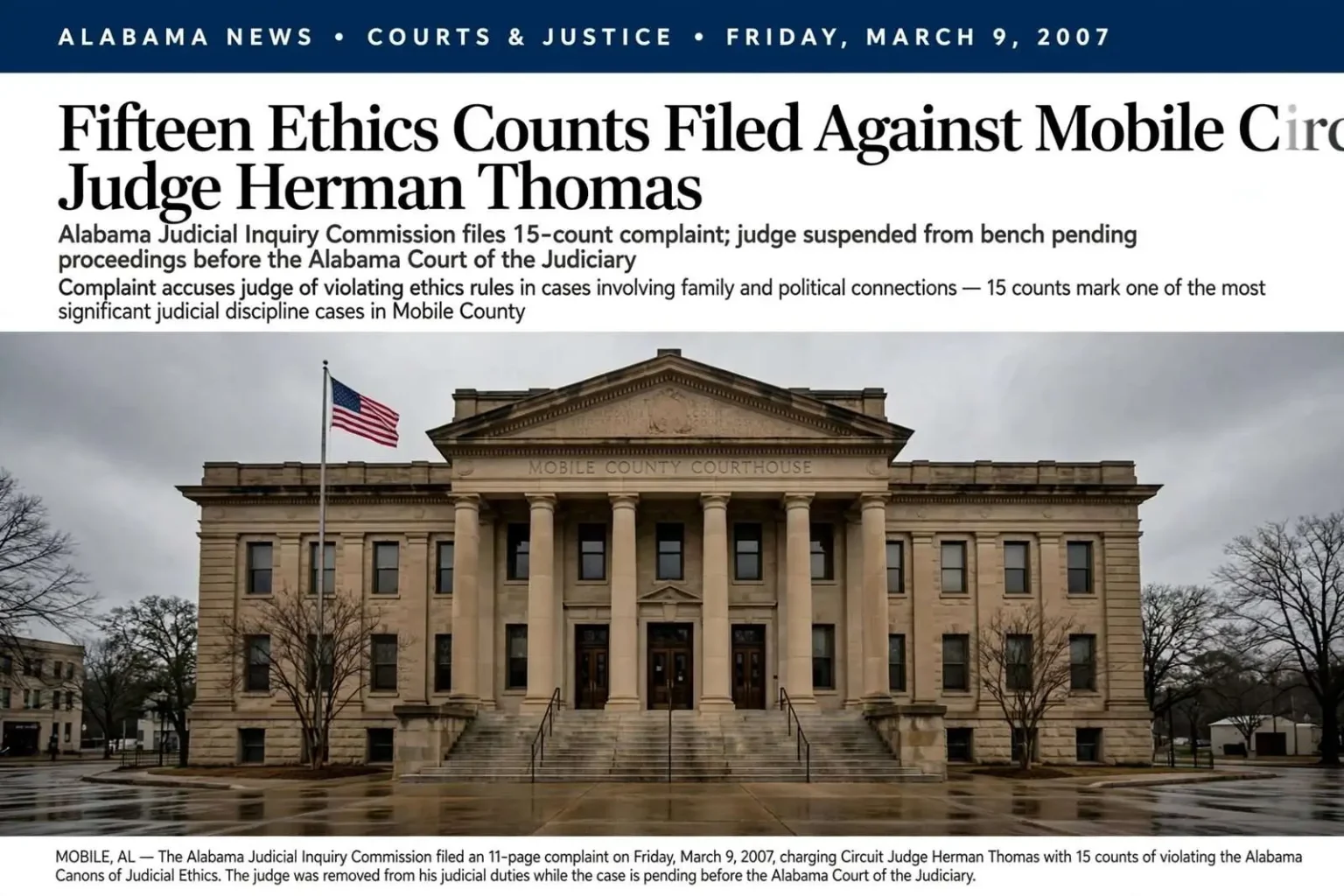
Fifteen Ethics Counts Filed Against Mobile Circuit Judge Herman Thomas
The Alabama Judicial Inquiry Commission lodged a 15-count complaint on Friday, March 9, 2007, charging Mobile County Circuit Judge Herman Thomas with violating the Alabama Canons of Judicial Ethics, an action that removed him from his duties on the bench while the case was pending. The 11-page complaint was presented for prosecution before the Alabama Court of the Judiciary, the body empowered to discipline or remove judges in the state.
The filing set in motion one of the most consequential judicial discipline cases Mobile County had seen — a sitting circuit judge, stripped of his docket by the suspension that accompanied the complaint, facing fifteen counts built on his handling of criminal cases involving people close to him.
The allegations
The charges stemmed from Thomas’s conduct in criminal matters involving three individuals with connections to him or to prominent Mobile families:
His cousin, David Thomas, an ousted Mobile County School Board commissioner; Leonardo Carson, the former professional, Auburn and Shaw High School football star; and Akil Figures, son of state Sen. Vivian Figures and the late Michael Figures.
The complaint stated that Thomas, while serving as a circuit judge, “did willfully allow his family, social, political, or other relationships to influence his judicial conduct or judgment.” Thomas returned a call but declined to comment.
The named cases drew the community’s attention because each connected back into Mobile’s public life — a school board figure, a locally famous athlete whose college and professional career had made him a household name, and the son of two of the city’s best-known political families. Judges are barred under the canons from allowing any personal relationship to touch their official conduct, and the complaint’s fifteen counts alleged that the line had been crossed repeatedly.
Calls to Circuit Judges Charlie Graddick and Rusty Johnston were also unsuccessful; some of the charges against Thomas involved communications with his fellow judges. That element — allegations reaching into the bench itself — shaped much of the legal community’s speculation about the case’s outcome, since statements made to other judges would be central to any question about Thomas’s truthfulness.
How the process worked
The Court of the Judiciary is a nine-member panel composed of five judges, two lawyers and two lay members. A unanimous vote is required to remove a judge from office. Lesser sanctions, including censure or suspension, require six votes.
At the time the complaint was filed, the panel had three vacancies: both lay-member seats and the presiding officer’s post. Gov. Bob Riley had not named replacements for Mobile Mayor Sam Jones and Sue McInnish of Montgomery, whose terms had expired in January and February 2006. The Alabama Supreme Court had not named a successor to Civil Appeals Judge William C. Thompson as presiding judge, and the term of alternate presiding judge Bucky McMillan of the Court of Criminal Appeals had also expired.
Thomas had 30 days to respond, after which a discovery phase would begin. The defendant is entitled to 30 days notice of a trial date unless he waives the requirement, according to court Clerk John H. Wilkerson Jr.
The procedural calendar meant months, not weeks, before the case reached the Court of the Judiciary — time during which the vacancy on the panel would need to be filled by the governor and the Supreme Court, and during which Thomas’s defense could negotiate or contest the counts. A removal required all nine members to agree; six votes would suffice for censure or suspension, and a panel with vacancies made even the arithmetic of discipline uncertain.
Divided opinion in the legal community
Lawyers familiar with the process split sharply on whether Thomas would survive. One experienced source well-versed in the commission’s dealings believed Thomas could emerge scarred but still on the bench. “He may be able to mediate it,” the source said. “He needs to show some contrition and commit to clean up his act. Be a judge, not a social worker.”
The source described Thomas as having “way overreaching” the authority of his office, noting that Thomas had never been in private practice and may not have appreciated that a judge cannot make the kind of calls a defense attorney routinely makes. The distinction the source drew — between a lawyer’s advocacy on behalf of clients and a judge’s duty of neutrality — was the fault line the complaint alleged Thomas had failed to observe.
A second source with equally deep knowledge concurred: “I also believe that he will get only a reprimand or a short suspension, because the only charges relate to situations where he was trying to help someone else, not himself.”
Others saw no path back. If the evidence established that Thomas had been untruthful to his fellow judges, one veteran attorney asked, how could he be permitted to administer the oath to witnesses?
“The evidence against him with the JIC appears to be overwhelming and I don’t see that he can survive,” another attorney said. “Ultimately, Herman’s problems stem from a boundless desire to help family and friends. As far as I know, none of Herman’s indiscretions were born of self-interest.”
The two camps disagreed about the ending but described the same character. Those who expected him to survive saw a judge whose offenses were interpersonal overreach rather than corruption; those who expected removal saw a truthfulness problem that no sanction short of leaving the bench could cure. Both agreed the case turned on what the fellow judges would say about the communications alleged in the complaint.
An unusual path to the bench
Thomas was a graduate of the Florida State University College of Law and was approaching his 20th anniversary as a member of the Alabama State Bar. He had worked as a prosecutor under former Mobile County District Attorney Chris Galanos before becoming a district judge and later moving up to circuit court. He chaired Mobile County’s judicial nominating committee.
His arrival on the bench some 17 years earlier had come about in peculiar political circumstances. The nominating committee, then dominated by Democrats, sent Republican Gov. Guy Hunt a list of three prospects, all of them Democrats: Thomas and two politically active Democratic attorneys, Beth Marietta Lyons and Merceria Ludgood.
Hunt’s appointments secretary, Chuck Spurlock, weighed Thomas’s background as a prosecutor and his general political and social conservatism. Thomas was deemed acceptable, and Alabama’s first Republican governor since Reconstruction appointed a Black Democrat to a district judgeship in Mobile County.
The following year the legal community rallied to secure Thomas’s election to a full term, in part to demonstrate that at-large election of judges did not prevent Black candidates from winning judgeships, and in part because the county’s judges, most of whom lived in Spring Hill, had no appetite for carving the county into single-member districts. Thomas won. The at-large system survived.
The Stakes for the Judiciary
The case tested more than one judge’s career. Alabama’s judicial discipline system — the Judicial Inquiry Commission investigating and the Court of the Judiciary adjudicating — exists to hold elected judges accountable between elections, and a 15-count complaint against a sitting circuit judge in the state’s second-largest county put the whole apparatus on display. Whatever the panel decided would establish a benchmark for how far a judge could go in assisting people with personal ties before the line into prohibited influence was crossed.
For Mobile County’s bench, the allegations involving communications with fellow judges raised questions that would outlast the proceedings: what obligation a judge has to report a colleague’s improper contacts, and how a court’s internal trust survives a case in which one of its members stands accused of misleading the others. The county’s judiciary, one of the busiest in the state, faced the prospect of answering those questions in a public trial of one of its own.
Thomas’s history made the case unusual from its opening chapter. His appointment by Gov. Guy Hunt — a Republican naming a Black Democrat to the Mobile County bench — had been a deliberate experiment in the county’s judicial politics, and his election to a full term the following year had helped defeat the push to break the county’s at-large system into districts. The same career that made him a symbol of the at-large system’s workability now faced the machinery built to police it.
The March 9 filing also arrived at a moment when the discipline system itself was in transition, with the three vacancies on the Court of the Judiciary awaiting gubernatorial and Supreme Court appointments. Until those seats were filled, the panel that would eventually sit in judgment on the complaint was not yet complete — a procedural gap that both the prosecution and the defense would have to factor into every calculation about how the case might resolve.