Propeller Club Called a Special Meeting as I-10 Bridge Routes Narrowed to Three
With 11 of 14 proposed routes eliminated and transportation officials nearing a decision, Mobile's maritime community convened a public session downtown that organizers called critical to the port's future.
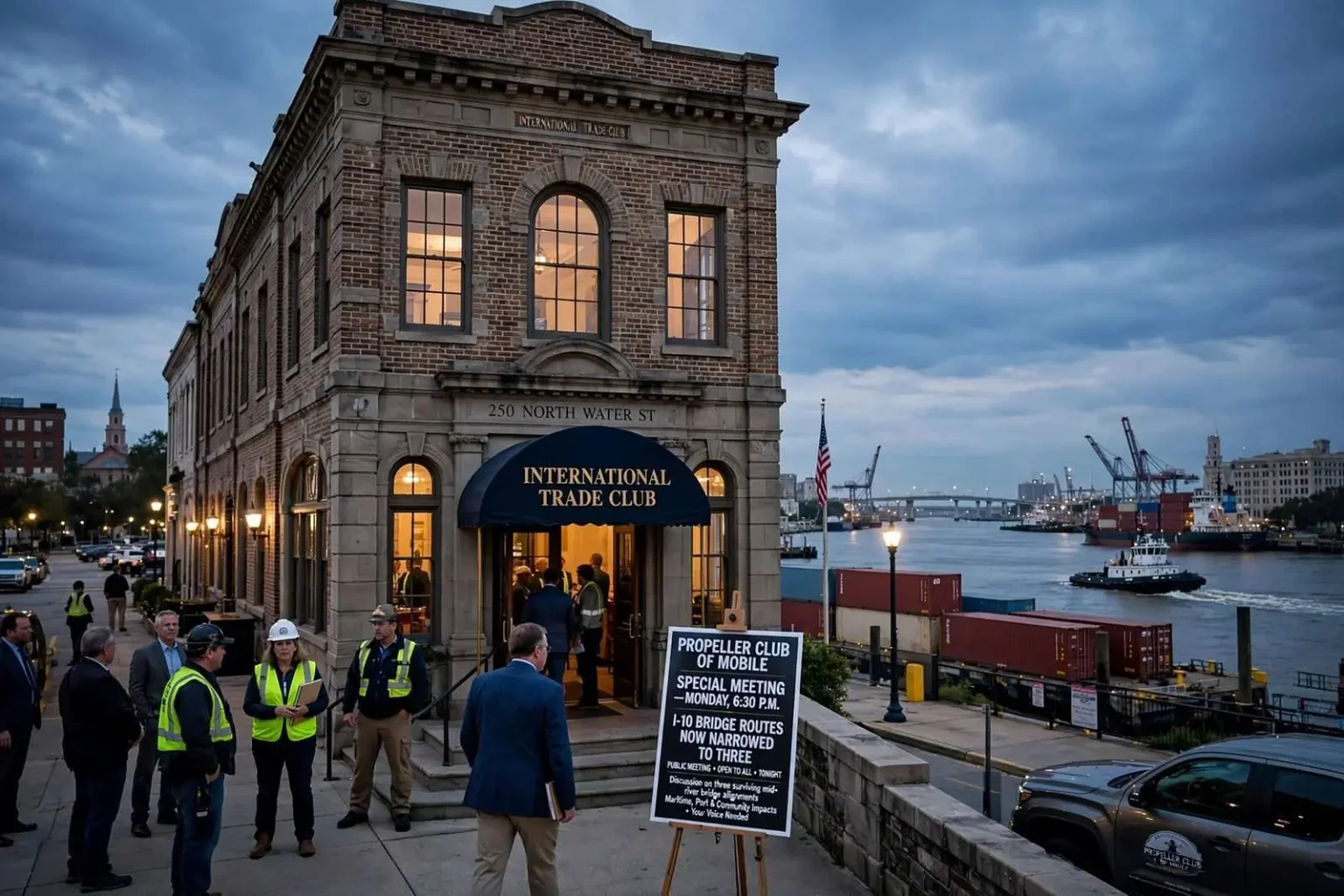
The Propeller Club of Mobile scheduled a special meeting at 6:30 p.m. Monday at the International Trade Club downtown to take up the question that had divided the waterfront for months: where to put a new Interstate 10 bridge over the Mobile River.
Organizers billed the session as “critical to the Mobile maritime community and others,” language that reflected how close the matter had come to a decision.
The State of Play
Transportation officials were nearing a choice on a route for the multimillion-dollar bridge, intended to relieve the traffic congestion caused by the bottleneck at the Wallace Tunnel in downtown Mobile.
Of the 14 routes originally proposed, 11 had been eliminated. The three that survived all crossed mid-river, which is precisely what alarmed the people who make their living on that river.
The objections came from nearly every direction:
Maritime and shipbuilding interests concerned about clearance, construction and the working waterfront
Downtown redevelopment advocates worried about a massive structure and its ramps cutting through the city center
Cruise terminal supporters anxious about the future of Mobile’s passenger ship business
Historic preservationists defending some of the oldest neighborhoods in Alabama
The breadth of that list is what made the bridge debate different from the ordinary road project. Each objection came from a constituency with its own claim on the same narrow corridor of river and city: the terminals and shipyards that needed air draft and pier access, the downtown districts that needed a skyline and walkable streets, the cruise industry that needed a tall ship to turn and dock unobstructed, and the historic neighborhoods — Church Street East, De Tonti Square, Down the Bay — whose buildings predate the automobile and could not be moved out from under an interchange. A route choice among three mid-river alignments was, in practice, a choice about which of those claims would bear the cost.
The Speaker
Marsha Anderson Bomar, president of Street Smarts, a transportation planning and engineering consulting firm engaged by Keep Mobile Moving, was scheduled to address the meeting.
The involvement of an outside consultant was itself a signal. The bridge debate had grown technical enough that the competing interests were arming themselves with expertise, and the maritime community wanted to hear the traffic engineering case explained by someone who could speak the language of the state and federal agencies making the decision.
Keep Mobile Moving — the citizens’ group organized around the project’s promise — had spent the route study advocating for a fix to the tunnel bottleneck, and bringing in a firm like Street Smarts extended that advocacy into the technical arena where the route decision would actually be made. Bridge alignments are chosen through engineering criteria: vertical clearance for navigation, horizontal clearance for the channel, interchange geometry, wetlands impact, cost per segment. Whoever could frame their preference in those terms held an advantage in the process, and the maritime community understood that hearing — and questioning — the engineering case in person was its last inexpensive opportunity to do so before the study advanced.
Why the Propeller Club
The Propeller Club of the United States is a maritime industry association with ports, or chapters, in shipping cities across the country. Its Mobile port draws its membership from the people who run the terminals, the shipyards, the stevedoring companies, the towing outfits, the pilots’ association, the maritime law firms and the freight forwarders. It is, in effect, the trade organization of the Mobile waterfront.
When that group calls a special meeting about a bridge, it is not an academic exercise. The Port of Mobile was, and is, one of the busiest in the country and the anchor of the region’s industrial economy. A bridge in the wrong place, at the wrong height, with piers in the wrong water, can foreclose decades of terminal expansion and vessel traffic.
The stakes were concrete, not abstract. The riverfront north of downtown held the bulk of the port’s general cargo terminals; the shipyards south of the harbor required clear water for launching; the channel itself was dredged and maintained to accommodate the vessels the port’s business depended on, and every foot of vertical clearance written into a bridge design determined the largest ship the river could ever serve beneath it. The Alabama State Port Authority’s expansion plans, the shipyards’ contract schedules and the towboat industry’s daily navigation all shared the same water a mid-river crossing would occupy.
The Underlying Dilemma
Everyone agreed the Wallace Tunnel was failing. Built to carry a fraction of the traffic it was handling, the twin tubes under the Mobile River choked daily, backed up for miles when a truck jackknifed at the eastbound approach, and forced hazardous-material haulers onto surface streets through downtown because they are prohibited from the tunnel.
That last point deserved attention in any discussion of the replacement. The tunnel’s prohibition on hazmat routing pushed tanker trucks carrying the port’s own cargo — chemicals, fuels, the feedstocks of the petrochemical corridor — through downtown surface streets twice, once approaching and once leaving the river, past neighborhoods and businesses with no say in the routing. The bottleneck was thus not merely an inconvenience but a public-safety argument for a new crossing that everyone on every side of the route debate accepted. The disagreement was about the price of the cure.
A bridge tall enough to let ships pass and strong enough to carry interstate traffic is an enormous object. Placed at mid-river near downtown, it would loom over the Church Street and De Tonti Square historic districts, over Down the Bay, and over the cruise terminal that Mobile had just spent public money to build.
The cruise terminal had become the debate’s sharpest symbol. The city had invested in the riverfront terminal specifically to hold onto a passenger ship business that brought thousands of visitors a week through downtown, and the vessels that business depended on were exactly the tall ships a mid-river bridge would measure itself against. If the bridge’s clearance did not clear the cruise ships’ masts and stacks, the terminal investment — and the hotels, parking and restaurants built around it — would be undercut by the very project meant to improve the city’s connection to the east. Preservationists made the mirror-image argument: the oldest surviving neighborhoods in Alabama, concentrated on the hill just west of the river, would live permanently beneath an elevated interstate that earlier generations of Mobilians had fought to keep out of their midst.
The geometry allowed no cheap compromise. Ramps serving a high bridge descend over blocks, not feet; an alignment that cleared the channel downtown would thread its approaches through the same districts the preservationists defended. Moving the crossing farther upriver would spare downtown but lengthen the crossing, raise the cost, and shift the burden to the industrial waterfront — which is why the three surviving alignments all remained mid-river, and why every constituency had shown up for the argument.
The Meeting and the Window
The meeting was open to the public, admission was free, and seating was limited. Reservations were recommended. The International Trade Club was located at 250 North Water St.
The venue itself carried meaning: 250 North Water Street sat directly on the waterfront the meeting was about, in the district of offices and terminal headquarters where the bridge question was daily business rather than abstract planning. Holding the session there, in the evening and open to the public, let the maritime community bring in dockworkers, port neighbors and downtown residents alongside its member companies — broadening the record of concern beyond the industry’s usual spokesmen.
Whatever the audience heard that Monday evening, the decision itself belonged to transportation officials, and the window in which the maritime community could still influence it was closing.
The route study process — public meetings, alternatives analysis, agency review — had been designed to gather exactly the objections the Propeller Club meant to sharpen, but the stage of the process mattered. With 11 of 14 routes already eliminated and the survivors all mid-river, the remaining choices concerned details with enormous consequences: exact alignment, clearance height, pier placement, interchange design. Those details would be written into the engineering documents the federal approval process would then follow, and after that approval, revisiting them meant years and litigation. The Monday meeting was, in that sense, the waterfront working the last open door — a room full of the people whose livelihoods sat under the proposed span, hearing the engineering case and preparing their response while the response could still change the drawings.
What Was at Stake on the River
The deeper story was the collision of two Mobiles that had grown up sharing the same few miles of water. The working river — terminals, towboats, shipways, the pilot boats running out to meet inbound ships — built the city’s economy and still anchored it. The modern city — the interstate, the cruise terminal, the historic districts now marketed to visitors, the downtown renaissance that depended on a breathable, walkable center — had grown up around and above the waterfront. Both needed the bottleneck fixed; neither could absorb the fix without cost.
That is why the meeting mattered beyond one Monday night. A decision of this scale — a multimillion-dollar interstate crossing over one of the country’s busiest ports, in the shadow of Alabama’s oldest neighborhoods — would set the shape of downtown and the working river for the next half-century. The Propeller Club’s special session put the people who would live with that shape, in both senses, in the same room with the engineering case for it, and did so while the drawings could still be redrawn. Whether the bridge that eventually rose over the Mobile River looked anything like the three mid-river routes then on the table, the arguments aired at 250 North Water Street were the waterfront’s account of what Mobile stood to lose — entered into the record while the record was still open.