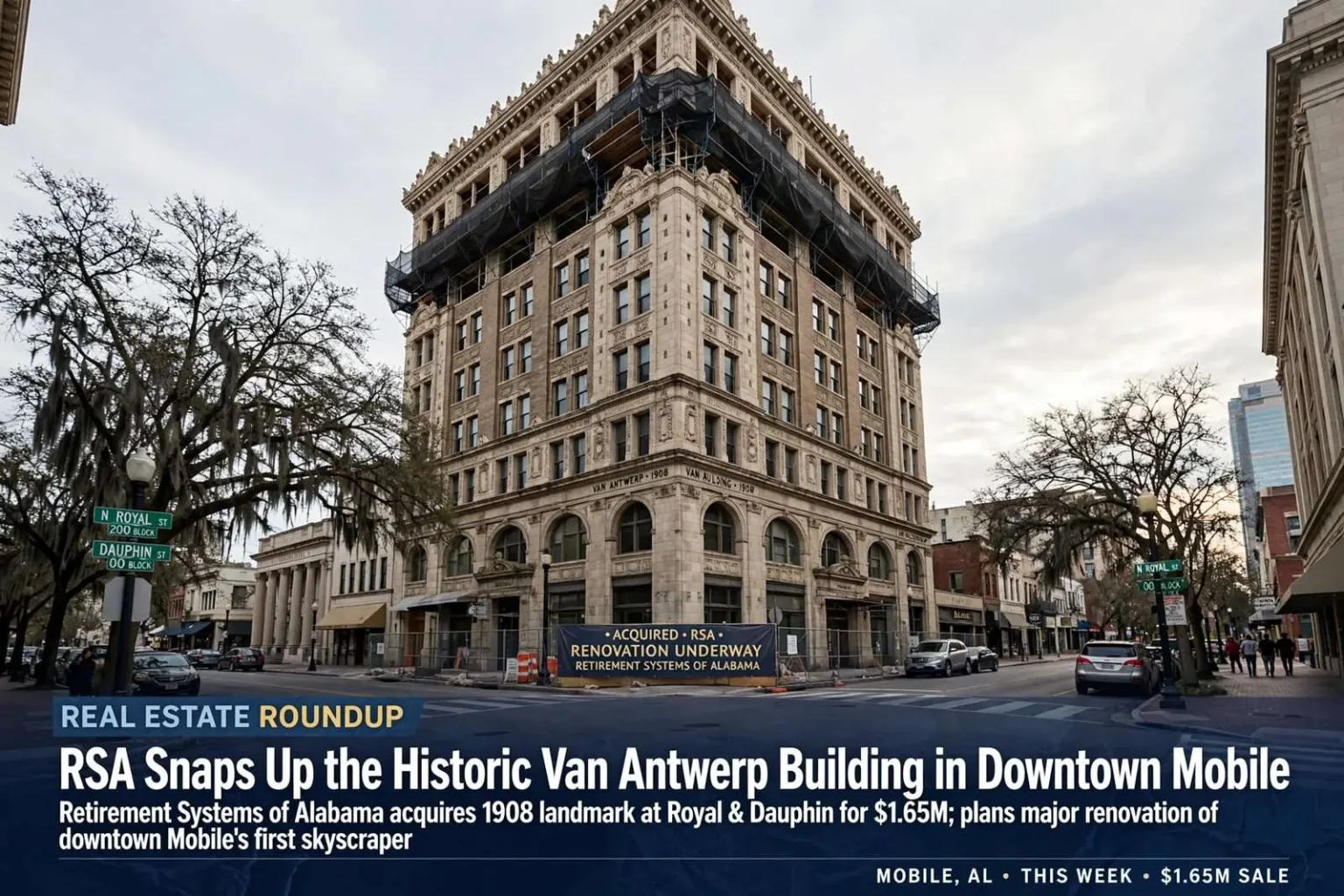
Real Estate Roundup: RSA Snaps Up the Historic Van Antwerp Building in Downtown Mobile
The Retirement Systems of Alabama expanded its downtown Mobile footprint with the historic Van Antwerp building and a Royal Street law office, as Whole Foods eyed a Pinebrook location.
A Mississippi-based investor paid $1.65 million for the bank-owned Romar Harbor Marina on 2.6 acres on Cotton Bayou Drive in Orange Beach, according to Bob Shallow of REMAX Paradise, who represented the buyer, and John Vallas of Vallas Realty, who worked for the sellers. The 220-slip marina included 20 wet slips, 200 dry slips and three storage buildings.
The sale put one of the beach’s most convenient marina properties back in private hands after the bank that held it moved to dispose of the asset. Cotton Bayou Drive sits in the heart of Orange Beach’s high-traffic corridor near the pass, where boat storage and wet slips are perpetually in demand from a boating public that grows every year. A 220-slip facility so close to the water — with dry stack capacity for 200 boats and three storage buildings thrown in — is the kind of property that rarely trades, and the bank-owned sale gave an out-of-state investor a foothold in one of Baldwin County’s strongest niche markets.
RSA Grows Downtown
The Retirement Systems of Alabama had the Phelps Dunbar law office and adjacent parking lot at 2 N. Royal St. under contract, with plans to close on the nearly $5 million purchase the following Tuesday, officials on both sides said. The firm, formerly Lyons Pipes & Cook, would remain as a tenant in the 16,000-square-foot building next to the RSA-owned Battle House Renaissance Hotel.
The deal extended the pension fund’s already considerable footprint in downtown Mobile. The Retirement Systems of Alabama, the state agency that invests and manages the pensions of public employees, has been the single most influential force in downtown Mobile’s commercial revival, assembling hotels, office towers and parking infrastructure around the RSA Tower and the restored Battle House. Adding the Phelps Dunbar block continued the pattern: acquire well-located property near existing RSA holdings, keep the established tenant in place, and let the district’s momentum raise the value of the whole portfolio.
For the law firm, the transaction changed the landlord, not the address. Phelps Dunbar — which operates in the region under its heritage name Lyons, Pipes & Cook — remained in its 16,000-square-foot space, preserving a presence on Royal Street that places the firm steps from the county courthouse complex and the city’s legal community. Downtown tenants of that kind are exactly the anchor occupants RSA has sought to keep in place as it rebuilt the city’s central business district block by block.
The deal came a week after RSA paid $1.65 million for the circa-1908 Van Antwerp building at Royal and Dauphin streets, with plans for a major renovation of the 10-story historic office tower, according to leasing agent Joe Toole. The Van Antwerp had been owned by a local investor in the used-car business, according to Burton Clark of Cummings & Associates, who represented the seller.
The Van Antwerp is one of downtown Mobile’s most recognizable historic structures — a steel-frame office tower from the era when Mobile’s cotton and timber fortunes were climbing, long celebrated as the city’s first skyscraper. Its corner site at Royal and Dauphin puts it in the middle of the RSA-built revival, and the announced renovation plans signaled that the pension fund intended to restore the landmark to active office use rather than let it sit. The building’s prior ownership by an investor outside the real estate establishment illustrated how many of downtown’s historic properties passed through unconventional hands during the decades before the current boom.
Seafood, Reggae and Groceries
The owners of The Shrimp Basket paid $375,000 for a 20,000-square-foot warehouse on Flying K Road off Alabama 59 in Loxley, planning to open a wholesale operation called Fresh Seafood Delivery to supply their 19 restaurants and other businesses, according to co-owner Eddie Spence.
The purchase moved the growing restaurant group into the wholesale side of the seafood business, giving its restaurant chain a dedicated supply operation rather than reliance on outside distributors. Loxley’s position along the Alabama 59 corridor — the main artery connecting the Interstate 10 interchange to the beach communities — made the warehouse location a practical one for a company moving product daily to restaurants scattered across south Alabama. A 20,000-square-foot footprint also left room to serve the operation’s other business customers, not just the company’s own kitchens.
Spence also reported that Universal Studios had declined its right of first refusal on a Bob Marley-themed restaurant, clearing the way for him and partners to finalize a Marley restaurant with an indoor stage on Alabama 182 in Orange Beach, with the blessing of the Marley family and the city Planning Commission.
The clearing of that right of first refusal removed the last legal obstacle to a concept that had been in the works for some time. Universal had held rights over the Marley-themed dining brand, and its decision to pass freed the local group to proceed on its own terms. An indoor stage put live music at the center of the concept — a natural fit for the beach highway’s entertainment strip — and the family’s approval meant the project would carry the authentic connection to the artist’s legacy that such venues trade on. City planning approval indicated the project had cleared Orange Beach’s development review process.
In Mobile, Whole Foods was studying a location in the Pinebrook Shopping Center at Airport Boulevard and South McGregor Avenue, a move that would require reshuffling existing tenants and a new traffic signal, according to a site plan submitted to the Planning Commission. The Austin-based grocer had not signed a lease.
The exploratory site plan drew immediate attention in west Mobile, where the Pinebrook center sits in one of the city’s most established retail corridors. Whole Foods’ arrival in a market has long been treated by developers and shoppers alike as a signal of a community’s retail standing, and the prospect of reshuffling a shopping center at one of Airport Boulevard’s busiest intersections — including a new signal to handle the traffic a high-volume grocer generates — showed the scale of what was being contemplated. The absence of a lease, however, meant the project remained a study rather than a commitment, and planning documents alone did not guarantee the deal would close.
Around the Region
The Shoppes of Foley added Pearl Nails & Spa and Salon Fahrenheit & Spa, filling the 8,200-square-foot center. The two leases rounded out the small retail center, reflecting the steady demand for personal-service tenants along Foley’s commercial corridors as the city’s population and retail base have grown alongside the outlet-shopping traffic that defines the area’s economy.
Crown Products Inc. leased a 9,000-square-foot office warehouse on Halls Mill Road in Mobile, and Sun Loan Company leased space in Chamber Plaza off Alabama 59 in Bay Minette. Both deals illustrated the quieter end of the commercial real estate market that keeps the region’s economy moving — small and mid-sized tenants taking space along established corridors, from the industrial-flavored stretch of Halls Mill Road to Bay Minette’s Chamber Plaza, where the consumer lender joined a center positioned along one of the northern county’s busiest thoroughfares.
Taken together, the week’s deals traced the region’s commercial map: a marina sale in Orange Beach driven by the boating economy, the state pension fund consolidating downtown Mobile’s revival around its own holdings, a restaurant group integrating backward into wholesale seafood in Loxley, a themed restaurant concept moving forward on the beach highway, and national grocer and retail tenants circling established corridors from west Mobile to Foley. Each transaction told a small story, but the collection of them — marinas, towers, warehouses and strip centers — was a snapshot of a regional economy expanding in every direction at once.
What the Deals Say About the Market
The clustering of activity in the roundup reflected conditions familiar to brokers across the region at the time. Bank-owned properties like the Romar Harbor Marina were still working through the aftermath of the lending downturn, giving investors opportunities to buy income-producing assets at prices unavailable a few years earlier. At the same time, the region’s strongest operators — restaurant groups, pension funds, national retailers — were expanding into owned or leased space, a sign that confidence had returned to the market even as distressed properties continued to change hands.
The marina sale fit squarely into the first pattern. Lenders that had taken back waterfront assets during the downturn spent the recovery years selling them to buyers with cash and patience, and a 220-slip facility in Orange Beach — with its mix of wet slips, dry storage and buildings — represented the kind of secured asset that financial institutions were glad to move. Buyers willing to hold such properties through the market’s upswing stood to benefit from both rising slip demand and the steady appreciation of scarce waterfront land.
RSA’s downtown purchases fit the second pattern. The pension fund’s strategy in Mobile has always been countercyclical patience — buying when others hesitated, renovating patiently, and letting tenant demand catch up to the improved product. The Van Antwerp purchase, following the Phelps Dunbar contract by a week, showed that approach operating on two tracks at once: restoring a century-old landmark while assembling the adjacent office property its legal tenant already occupied.
The retail and restaurant deals traced yet another pattern: the regional economy’s steady decentralization. A wholesale seafood operation in Loxley, a Marley-themed venue on Alabama 182, salon leases in Foley and a consumer lender in Bay Minette all pointed to growth spreading beyond the beachfront and downtown cores into the corridors where residents actually shop and work. Brokerage firms on both sides of the bay reported that deal flow in those secondary markets had become the backbone of their business, even as headline-grabbing downtown and waterfront transactions drew the press coverage.
For local officials, the week’s activity offered reassurance on two fronts: that investors from beyond the region continued to see value in Baldwin County’s waterfront and commercial properties, and that Mobile’s downtown — the beneficiary of the state pension fund’s long-running commitment — had reached the point where private firms like Phelps Dunbar were worth nearly $5 million for a single building and parking lot. Both were signals of a market moving in one direction, even if each deal, on its own, was just another line in the roundup.