Oddsmaker Favors Jones for Re-election; a Would-Be Rival Pushes Back
Sports and political analyst Danny Sheridan made Mayor Sam Jones a heavy favorite for re-election in 2013, prompting prospective challenger Tilmon Brown to argue that no candidate is unbeatable.
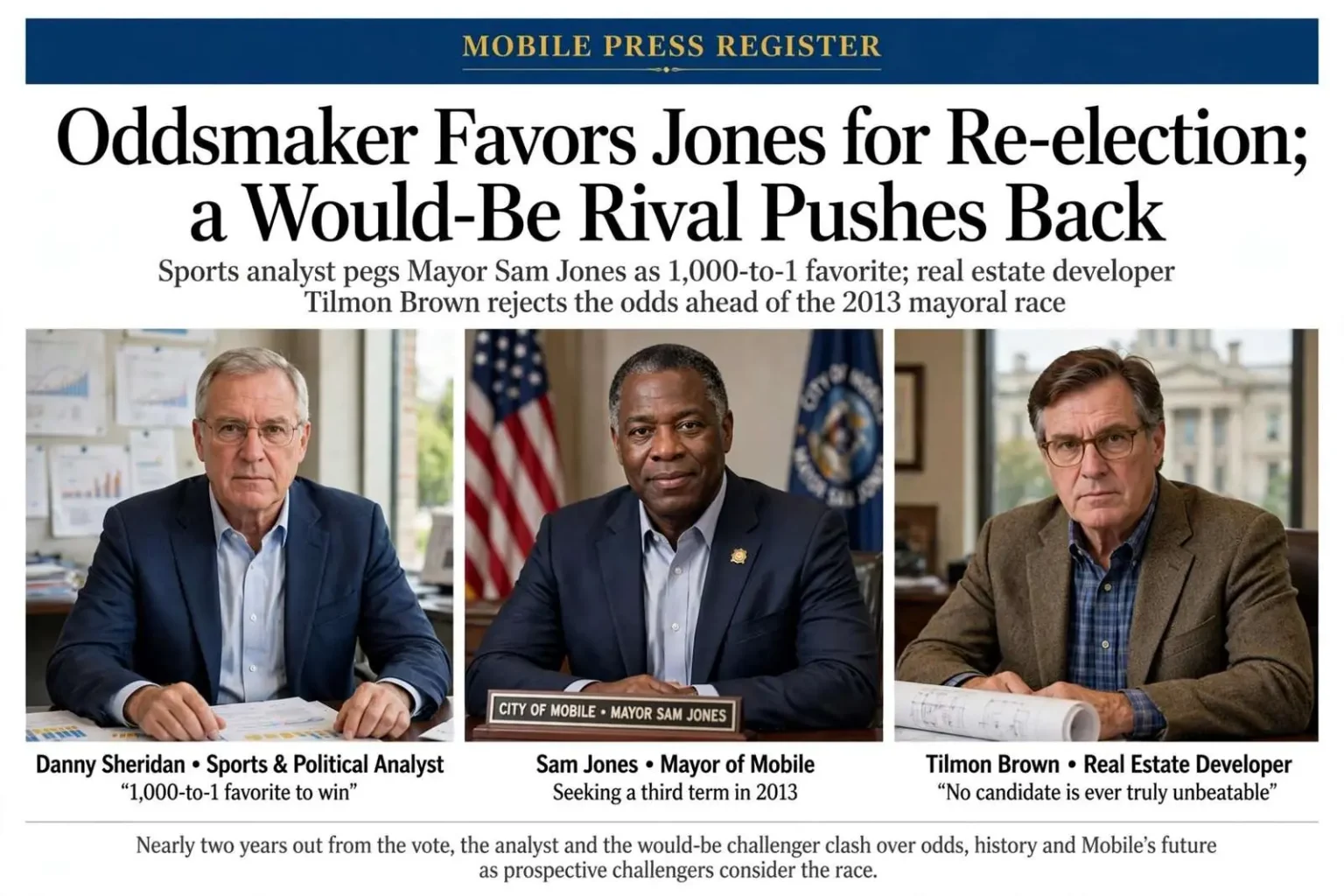
Sports and political analyst Danny Sheridan made Mobile Mayor Sam Jones an overwhelming favorite to win re-election in 2013, and the pronouncement drew a spirited rebuttal from Tilmon Brown, a prospective challenger who insisted that no candidate is ever truly unbeatable. Sheridan placed the odds at 1,000 to 1 that Jones would win, casting the city’s first Black mayor as nearly invulnerable given a voter base that had grown since he first won the office. Not everyone accepted that assessment, and Brown, a real estate developer specializing in historic properties, was among the doubters.
A challenger’s rebuttal
Brown, 57, argued that Jones was in fact beatable, and he reached for history to make his point. He rattled off a list of candidates who had been written off before pulling upsets, contending that the political landscape was littered with contenders who supposedly could never be beaten. Experts, he suggested, had been wrong before, and would be again. American political history offered him plenty of material — incumbents at every level have fallen to challengers the oddsmakers dismissed, and municipal politics in particular has a habit of turning on issues that pollsters and pundits never see coming.
Sheridan pushed back on the framing. He said he had never claimed Jones could not be beaten, only that the odds today strongly favored him. Those odds, he added, might rise or fall as the election approached, but if Jones ran, Sheridan predicted he would win, and forecast that Brown would finish third or fourth in a five-person field. The prediction was characteristically specific, the kind of concrete call that had made Sheridan a familiar voice on radio and television across the Southeast, where he had built a career turning analytical judgment into quotable odds.
Facts versus feeling
The exchange turned into a debate over whose read of the electorate carried more weight. Brown dismissed Sheridan as someone who merely guessed the future and was out of touch with the frustrations of Mobile’s citizens. Sheridan countered that his observations rested on facts, objectivity and decades of experience, and on his sense of what most Mobilians would do on election day.
Brown insisted that Sheridan possessed no firsthand knowledge of residents’ sentiments or their concern for the city’s future, and he argued that voters were tired of a city he characterized as settling for mediocrity. He said Mobile should strive to be a great city, the premier city on the Gulf Coast, rather than one that made excuses for itself. The critique drew on a frustration long audible in Mobile’s civic conversation — the sense that a city with the port, the history and the footprint to lead the Gulf Coast had too often contented itself with less.
Sheridan, for his part, rested his case on the observable record. An incumbent mayor with no declared serious opposition, a consolidated electoral base and nearly two years to raise money and organize was, in the analyst’s arithmetic, a heavy favorite regardless of the city’s mood. Odds, he noted, were not endorsements; they were summaries of what the evidence showed on a given day.
A wager on the table
Sheridan, unbowed, suggested that Brown put his money where his mouth was. If Brown truly believed the analysis was wrong, Sheridan said, he should wager at least $10,000 that Jones would not be the next mayor, with any winnings going to charity. He maintained that he had never claimed the power to decide the race, only to set objective odds and, in this case, to explain his reasoning.
Brown declined the bait, questioning Sheridan’s motives for making such a prediction so far in advance. If he decided to run, Brown said, it would be out of a desire for a better Mobile, not because of a bet with an oddsmaker.
An early skirmish, two years out
The back-and-forth unfolded nearly two years before the vote, with Jones having said he intended to seek a third term and other prospective candidates, including lumber executive Sandy Stimpson, weighing bids of their own. The distance from the election made the exchange more about positioning than prediction: any challenger considering the race had to assess not just the incumbent’s strength but the field, the fundraising landscape and the appetite of the city’s business community for a change.
Sheridan noted that the city had absorbed setbacks on Jones’s watch, from the loss of a major military tanker contract at Brookley to the departure of a cruise ship, yet still judged the incumbent a strong favorite. The Brookley episode stung particularly deeply in Mobile, where the aerial refueling tanker contract had been pursued for years as a transformative anchor for the airport industrial complex, and its loss to a rival bid became a symbol of the city’s frustrated ambitions. The cruise ship’s departure, similarly, took with it a visible symbol of downtown vitality that city leaders had promoted heavily.
That such setbacks coexisted with Sheridan’s 1,000-to-1 odds illustrated the incumbent’s structural advantages in a city election. Jones, first elected in 2005 as Mobile’s first Black mayor, drew on a coalition that had re-elected him comfortably, and the city’s at-large election structure meant any challenger needed to assemble a coalition across neighborhoods and constituencies that historically voted differently. No challenger had yet declared, much less begun the fundraising and coalition-building a serious campaign would demand.
The politics of being the underdog
Brown’s rebuttal, whatever its chances, sketched the argument any 2013 challenger would eventually make. The case against an incumbent of either party in a city election tends to rhyme: unfulfilled promises, stalled development, a sense that the city has settled. Brown’s formulation — Mobile should be the premier city on the Gulf Coast, not one making excuses — was a theme that contenders in Mobile mayor’s races have reached for repeatedly, aimed at voters who measure the city against Tampa or New Orleans rather than against its own recent past.
The oddsmaker-versus-candidate dynamic also said something about how local campaigns get framed in the public eye. Sheridan’s odds gave the race a narrative before it had candidates, and Brown’s objection — that no one outside the city’s neighborhoods could know what voters felt — was the standard rebuttal of everyone who has ever been listed as a longshot. Both positions contained truth: elections are decided by voters, and voters’ moods can shift in ways analysts miss, yet incumbents with money, organization and a record usually do win.
Whatever the eventual field, the spat offered an early glimpse of the arguments a 2013 challenger might deploy, and of the skepticism any contender would have to overcome. For the moment, the contest existed largely in odds and rhetoric, with the voters’ verdict still a long way off — and in politics, as both men knew, two years is enough time for longshots to become nominees.
Mobile’s 2013 mayoral landscape
The conversation between the oddsmaker and the would-be candidate unfolded against a Mobile political calendar that had already begun to stir. Jones, elected in 2005 and re-elected four years later, had governed through a period that included both genuine wins and bruising losses: the city had landed major industrial projects along its port and airport corridors, while the tanker contract defeat at Brookley and the loss of its cruise ship served as reminders that some of the city’s biggest ambitions remained out of reach. Mayoral races in Mobile traditionally draw a wide field, and the prospect of a five-person contest — the number Sheridan cited in predicting Brown’s third- or fourth-place finish — reflected how open the field remained this far from election day.
Sandy Stimpson’s presence among the prospective candidates, noted in the exchange, hinted at where serious challenge energy might eventually concentrate. A lumber executive with deep business-community ties, Stimpson represented the kind of self-funded, business-oriented candidacy that Mobile’s elections had seen before and that Sheridan’s odds implicitly dismissed. Whether Brown, Stimpson or others entered, each would face the same structural math the oddsmaker had laid out: an incumbent with name recognition, a fundraising base and the power of the office itself.
Brown’s profile as a challenger was distinctive in its own way. A real estate developer specializing in historic properties, he had spent years working on the built fabric of the city’s older neighborhoods — the very districts whose fortunes fed the mediocrity-versus-greatness argument he pressed. Candidates drawn from historic preservation often carry a message about civic identity as much as municipal management, and Brown’s insistence that Mobile stop making excuses for itself fit that mold precisely.
The long history of writing candidates off
Brown’s appeal to history — the long list of contenders once counted out who went on to win — was more than rhetorical habit. American municipal politics offers a steady supply of upsets in which incumbents or anointed favorites lost to challengers whom the political class had barely noticed. Local elections, decided by small electorates and low turnout, are especially susceptible to shifts that no one models: a late-breaking issue, a gap between the incumbent’s perception and performance, or a challenger who spends months building block-by-block organization while the experts watch other races.
Sheridan’s answer to that history was to concede the point while standing by his numbers. Odds describe probability, not certainty; 1,000 to 1 against an outcome is not a claim that the outcome is impossible, only that it would be surprising. His willingness to revise the odds as the election approached — and his $10,000 challenge, framed as a charitable wager on his own analytical accuracy — was a way of saying that his prediction was a professional judgment open to being tested, not a proclamation immune to events.
Brown’s refusal of the wager returned the exchange to its real subject. He declined to have a race about the city’s future reduced to a bet with an oddsmaker, insisting that his interest in running, if it came to that, would flow from the same civic frustration he had expressed from the start. The exchange ended where early campaign exchanges usually do — with the incumbent undeclared, the challengers uncommitted, and the argument between facts and feeling left for the voters themselves to settle, two Augusts away.