Halfway Through the Year, Mobile’s Books Tell a Post-Katrina Story
A walk through Mobile's mid-year financial report for fiscal 2006-07 found revenue down 6.8 percent, hotel taxes collapsing against a Katrina-inflated year, and a transit subsidy running 121 percent over budget.
City financial reports are not written to be read. They are written to be filed.
But halfway through the 2006-07 fiscal year, Mobile’s monthly report repaid a slow amble through its columns, because the numbers told a coherent story about a city coming down off a strange, storm-distorted boom.
Revenue: down, and mostly for one reason
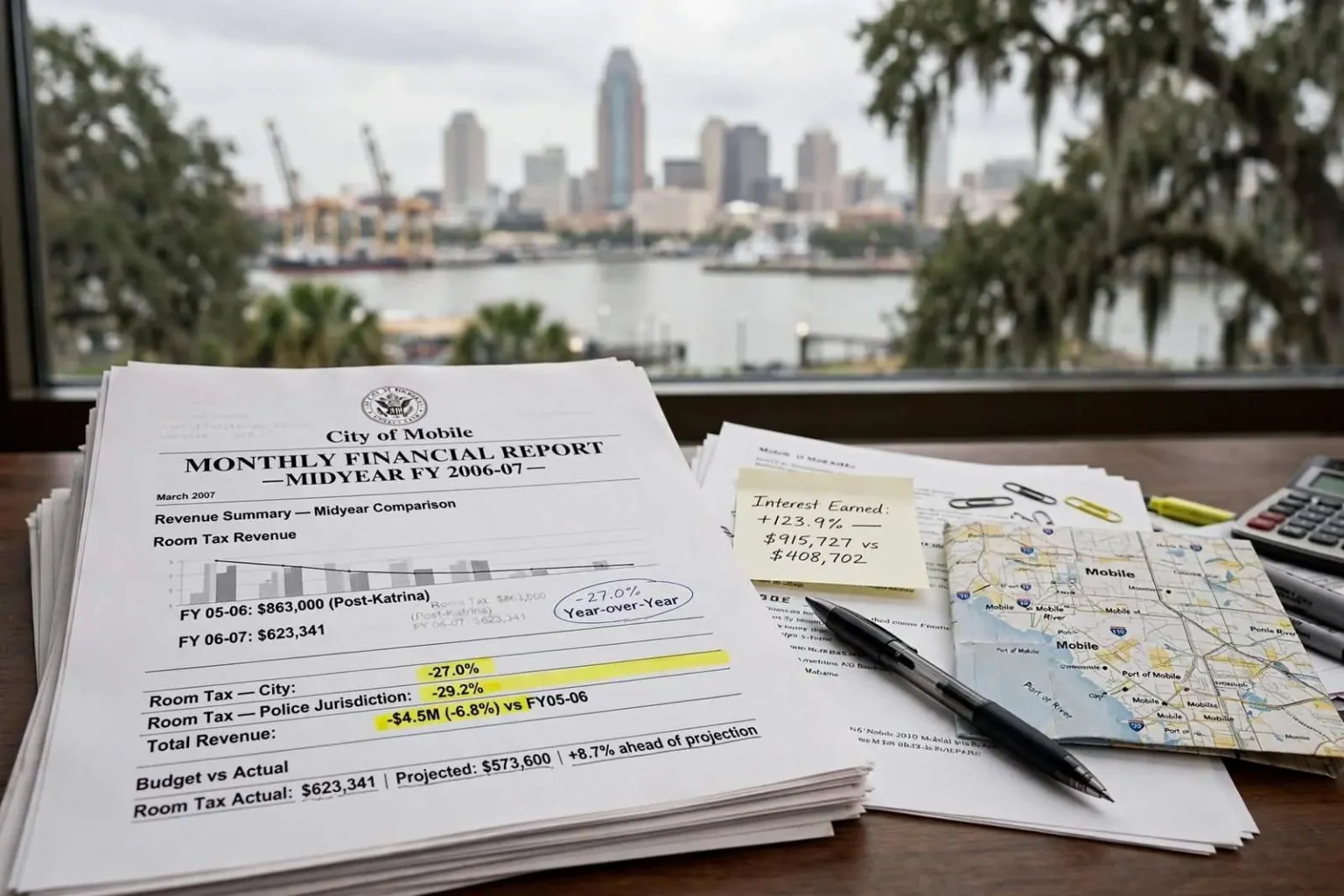
At the midpoint, revenues were running more than $4.5 million, or 6.8 percent, behind the same stretch of fiscal 2005-06.
The single most dramatic line was the room tax. Hotel tax collections fell 27 percent inside the city and 29.2 percent in the police jurisdiction.
The explanation was not a collapse in tourism but the year it was being measured against: in the months after Hurricane Katrina, Mobile’s hotels were full of displaced families, contractors and relief workers.
Katrina struck the central Gulf Coast at the end of August 2005, and Mobile — the nearest major city east of the disaster zone — became a staging point for the entire recovery. Its hotel rooms filled with evacuees from the Mississippi Gulf Coast and southeastern Louisiana, then with the contractors and utility crews who rebuilt the Coast through the fall and winter, and then with the insurance adjusters, FEMA staff and relief organizations that followed. The city’s hotel inventory, built to serve conventions and travelers, was effectively commandeered by the recovery at rates the market had never seen. Every occupied room paid the city’s room tax, and the first half of fiscal 2005-06 — October 2005 through March — recorded the revenue peak that followed.
Measured against that artificial peak, a return to normal looked like a rout. By the same stretch of 2006-07, the recovery economy had moved on: evacuees had relocated or returned, the contractor wave had receded, and Mobile’s hotels were back to serving the business and leisure traffic they were built for. The 27 and 29.2 percent declines in the room tax lines described that retreat, not a downturn — the police jurisdiction, which wraps the corridor of hotels along the interstate and airport approaches, fell slightly harder because that is where the relief-worker inventory had been concentrated.
Against the city’s own budget projections, room tax revenue was actually running 8.7 percent ahead, at $623,341 versus a projected $573,600.
That contrast is the interpretive key to the whole report. The city’s budget office, writing its projections in the fall of 2006, had assumed the Katrina bump would not repeat and built its estimates on a normalized hospitality market — and the actual collections came in comfortably above even that. The story the two comparisons tell is not a city losing money; it is a city landing from an extraordinary year onto an ordinary one and finding that the ordinary year is still healthy.
Elsewhere in the ledger
The rest of the revenue picture produced small oddities worth reading one at a time.
Tobacco taxes slipped 4.5 percent inside the city but jumped 21.3 percent in the police jurisdiction.
The divergence traces the same geography. The police jurisdiction — the band of unincorporated territory just outside the city limits where Mobile enforces its ordinances and collects its taxes — is where the region’s highway-oriented retail sits, and the tobacco collections there reflect the convenience-store economy along the corridors. A 21.3 percent jump in that line against a modest city-side decline suggests traffic through the corridor — much of it tied to the Gulf Coast recovery trade — stayed elevated even as the hotel boom unwound.
Fines and forfeitures rose 20.6 percent, with driver education program revenue nearly doubling.
Enforcement revenue is usually the most volatile line in a municipal budget, responding to staffing, traffic patterns and enforcement campaigns rather than to the economy. A 20.6 percent rise with driver education revenue nearly doubling points to expanded traffic enforcement activity during the period — plausibly connected to the surge in Gulf Coast traffic, recovery convoys and relocated drivers on the region’s roads after the storm, though the report’s columns record the result without narrating the cause.
Interest earned on idle funds more than doubled, climbing 123.9 percent from $408,702 to $915,727.
The interest line is the cleanest read on the financial environment. Idle cash in city accounts was earning sharply more because short-term rates had been climbing since the Federal Reserve began tightening in 2004, and by the report’s midpoint the rate on municipal cash balances was well above the levels of two years earlier. A 124 percent jump on a line of this size is a windfall worth roughly half a million dollars — money the city earned by holding its own cash in a rising-rate market rather than through any revenue-raising effort.
Spending: some departments lean, some not
On the expenditure side, the legal department spent $174,677 less than the year before, a 26.1 percent reduction.
Legal spending tracks caseload and litigation activity, and the reduction suggests the city’s docket in the first half of 2006-07 was lighter than the storm-charged period that preceded it. The aftermath of a catastrophic hurricane generates legal work — contract disputes, emergency procurement reviews, personnel claims, litigation with contractors and insurers — and the year-over-year decline reads as the return of a calmer legal calendar.
Solid waste expenses fell 31.9 percent, down $609,708 to $1,302,172.
The storm explains this line most directly. Katrina’s debris removal in Mobile — downed trees, torn roofing, wind-scattered material across a metro that absorbed a Category 3 eyewall’s northern edge — had driven hauling and disposal costs to extraordinary levels in the months after the storm. By the midpoint of 2006-07, the debris was cleared, the surge contracts had expired and the department had returned to its ordinary collection schedule, leaving a third of a year’s costs behind it.
Workers’ compensation costs dropped 19 percent, and the cost of property and fire insurance fell 57.9 percent, from $279,896 to $117,894.
The insurance decline is the strangest number in the report and worth a second look. Coming off the costliest catastrophe season in American insurance history, a Gulf Coast city’s property coverage getting 58 percent cheaper runs against the region’s experience entirely. The plausible reading is renewal-cycle mechanics: the city’s prior premium had been priced through the storm period with emergency endorsements — temporary coverage for damaged properties, expediting costs, storm-season riders — that rolled off in the renewal, leaving a leaner policy on a stabilized exposure base. Whatever the composition, the savings of roughly $162,000 was real money against a midyear budget.
Other lines ran the other way. Administrative services spending more than tripled, from $27,856 to $85,446.
A tripling on a line this small signals a discrete event rather than a trend — a one-time administrative purchase, contract or service the department did not carry in the prior-year period. Small municipal lines swing on single purchases, and the report’s midpoint columns record the arithmetic without the memo behind it.
Public works administration rose 41 percent, a larger and more structural increase that tracks the department’s ordinary growth and, in a city of Mobile’s size, the ongoing demands of streets, drainage and fleet maintenance. Culture and recreation spending was up 8.4 percent, to nearly $5.5 million — the city’s investment in parks, senior centers, museums and recreation programming continuing its steady expansion as the post-storm period faded.
The story the columns tell
Read as a whole, the midyear report describes a municipal ledger normalizing after an extraordinary twelve months. Revenue was down against a peak nobody could have budgeted for and up against projections that assumed normalcy. The lines that had ballooned during the storm — hotels, debris hauling, storm-season legal work — came back to earth, while the lines that respond to the economy’s ordinary machinery — enforcement, interest earnings, corridor retail — stayed strong or improved.
The fiscal year’s midpoint is the moment when a city learns whether its budget assumptions are holding. Mobile’s report answered in the affirmative: the Katrina distortion had inflated one year and deflated the comparison, but underneath both, the city’s ordinary revenue base was intact and slightly ahead of plan. The $4.5 million year-over-year decline in total revenue was the echo of a boom, not the sound of a problem.
That is the quiet achievement in the numbers. Mobile had absorbed a direct hit from the costliest hurricane in American history without a corresponding fiscal wound — its storm costs were met, its hospitality market survived the surge-and-retreat cycle, and its budget projections had priced the recovery correctly. The columns that follow a hurricane’s aftermath are usually written in red; Mobile’s were written in the same black ink as any ordinary year, which is exactly what a midyear report is supposed to show.