A Judicial Shuffle in Mobile County: New Faces on the Bench and a Campaign Season Underway
A packed campaign kickoff at Wintzell's, a newly sworn district judge and a quiet bar inquiry into a former circuit judge left the Mobile County courthouse in an unusual state of flux in January 2008.
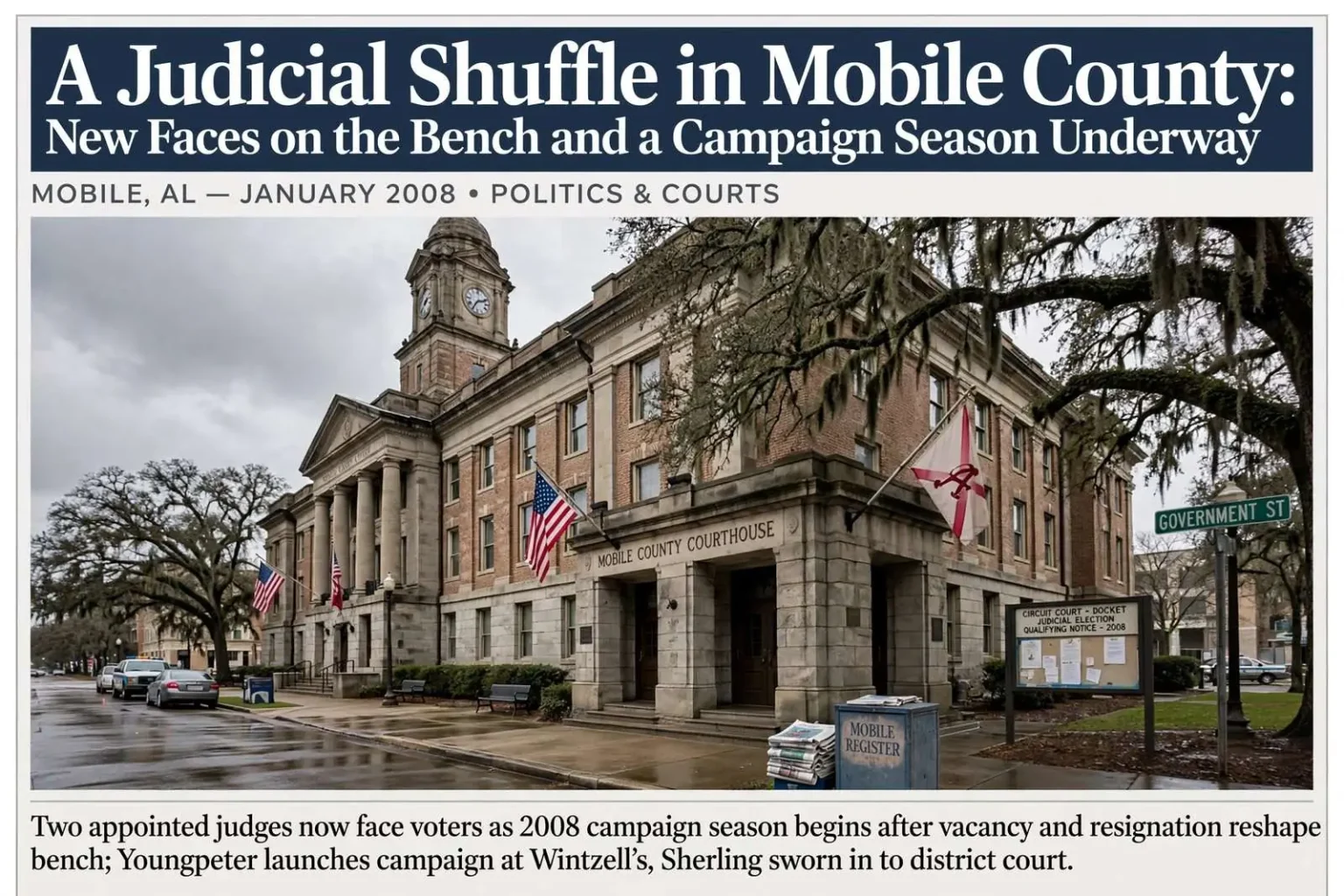
The Mobile County courthouse entered the 2008 election year with an unusual number of moving parts. Two judges had reached the bench by appointment rather than election, both faced voters within months, and the resignation that opened one of those seats continued to generate quiet legal fallout. For courthouse regulars — lawyers, clerks, bailiffs and the politicians who circle judicial races — the question of the new year was not whether Mobile County would have contested judge races, but how many and how expensive.
Youngpeter opens his campaign
More than 200 people turned out at Wintzell’s Oyster House downtown for the campaign kickoff of Circuit Judge Michael Youngpeter, who had been appointed to the bench earlier in the month by Gov. Bob Riley. Supporters said the event brought in roughly $34,000, with a final accounting expected to push the total past $50,000 — a substantial sum for a judicial race in Mobile County at the time, and a signal in January about how the rest of the cycle would run.
Youngpeter filled the vacancy created by the resignation of former Circuit Judge Herman Thomas, and he announced he would seek the seat in his own right as a Republican. The announcement converted his appointment from a stopgap into a candidacy, with the powers and perils of incumbency attached: record on the bench, campaign war chest and the governor’s endorsement, but also the backdrop of the scandal that had created the opening.
The early speculation centered on whether he would draw a serious Democratic challenger. Former Circuit Judge and ex-District Attorney Chris Galanos, one of the best-known names in Mobile legal circles, was reported to be weighing a run. Galanos had spent years as the county’s top prosecutor and on the circuit bench, and his entry would have transformed the race from a referendum on a new appointee into a contest between two of the best-known legal careers in the county. Local lawyers spent the early weeks of 2008 game-planning the matchup — experience against incumbency, name recognition against gubernatorial backing — while Galanos kept his decision to himself.
Sherling takes the district bench
On the district court side, Bob Sherling had already been sworn in as a Mobile County district judge, though his formal investiture was not expected until the middle of February. Riley selected Sherling from a slate of finalists that also included Barbara Brown and Ed Blount — the shortlist produced by the county party’s screening process, through which local bar members and Republican officials rank candidates before the governor chooses.
The vacancy opened when Judge Judson Wells retired from the bench to join a private law firm — a routine departure by the standards of the period, and a stark contrast with the circumstances on the circuit side. District judges in Mobile County handle the volume work of the local courts: misdemeanors, small claims, preliminary hearings in felony cases and the early stages of civil disputes that never reach a circuit jury. The quality of that bench shapes most residents’ actual experience of the courthouse far more than the felony trials that make headlines.
The appointment route
The appointment route was, and remains, a familiar path onto Alabama’s trial benches. Under state law, the governor fills judicial vacancies between elections, and appointees then stand before voters at the next opportunity. The system concentrates enormous power in the executive office — a single governor’s terms can reshuffle trial benches across all 67 counties — and it embeds judicial selection in partisan politics, since the Republican Party of that era screened finalists for the governor’s Republican appointments.
In practice, that gave both Youngpeter and Sherling the advantages of incumbency heading into the 2008 cycle. An appointed judge enters an election with the title, the courtroom, the docket experience and the implicit endorsement of the state’s chief executive. Challengers must argue that the seat was never the voters’ to award in the first place — a message that works only when the appointment itself is controversial, which made the Thomas history attached to Youngpeter’s seat a live issue even as he raised money at a pace challengers envied.
For voters, the arithmetic of 2008 was unusual: two judgeships changing hands by appointment, followed immediately by elections in which the public would be asked to ratify or reject decisions already made in Montgomery. Judicial races rarely draw the attention of a county commission or sheriff’s contest — turnout research has repeatedly shown that many voters skip the rows entirely or vote on name recognition — but the outcomes determine who sentences felons, divides families and rules on injuries for the following six years.
The Thomas matter lingers
The seat Youngpeter inherited carried a complicated history. Herman Thomas had resigned from the circuit bench the previous fall, just as charges brought by the Alabama Judicial Inquiry Commission were set for trial before the state Court of the Judiciary — the constitutional body that disciplines and can remove Alabama judges. His resignation ended those proceedings, since the court’s jurisdiction over a sitting judge ends with the judgeship, but it did not necessarily end his exposure.
Legal sources familiar with the grievance process said the Alabama State Bar had opened an investigation into Thomas’s conduct as an attorney. A bar spokesman would neither confirm nor deny it. The bar’s general counsel noted that the rules of the Alabama Supreme Court prohibit the organization from acknowledging whether a complaint even exists, and that disciplinary matters remain confidential unless a lawyer pleads guilty to a rules violation or is found guilty by the Disciplinary Board or Disciplinary Commission.
That confidentiality rule is a standing feature of Alabama’s attorney discipline system. It means the public typically learns of a bar investigation only when it concludes — a structure that protects lawyers from unproven accusations but also leaves reporters, and voters, working from the outside. For the 2008 campaign, the practical effect was that the Thomas story could shadow the circuit race without ever producing a documented resolution the candidates could be asked about on the record.
Why it mattered
Judicial races rarely draw the attention of a county commission or sheriff’s contest, yet the stakes in 2008 were real. Circuit judges in Mobile County handle felony trials, major civil litigation and domestic matters that touch thousands of families a year — divorces, custody disputes, adoptions and juvenile cases that never generate a headline but fill the family division’s docket week after week. The circuit bench also hears the county’s highest-profile criminal prosecutions, and a single seat can shift years of scheduling pressure across the courthouse.
Two seats changing hands by appointment, followed immediately by contested elections, meant voters would be asked to ratify or reject decisions already made in Montgomery. That inversion — the governor acts first, the electorate follows — is the defining feature of Alabama’s mid-cycle judicial vacancies, and it shapes campaigns: appointees run on their first months’ work, challengers on the argument that the appointment was a backdoor. Both Sherling and Youngpeter would spend the spring converting their new titles into ballot-box legitimacy.
Money in judicial politics
The fundraising numbers coming out of Wintzell’s that month made one thing clear early: judicial campaigns in Mobile County had become expensive, professional affairs, and the candidates were preparing accordingly. A kickoff that cleared $34,000 in an evening — on its way past $50,000 — placed the circuit race in the same fundraising company as legislative contests, and Alabama’s judicial elections were already nationally notorious for their cost.
Wintzell’s itself was the right stage for the scene. The oyster house on Government Street, with its decades of wall-mounted one-liners, has long been Mobile’s political clubhouse, the place where judges, commissioners and legislators mark their launches and count their audiences. More than 200 supporters crowding its tables for a judge’s kickoff told downtown’s lawyers everything they needed to know about the seriousness of the campaign.
Mobile County’s circuit bench watched the developments with particular interest, since its own judges worked alongside the appointees the process produced and supplied many of the finalists screened for vacancies. The county’s bar — one of the largest and most active in the state — had long functioned as the informal farm system for southwest Alabama’s courts, and each appointment rippled through the local legal economy.
By the time qualifying closed that spring, the shape of the ballot would look considerably different from what the January speculation suggested. Whether Galanos ran, whether the Thomas history surfaced in advertising, and whether Sherling drew a Democratic opponent were all questions the qualifying deadline would answer. What was already settled by February was the template: appointees with war chests, incumbency to defend and a courthouse full of observers aware that the election-year shuffle had only begun.