University of South Alabama Mobile
Congressman Artur Davis Works a Mobile Room as Talk of Higher Office Grows
U.S. Rep. Artur Davis of Birmingham came to Mobile for a Dutch-treat luncheon with three dozen politically active locals, an introduction arranged as speculation about a future statewide run followed him.
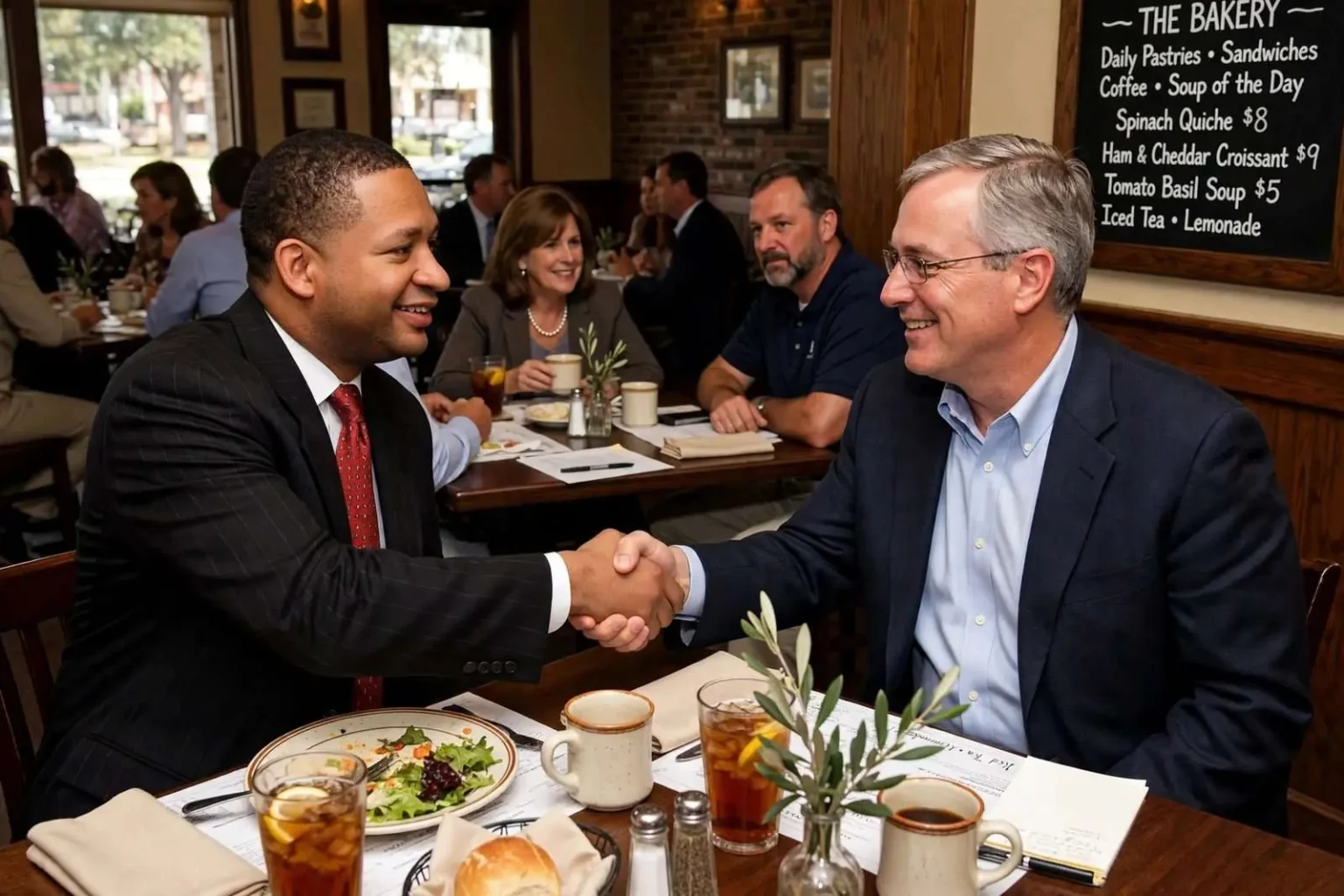
U.S. Rep. Artur Davis, D-Birmingham, spent part of a spring afternoon in Mobile doing the quiet, unglamorous work of statewide ambition: shaking hands over lunch with three dozen or so of the city’s politically active residents. The gathering, a Dutch-treat luncheon at The Bakery, was arranged by Mobile attorney and political figure Palmer Hamilton, who described the purpose in plain terms.
“The purpose was to let him meet some Mobilians,” Hamilton said. “He has been here, of course, but he hasn’t gotten to spend a lot of time here. And Mobile is going to need his help in the future.”
The format was deliberately low-key. There was no keynote, no campaign banner and no admission fee beyond the cost of one’s own lunch — a Dutch-treat arrangement that kept the event in the category of civic introduction rather than political fundraiser. Davis worked the room in the manner of a congressman getting reacquainted with a city that sits outside his own district but inside his political future. For a Birmingham-based lawmaker whose district lies hours to the north, the afternoon was less about asking for anything than about being present, remembered and understood.
In Alabama politics, that kind of presence is never incidental. Statewide candidates are made in living rooms, chambers of commerce boardrooms and Rotary luncheons across the state’s metropolitan centers, and Mobile — the state’s oldest city and its third-largest — has long been a required stop on any credible path to higher office. Hamilton, a veteran of Mobile’s legal and political circles, understood that arithmetic well enough to put the room together himself.
A congressman with unusual leverage
The practical case for the luncheon went beyond introductions. Davis, a Harvard-educated lawyer and former federal prosecutor representing Alabama’s 7th District, held a pair of positions that gave him more influence than his seniority alone would suggest. He served as an assistant majority whip in the House, and he was the only member of the Alabama delegation seated on the House Ways and Means Committee — the panel that writes tax law and, by extension, holds sway over the incentives that states use to lure industry.
That committee assignment was the rarest currency in Alabama’s congressional delegation. Ways and Means has jurisdiction over taxation, trade, Social Security, Medicare and a long list of programs that touch nearly every business and household in the country. For a state that competes aggressively for foreign investment using tax incentives, having one of its seven representatives inside the room where tax policy is drafted was a meaningful advantage, and one that no other Alabamian on Capitol Hill could claim.
For a metropolitan area then in the middle of an industrial recruiting run — with ThyssenKrupp’s steel complex north of Mobile, Austal’s shipyard on the river and a string of other prospects in play — a friendly voice on Ways and Means was not an abstraction. Hamilton noted that Davis was well positioned to advocate for the state with industrial recruits in particular.
The timing mattered. The Gulf Coast was in the middle of the largest industrial build-out in its modern history, and the companies doing the building were weighing questions that Washington helps answer: trade policy that affects imported steel and ship components, tax treatment of capital investment, and the federal posture toward the port and shipbuilding industries. A congressman who could pick up the phone to a foreign investor’s Washington counsel, or flag a tax provision that might complicate a deal, had something real to offer a chamber of commerce crowd.
The industrial moment on the Gulf Coast
The context for the lunch was an economy being remade in plain view. German steelmaker ThyssenKrupp had committed to one of the largest industrial investments in American history at a site in north Mobile County, a project that would eventually employ thousands during construction and permanent operation. Austal, the Australian shipbuilder with a yard on the Mobile River, was expanding its footprint in commercial and military vessel construction. Around those anchors sat a roster of suppliers, contractors and service firms whose fortunes rose and fell with the success of the big projects.
Each of those developments generated demand in Washington — for appropriations that deepened the ship channel, for trade rulings, for the kinds of tax and regulatory certainty that multinational boards require before they sign. Members of Congress who sat on the right committees could move those needles; members who did not could only ask. Davis, whatever else he was, sat on the most powerful committee in the House, and Mobilians in the recruiting business were in no position to be indifferent to that.
The luncheon also reflected a longer-running truth about Alabama’s congressional delegation: with only seven members, each one’s committee assignments carry outsized weight for the whole state. A single seat on Ways and Means, Appropriations or Armed Services shapes what the state can realistically expect from Washington on everything from port dredging to defense contracts. The state’s business community tracks those assignments the way sports fans track a roster, and the arrival of a Mobile-friendly chairman of the Mobile Area Chamber board at a lunch with the delegation’s only tax writer was, in that sense, routine business conducted in a social register.
Who came to the table
The guest list was a fair cross-section of Mobile’s business and civic leadership. Among those present were Bestor Ward of Ward Properties, then chairman of the board of the Mobile Area Chamber of Commerce; University of South Alabama President Gordon Moulton; Keith King of Volkert Engineering; Bruce Croushore; Marietta Urquhart of Heggeman Realty; CPA Mike Thompson; University of South Alabama lobbyist Happy Fulford; Buffy and Bob Donlon of Wintzell’s; Alabama Gulf Coast Chamber of Commerce president Mark Berson and two of his sons; attorney E.B. Peebles; and Ginny Russell and Bill Sisson of the Mobile Area Chamber of Commerce.
Read as a roster, the list mapped the constituencies a statewide candidate must eventually assemble. Ward and the chamber leadership represented the organized business community whose endorsements and donor networks matter in every Alabama campaign. Moulton and Fulford brought the university’s interests — higher education funding, research grants and the political weight of a campus that is one of the city’s largest employers. King’s engineering firm sat squarely in the path of the infrastructure work that port and industrial growth generates. The real estate, accounting and legal presences filled in the professional class that staffs campaigns and lends them credibility among fellow professionals.
One businessperson who attended called Davis “certainly an impressive speaker with an impressive presence.” That impression — of a young, polished, nationally credentialed politician — was precisely the asset Hamilton was showcasing. Davis was in his early forties at the time, a graduate of Harvard College and Harvard Law School who had worked as a federal prosecutor in Alabama before unseating an incumbent Democratic congressman in 2002 to claim the 7th District seat. To a room of Mobile business leaders accustomed to the state’s more traditional political style, he presented a distinctly modern profile.
By happenstance, Davis’s Republican colleague from Mobile, U.S. Rep. Jo Bonner, was lunching at The Bakery the same day. Bonner stopped by briefly to tell the group about what he described as the strong working relationship within the Alabama delegation — a bipartisan grace note that said something about how the state’s congressmen preferred to be seen at home.
The moment was more than color. Alabama’s House members, Republicans and Democrats alike, have historically cultivated an image of cooperation on matters of state interest — port funding, military installations, hurricane recovery — on the theory that divided government in Washington makes friendly interstate and interparty relations a practical necessity. For Bonner, the Mobile-based Republican whose district included the city, to publicly vouch for the bipartisan spirit of the delegation was a quiet assurance to the room that helping Davis would not mean crossing party lines in any way that mattered locally.
The subtext: what comes next
Nobody at the table needed the speculation spelled out. Davis had been mentioned for higher office almost from the moment he arrived in Congress in 2003, first for the U.S. Senate seat held by Republican Jeff Sessions, and more recently for the governorship in 2010, when Republican Gov. Bob Riley would be term-limited out. In the unlikely event that U.S. Sen. Richard Shelby retired, Davis was expected to weigh that race as well. And if Democrats held the House, his influence within it stood to keep growing.
Each scenario carried its own logic. A Senate run would pit Davis against an incumbent with formidable name recognition and fundraising, but Senate races in Alabama have always turned on the ability to build a statewide coalition from a regional base. A gubernatorial race offered an open seat with no incumbent to defeat — the single most favorable condition a challenger can ask for. And within the House, seniority plus a majority meant the possibility of subcommittee chairmanships and the tangible projects that come with them.
The mathematics of any of those runs ran straight through the room where Davis was eating lunch. Any statewide campaign in Alabama runs through Mobile and Baldwin counties, which together anchor the southern end of the state and deliver a large share of the Democratic primary vote as well as a formidable Republican general-election bloc.
For a Democrat, in particular, Mobile County’s primary electorate — with its significant urban Democratic vote — can be decisive in a crowded field. For a general election, the two counties’ business community supplies donors, endorsements and the aura of electability that conservative voters in Alabama require before they will cross party lines. Introductions of the kind Hamilton arranged were the necessary groundwork: the first, inexpensive step in a process that, if it continued, would require years of cultivation.
The 7th District Davis represented, stretching from Birmingham through the Black Belt, is geographically distant from the Gulf, which is why his Mobile forays required deliberate effort. Alabama’s urban Democrats — Birmingham, Montgomery, Mobile — form overlapping but distinct political communities, and a candidate who is known in one and unknown in the other two faces a steep recognition deficit. Luncheons like this one were how the deficit was paid down, one room at a time.
There was also a fundraising dimension that went unspoken. Mobile’s business leaders write checks in every statewide cycle, and a Dutch-treat lunch that ends with a favorable impression is worth as much as many a paid fundraiser. The attendees represented firms and institutions — real estate, engineering, higher education, hospitality, law — whose principals sit on the invitation lists for every major campaign event in the region. Being remembered favorably by that group is a form of infrastructure as real as any highway project.
What came after
Davis did run for governor in 2010. He lost the Democratic primary decisively to Agriculture Commissioner Ron Sparks, a defeat that ended his career in Alabama Democratic politics and eventually led him to switch parties. But in the spring of 2007, in a private room in Mobile, that outcome was unimaginable.
What the room saw was a young congressman with a seat on the most powerful committee in the House, meeting the people who would have to be with him if he ever asked the state for something bigger.
For Mobile, the afternoon was also a reminder of the city’s standing in state politics. Lawmakers from elsewhere in Alabama do not come to Mobile for no reason; they come because the city’s votes, dollars and industrial fortunes matter to the state as a whole. A congressman from Birmingham who took the time to be known here — and a Mobile congressman who happened to be lunching nearby and dropped in to vouch for him — were both acting on the same understanding: that in Alabama, the road to statewide office is paved in rooms like this one, three dozen people at a time.