After the 2006 Vote, Mobile County’s Parties Take Stock of a Mixed Night
Democrats celebrated nationally and cheered statewide but stumbled in Mobile County. Party figures and consultants dissected losses by Gary Tanner, Chip Herrington and Pat Lindsey and asked what the results meant.
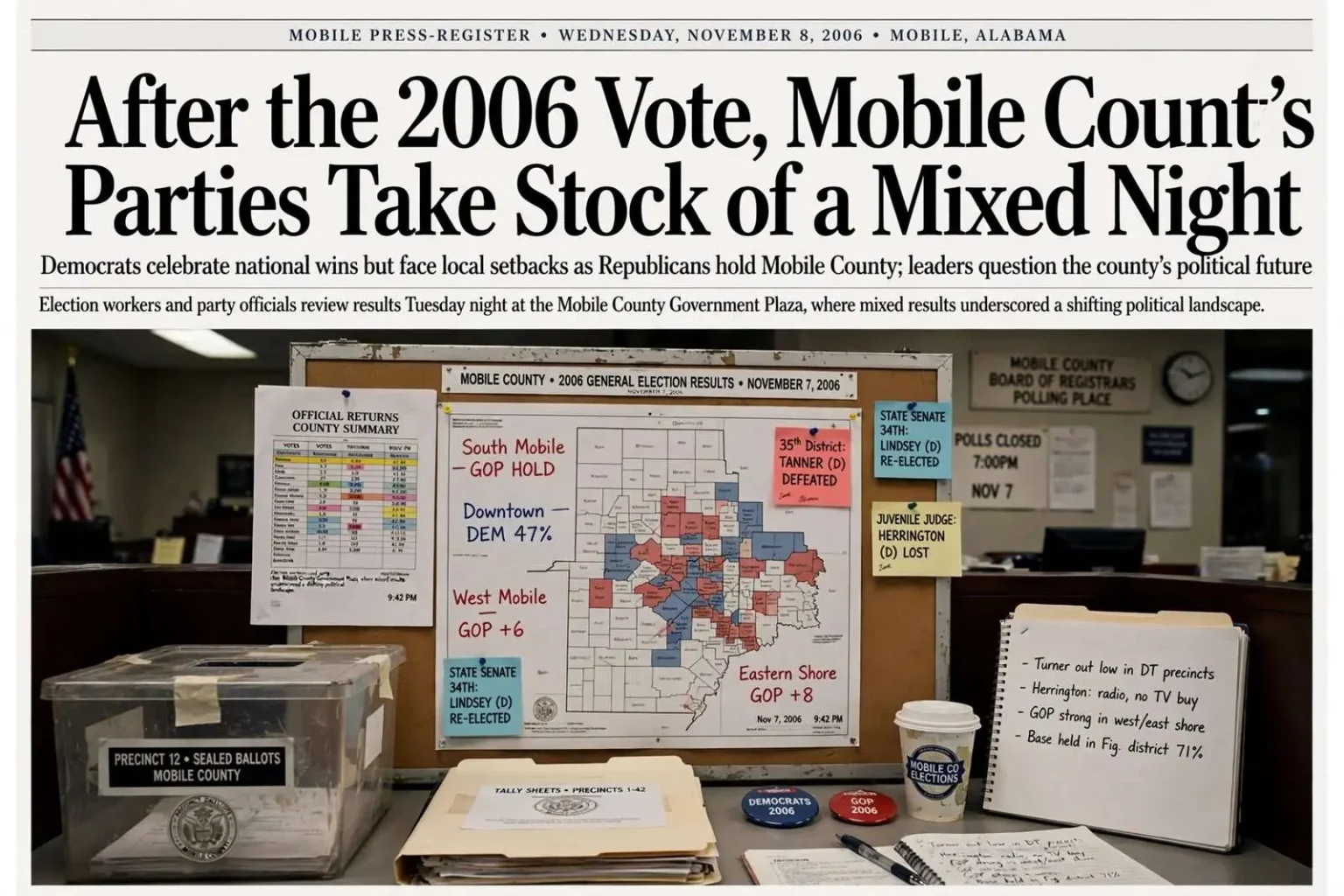
Tuesday’s returns gave Democrats plenty to cheer nationally and at the state level, but in Mobile County the mood was more complicated. Republicans, gloomy about their national drubbing, could point to a string of local victories that suggested the party’s grip on the county remained firm.
The results raised a pointed question for both sides: what had voters said about the future of the parties here?
Democrats had lost several races they hoped to win, including incumbent state Sen. Gary Tanner’s defeat in south Mobile, Chip Herrington’s countywide loss in an energetic campaign for juvenile judge, and north Mobile County’s rejection of incumbent state Sen. Pat Lindsey, who nonetheless drew on strength outside the county to win re-election.
Tanner’s seat had been a fixture of south Alabama Democratic politics, and the 35th District contest drew heavy spending by local standards, with both sides buying television time across the Mobile market. Lindsey’s district, redrawn to stretch from Mobile County deep into the Black Belt, presented the opposite problem: a seat a Democrat could hold only by running up numbers far beyond the county line.
Nationally, the election was a wave year for Democrats, who took control of the U.S. House and Senate and swept governorships in the Midwest. In Alabama, Democrats held on to most down-ballot statewide offices, but the county-by-county map told a different story in south Alabama, where Republican margins kept widening in suburban and fast-growing areas.
Mobile County sat squarely at the intersection of those trends: a county that had once produced Democratic landslide margins but had been trending Republican in federal races for a decade, while still electing conservative Democrats and independents to local offices.
A Republican reads the returns
One local Republican official argued the outcomes proved just how steep the climb had become for county Democrats. Herrington, he said, “worked as hard or harder than any local candidate that I have ever seen,” and Tanner ran strong media and clearly defined the issues.
Democratic consultants, he added, had consistently outperformed their Republican counterparts. “Given these facts, Brooks and Naman still won,” he said. “I think this proves that it is and will continue to be difficult for Democrats to win countywide in Mobile.”
The official’s point was that the losses could not be blamed on lazy campaigns or inferior talent. If well-funded, hard-working Democratic candidates with professional help still fell short countywide, the deficit was structural — a matter of who voted, not who campaigned.
A consultant urges caution
A local political consultant cautioned against reading too much into the losses. He noted that non-partisan candidates widely understood to be Democrats, such as Sam Jones and Mike Dow, had won handily in the past, and that some Democrats had polled as high as 47 percent in contested county races, with Vivian Figures drawing 71 percent.
“When the Dems can turn out their base, they can do well in Mobile County,” he said, suggesting the lack of marquee local contests had left Democratic voters unmotivated.
The numbers were the consultant’s way of separating the party’s performance from the party’s potential. A candidate drawing 47 percent in a contested countywide race was within reach of victory with a modest shift in turnout; a base precinct that stayed home in a year with no mayoral or sheriff’s race at the top of the local ballot was a resource left unspent.
Jones and Dow, the city’s consecutive mayors, had built coalitions that crossed party lines in a city where municipal elections are officially non-partisan. Figures, a veteran state senator whose district anchored much of Mobile’s Democratic base, drew her 71 percent in a race where that base was fully engaged. The consultant’s argument was that the county’s Democratic ceiling was higher than Tuesday’s results implied — but only when a candidate and a contest gave the party’s voters a reason to show up.
Turnout patterns bore out the point. Precincts in and around downtown Mobile and the county’s older communities turned out at rates far below what they had produced in cycles with competitive countywide races on the ballot, while Republican-leaning precincts in west Mobile and the eastern shore turned out heavily for national and state races.
A Democrat’s blunt post-mortem
The sharpest self-criticism came from a longtime Democratic lawyer, who traced Herrington’s difficulties to a candidacy “born of anti-Millsaps sentiment” that lost its footing once that sentiment faded.
Herrington’s campaign for juvenile judge had been one of the most energetic countywide races of the cycle, built on courtroom credentials and a message aimed at families across the county. The judicial nature of the race made it unusually dependent on name recognition and media reach, since judicial candidates are constrained in what they can promise on the campaign trail.
The lawyer was less surprised by Lindsey’s showing, given how small a share of the district lay in Mobile County. Lindsey’s senate district stretched across several counties north of Mobile, and the precincts outside the county — where his name and service were better known — carried him to re-election despite his losing the county’s share of the district.
Tanner’s loss, he said, was “somewhat more disturbing.” Tanner was an incumbent with seniority and a record of steering money to his district, the kind of senator whose re-election Democrats had treated as automatic, and his defeat signaled that even the party’s safest south Alabama seats were no longer safe.
He reserved his harshest words for his own party’s organization, faulting a decision to reshuffle the sheriff’s nomination that, in his view, dampened turnout in key precincts. Local party rules and last-minute substitutions, he argued, had left some Democratic-leaning precincts without a full slate to rally around, and the confusion at the top of the local ticket trickled down.
Democrats, he insisted, “are going to have to work harder and smarter,” and stop sending signals that the party remained stuck in the 1950s. “We need us a Huey Long,” he added ruefully — a reference to the legendary Louisiana populist, invoked as shorthand for the kind of barnstorming, economic-populist campaigner he believed the party’s slate had lacked.
The remark captured a strand of thinking among Alabama Democrats after the election: that the party’s problems were not merely demographic but stylistic, and that a generation of cautious, establishment-style campaigns had left the party without an answer to the Republican coalition that dominated the state’s growing suburbs.
Lessons beyond party
A veteran strategist offered a less partisan diagnosis. Voters statewide, he said, had chosen candidates over parties, which squared with what he called his two rules for winning general elections: tell voters what you have done and will do for them, and win your primary handily.
The strategist’s two rules reflected the arithmetic of Alabama’s general electorates. A primary won narrowly signals a divided coalition and an exhausted base; a candidate who spends the general election explaining a primary fight starts behind. And voters without a concrete account of a candidate’s record and plans, he argued, default to party labels — the default that favored Republicans in most of the state.
“You cannot run on party or simply philosophical rantings,” he said. “That will win you a primary, but not a general.”
Applying those rules locally, he judged that Herrington had run a fine race but “never got to television,” spending too heavily on radio and leaning on Dow as a spokesman, a choice he called a negative. As a Democratic nominee, the strategist argued, Herrington should have run toward the center rather than shoring up his left flank.
The television point was the one local operatives lingered over. In a media market where countywide candidates live or die on broadcast reach, a campaign that never gets on the air is asking voters to learn about a judicial race through yard signs and word of mouth, a losing proposition against an opponent who is a familiar presence on the evening news.
The endorsement-by-surrogate strategy drew similar skepticism. Borrowing the popularity of a well-known citywide figure can reinforce a campaign’s message, but it cannot substitute for the candidate’s own argument, and it risks tying the nominee to city hall politics in a countywide race that stretches well beyond the city limits.
For county Democrats, the post-mortem converged on a shorter list of fixes than the hand-wringing suggested: find candidates with personal votes, fund them early enough to reach television, and give the party’s base a reason to turn out by contesting the countywide offices that had gone unopposed or underfunded in recent cycles.
Whatever the disagreements over specific races, the consensus among these observers was that Mobile County remained stubbornly its own political animal, resistant to the tides sweeping the rest of the country.
The 2006 results, they agreed, said less about a national mood than about a county that had been settling into its own durable pattern: Republican in federal races, competitive in countywide contests, and still capable — when the base showed up — of electing Democrats who campaigned as neighbors rather than partisans.