University of South Alabama Mobile
130 Boxes and a Termite Problem: A Mobile Political Life Went to the Archives
Former City Commissioner Lambert Mims donated more than 130 boxes of papers, photographs and reel-to-reel tapes to the University of South Alabama, documenting a quarter century in Mobile politics.
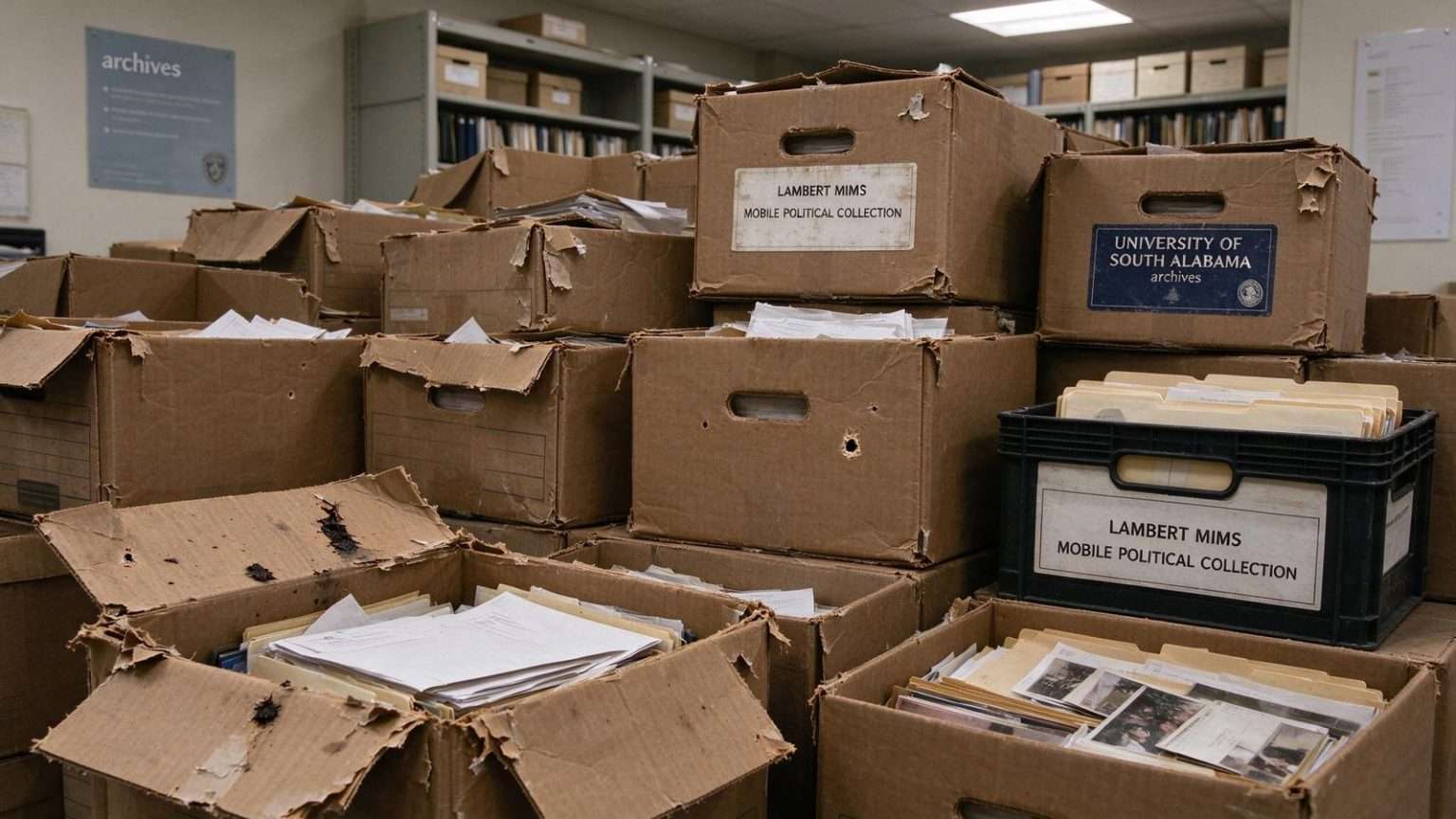
A quarter century of Mobile political history arrived at the University of South Alabama in cardboard boxes, some of them chewed. Former Mobile City Commissioner Lambert Mims, whose career in local politics spanned more than 25 years, donated more than 130 boxes of papers, correspondence, photographs and audio tapes to the university’s archives. The transfer moved a private accumulation of public records into an institution built to keep them, and it did so just in time, because the condition of the boxes told their own story about how paper survives — or fails to survive — in the climate of the Gulf Coast.
The collection is now in the hands of the USA Archives, the university’s repository for manuscripts, photographs and records relating to southwest Alabama. There, archivists began the patient work of sorting, preserving and cataloging material that documents city government in Mobile across one of the most consequential stretches of its twentieth-century history, from the era of the three-member city commission through the litigation that replaced it and the mayor-council structure that followed.
What was in the boxes
“When we donated the boxes, there were hundreds of files regarding various projects, public works and otherwise, thousands of photos of projects and thousands of pages of correspondence,” said Dale Mims, the former commissioner’s oldest son. The description matches what a working commissioner of that era accumulated: the project files that came across his desk, the letters from constituents and contractors, the photographs taken before, during and after public works that reshaped streets and neighborhoods.
Also donated were “hundreds of reel to reel tapes made at various radio stations” where Mims had updated the citizenry on city events and answered questions from listeners, along with campaign radio spots and other campaign material. In an age before cable access channels and government-access television, a commissioner who took questions from the public over broadcast radio each week was doing something that left a rare kind of record: an unscripted, spoken account of municipal government as it was happening.
Carol Ellis of the USA Archives told the family it would take more than a year simply to catalog the photographs. That figure, applied to the images alone and not to the files, the correspondence or the tapes, gives a sense of the scale facing the archival staff. Cataloging is the step that makes a collection usable — it is what allows a researcher in a later decade to find the one photograph or folder that matters without opening every box.
The enemy of the archive
Not everything survived. Much of the material was damaged or destroyed by termites, Dale Mims said. “They are trying to save those papers that have had some termite damage but were not completely destroyed,” he said. “They will microfilm those and discard them when complete.”
It is a detail worth dwelling on, because it describes how local history is actually lost. Not in fires or floods but in garages and attics along the Gulf Coast, where heat, humidity and insects work steadily on paper for decades until someone finally opens the boxes. Mobile’s climate is hard on records: summer humidity that rarely drops, temperatures that swell and shrink paper and adhesives, and insect populations that treat cardboard and the paper inside it as food and shelter. Archives exist in part because private storage cannot be trusted over decades.
Microfilming is the standard response for material that is too damaged to handle but too important to lose. Each salvageable page is photographed onto film that can last a century or more under proper storage, after which the fragile original is discarded. The result is a trade: the texture of the original document — the letterhead, the handwriting, the coffee stain — is given up in exchange for the survival of its content. For researchers, the content is usually what matters.
Why these particular boxes matter
Mims served during the era of Mobile’s city commission form of government, a three-member body in which each commissioner both legislated and ran a portfolio of city departments. Under that system, a commissioner responsible for public works was personally involved in the streets, the drainage, the garbage collection and the water, in ways that a modern council member is not. The arrangement concentrated administrative power in elected hands and made each commissioner the direct point of contact between city hall and the machinery of the city.
That structure, common across American cities in the early twentieth century, was eventually replaced in Mobile following litigation over minority representation, with the mayor-council structure Mobile uses today. The legal challenge to the commission system argued that at-large election of three commissioners diluted the voting strength of Black Mobilians, and the resulting change reordered how power was distributed in the city. The transition was among the most significant political events in the city’s twentieth-century history, and Mims was present for the whole of it — first as a participant in the old order, then as a figure navigating the new one.
His career, spanning more than 25 years, covered the period in which Mobile’s public works were expanded, its neighborhoods rose and declined, and its government was remade. The papers now at USA document that span from the inside: not the newspaper accounts of the day, but the working files of an official who had to act on it.
The radio tapes
The reel-to-reel radio tapes may prove the most unusual holding. A commissioner explaining city business to listeners over the radio, week after week, produced an oral record of municipal government in a period before cable access channels, before the internet, and before meeting minutes were posted anywhere a citizen could find them. The broadcasts captured not only the topics of the week but the tone — the way a commissioner answered callers, defended decisions and explained why a street would be paved or a fee raised.
Audio records of that kind seldom survive. Tape is fragile, players become obsolete, and broadcasts are rarely kept once aired. A collection of hundreds of such recordings, spanning years of weekly programming, is the sort of thing historians of southern municipal government would not think to ask for because they would assume it no longer exists. Its survival, like the survival of the papers, depended on a family holding onto it and then choosing to place it where it could be cared for.
What archives are for
Collections of this kind rarely make news when they arrive and often become indispensable later. A researcher writing about desegregation in Mobile, about the fight over the form of city government, about hurricane recovery, about how the city’s public works were financed, or about the fate of a neighborhood cleared for a project, will eventually need exactly this material: the correspondence, the working files, the photographs of the project before it was built. The value of a political paper collection is that it preserves the deliberation behind decisions, not just the decisions themselves.
The USA Archives has long served that role for the region, holding personal papers, organizational records and photographs that document southwest Alabama from the colonial period forward. A donation of this size becomes a reference point for years of scholarship, journalism and family research. It also comes with obligations: climate-controlled storage, security, staff time for processing, and the discipline of cataloging that turns boxes into a findable collection.
For the Mims family, the decision to donate placed the papers where those obligations could be met. For the university, the gift deepened its coverage of an era for which documentation is scattered — an era whose central political fight was settled in courtrooms and council chambers, and whose daily record ended up, for a quarter century, largely in the hands of the three commissioners who ran the city.
The transaction that brought the collection to campus was simple in outline: more than 130 boxes, carried out of private storage and into an institution whose purpose is to hold exactly such material. The contents were harder won. Hundreds of files on public projects, thousands of pages of correspondence, thousands of photographs and hundreds of broadcast tapes, weathered by termites and by decades in a Gulf Coast garage, now face the slow restoration of their usefulness.
Summary of the donation:
Donor: Former Mobile City Commissioner Lambert Mims
Recipient: University of South Alabama Archives
Size: More than 130 boxes
Contents: Project files, correspondence, thousands of photographs, hundreds of reel-to-reel radio tapes, campaign material
Condition: Significant termite damage; salvageable papers to be microfilmed
The university’s archivists faced years of work. But the papers were out of the garage and into a climate-controlled room, which is the difference between a public record and a rumor. In a region where paper decays quickly and political memory is short, that difference is not a small one. The boxes that arrived chewed and dusty will leave behind a cataloged, microfilmed, searchable record of how Mobile was governed for a quarter of a century — preserved not by luck, but by a family’s decision and an archive’s patience.