Nan Seas Restaurant Closes on Cody Road After a Post-Katrina Second Act
Nan Seas Restaurant, which relocated to Cody Road after Hurricane Katrina damaged its Dauphin Island Parkway home, closed its doors on March 2, 2009, ending a long run in Mobile.
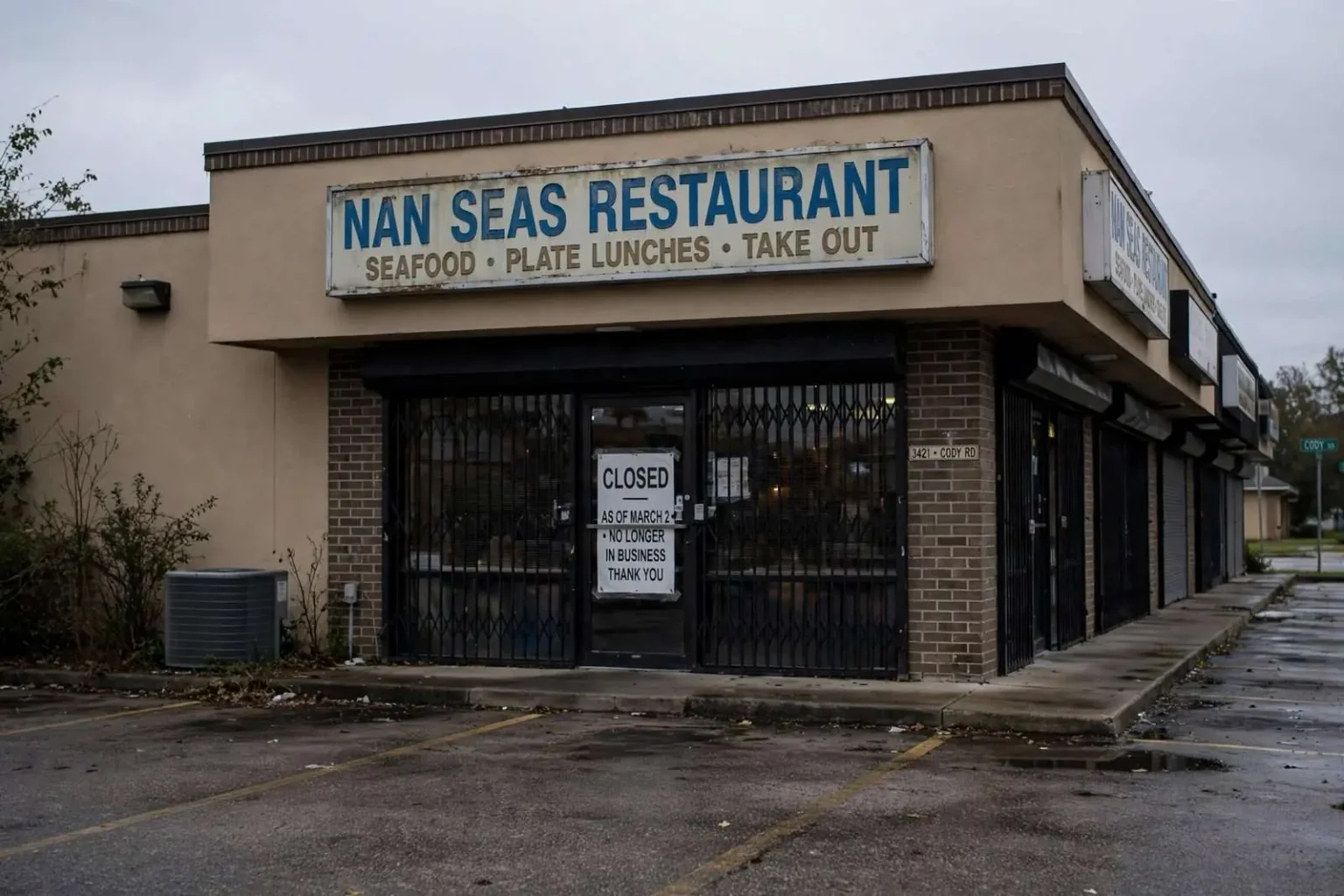
The message on the answering machine at Nan Seas Restaurant was brief, and it did not invite a follow-up question. “We are closed. As of March the 2 we are no longer in business,” a woman’s recorded voice said.
With that, one of the more durable names in Mobile’s casual dining scene came to an end. The restaurant had been operating on Cody Road, just south of Airport Boulevard, after relocating from the Dauphin Island Parkway area in south Mobile. Owner Willis Robinson could not immediately be reached for comment.
The announcement had the abruptness typical of small-restaurant closings. No going-out-of-business sale, no farewell week, no note on the door — just a recording, and a dining room that would not reopen. Regulars who called for takeout orders in the first days of March got the news the way everyone else did: from the machine.
A Restaurant That Had Already Moved Once
The Cody Road location was Nan Seas’s second act. The restaurant had made its name in the Dauphin Island Parkway corridor, the long stretch of south Mobile running down toward the bay, and it moved north and west after Hurricane Katrina.
That detail matters, because it places Nan Seas among a large and mostly uncounted group of Gulf Coast businesses whose histories are divided cleanly by August 2005. Katrina’s damage in Mobile was less catastrophic than in Mississippi and Louisiana, but the storm pushed water well up into low-lying south Mobile and left behind a long tail of businesses that had to decide whether to rebuild in place, move, or simply stop.
Nan Seas chose to move, and it kept going for more than three years in its new location, drawing a following that regarded it as a genuinely popular eatery rather than a relocated survivor. In the restaurant business, a successful second location is no small achievement — regulars must find the new address, and new neighborhoods must adopt a stranger’s habit as their own.
The Dauphin Island Parkway corridor, where the restaurant built its reputation, is the artery that carries Mobilians south toward the bay and the ferry to Dauphin Island — a commercial strip of seafood houses, bait shops, churches and small businesses serving the communities along the water. A restaurant’s name there is earned at the counter, over years of plate lunches and fried platters, and Nan Seas had done that work before Katrina scrambled the map.
Cody Road, the new home, sits in the heart of west Mobile’s residential sprawl, just south of the Airport Boulevard commercial spine. The move placed the restaurant near a different customer base — suburban families, hospital and office workers from the nearby medical corridor — and for a while the formula transferred. The dining room filled; the takeout business hummed; the name carried over.
Closing Into a Headwind
The timing of the closing said something about the moment. March 2009 was the trough of the recession that had begun the previous year, and restaurants sat squarely in its path. Discretionary spending falls quickly when households grow cautious, and a neighborhood restaurant operating on thin margins has very little room to absorb a sustained drop in traffic.
Mobile’s dining rooms felt that pressure through the winter of 2008 and into 2009, and Nan Seas was not the only local establishment to reach the end of its arithmetic. The national numbers told the story plainly: restaurant traffic fell as families traded dining out for cooking in, and the independent operators — the ones without corporate reserves or franchise backing — bore the brunt. Across Mobile and Baldwin counties in those months, familiar signs went dark, and the answering-machine message became a small, recurring genre of the recession.
But the restaurant’s closing was also, in its way, a story of survival — just shorter than it might have been. A business that had already outrun a hurricane, relocated across the city and rebuilt a customer base had demonstrated the exact qualities that carry independent restaurants through hard times. The recession simply outlasted the arithmetic.
For the neighborhoods that supported it, Nan Seas belonged to the category of places that define an area’s daily life without ever making headlines: the plate-lunch houses and seafood kitchens where the same families sit in the same booths week after week. Their closings register quietly — a locked door, a disconnected phone, a strip of sidewalk regulars no longer cross — and then the neighborhood reorganizes around the absence.
The Economics of the Neighborhood Restaurant
The independent restaurant model that Nan Seas ran on is unforgiving in the best of times. Food costs, labor, rent and utilities arrive on fixed schedules, while revenue flexes with weather, holidays and the mood of the household budget. Operators watch the margins in single percentage points, and a drop of even a tenth in weekly covers can erase the month’s profit. When traffic falls ten or twenty percent, as it did through late 2008 and early 2009, the model has nowhere to hide.
Restaurants that survived that stretch typically did so by narrowing — shorter menus, fewer hours, family working the floor — or by holding a customer base loyal enough to keep coming when everyone else stayed home. Mobile’s most durable independents had both advantages, and even they felt the squeeze. The ones that closed were rarely failed businesses; more often they were sound ones caught in a season when sound was not enough.
Katrina had already culled the region’s restaurant ranks three years earlier, disproportionately hitting the waterfront and low-lying establishments of south Mobile, south Baldwin and the Mississippi coast. The ones that reopened, relocated or started over — Nan Seas among them — did so against doubled insurance costs, disrupted supply chains and customers whose own homes were still under repair. That any of them made it to 2009 says something about the grit the trade requires on the Gulf Coast.
What the machine message could not convey was the ordinary weight of the ending. A closing like Nan Seas’s retires more than a menu: it ends the work histories of servers and cooks, the routines of the regulars, the circulation of a family’s savings and labor invested across two locations and a hurricane. Owner Willis Robinson’s silence in the days after the announcement — he could not be reached for comment — was itself telling, the reserve of an operator closing the books without a farewell tour.
Mobile’s dining scene has absorbed such losses repeatedly over its history, and the city’s fondness for its old restaurants is really a fondness for its own past: the rooms where engagements were announced, league teams held their banquets, and Sunday dinner happened without anyone cooking. When one of those rooms goes dark, the loss is measured in memory as much as in meals.
The Cody Road space joined the silent inventory of second-generation restaurant sites that dot west Mobile — locations that carry a kitchen, a parking lot and a history of feeding people, waiting for the next operator bold enough to try. Some such spaces find second lives; many wait a long time.
Nan Seas’s run — a first act on Dauphin Island Parkway that built the name, a storm that scattered it, a second act on Cody Road that sustained it three more years, and a March 2 answering machine that ended it — reads today as a compact history of the Gulf Coast small business: start, endure, move, endure, close. The recording said it in twelve words. The twenty years behind it said the rest.
The restaurant trade in Mobile has always leaned on its coastal pantry, and the casual seafood houses that grew up along the bay’s approaches — the DIP corridor among them — were the most local expression of that supply. Their menus followed the docks: oysters in the cool months, shrimp whenever the boats ran, fish whatever the boats brought. A kitchen like Nan Seas’s lived or died with the same seasons that governed the fleets up the road, and its regulars judged it by standards no chain restaurant ever had to meet.
When such a business moves, the menu moves with it but the sourcing does not always follow. West Mobile offered a different catch of customers but the same docks up the supply line, and the kitchen’s continuity — the recipes, the suppliers, the way the fried platter arrived — was the thread that connected the two locations. Regulars who tracked the restaurant across town did so for the plate they remembered, not the address.
The strip centers and corner lots of Cody Road held several such transplants in those years, businesses that migrated north and west after the storm and quietly re-established themselves in suburbia. They were part of the demographic tide Katrina set in motion: households displaced from the flooded south Mobile lowlands resettled west and northwest, and the businesses that served them followed. A restaurant that moved to be near its customers was simply reading the same map.
The recession’s toll on that map is still legible in the commercial strips of west Mobile — the vacancies that opened in 2008 and 2009 and, in many cases, never filled with anything as durable as what preceded them. Nan Seas’s dark dining room on Cody Road was one entry in that ledger, recorded not in a press release but in a telephone recording, twelve words long.