Deputy Chief Lester Hargrove Set to Lead Mobile Police as Cochran Retired for Sheriff’s Run
Mobile Police Deputy Chief Lester Hargrove was set to become interim chief in March 2006 as Chief Sam Cochran retired to run for sheriff of Mobile County, with Mayor Sam Jones to name a permanent successor.
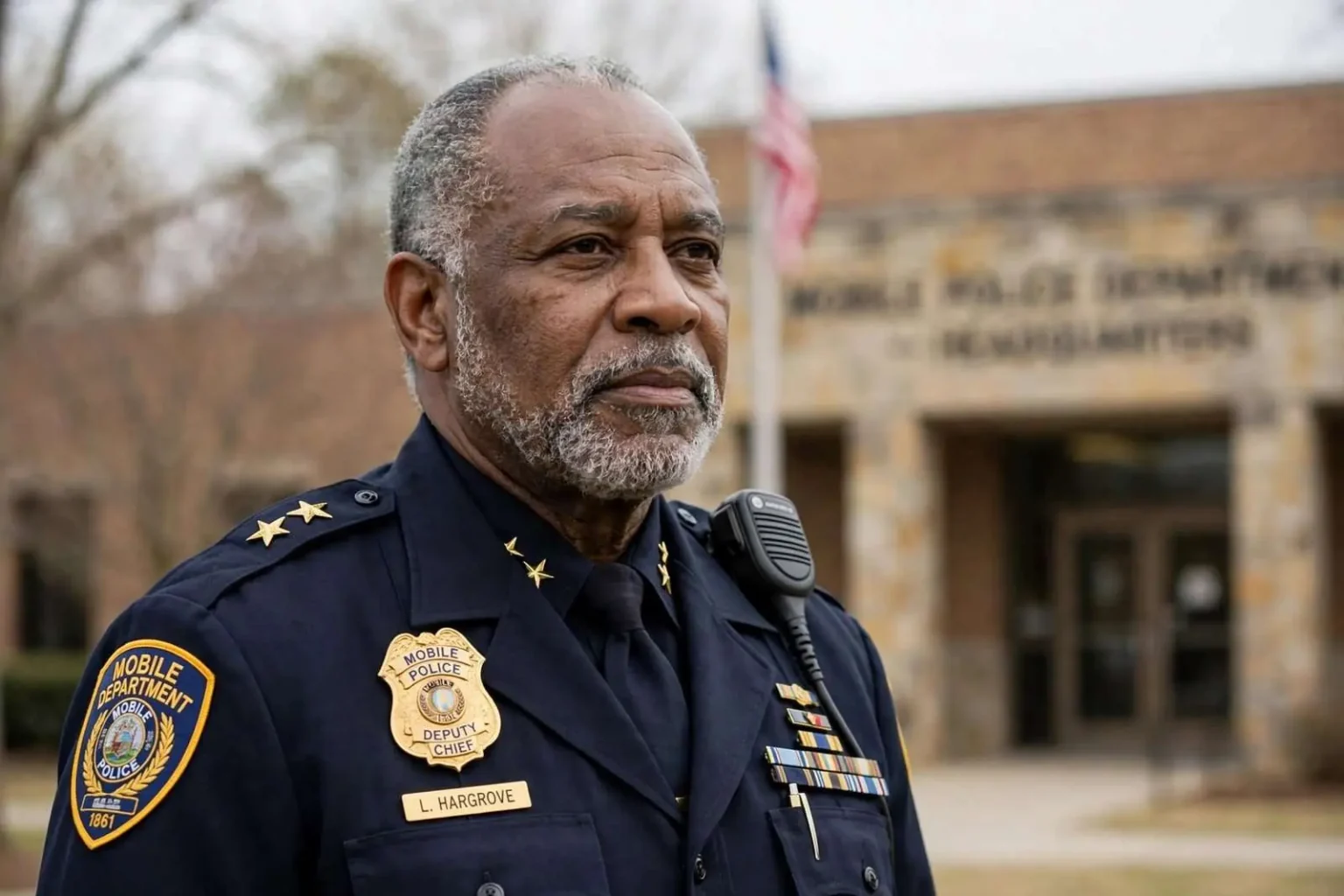
Mobile Police Department Deputy Chief Lester Hargrove was set to take over as interim chief of the department in March 2006, stepping in with the retirement of Police Chief Sam Cochran, according to law enforcement sources at the time. Cochran was stepping down to run for sheriff of Mobile County in that year’s elections, a move that set in motion a succession at the top of the city’s police force and reshuffled the county’s law enforcement politics in a single stroke.
Transitions like this one are rare enough in a city’s history to matter, and they arrive with a peculiar set of pressures. An interim chief must run a department of hundreds without the mandate of a permanent appointment, while the mayor weighs whether to elevate from within or search outside — all under the scrutiny of a community that watches its police leadership closely. For Hargrove, the interim badge carried both an opportunity and a test: the department’s most senior operational commander suddenly responsible for everything he used to oversee a piece of.
The man taking the reins
Hargrove commanded the Field Operations Bureau, the department’s largest section, which includes all of its uniformed personnel. There were roughly 300 sworn officers in the bureau at the time. Field Operations is where most policing actually happens. Nearly every call for service to the department, from a shoplifting complaint to a homicide, begins with the response of a uniformed officer.
The deputy chief who runs that bureau oversees patrol districts, shift staffing, response times and the day-to-day interaction between the department and the public, which makes it, in many ways, the most operationally demanding job in the building. Every scheduling conflict, every question about coverage in a growing annexation area, every complaint about slow response times lands on that desk. A deputy chief of field operations lives in the radio traffic of the city in a way no other command position does.
Hargrove had started with the department in 1972, giving him more than three decades of service by the time he was called on to lead it. That span covers an enormous amount of institutional change: the Mobile Police Department of the early 1970s was a smaller force in a smaller city, before the modern era of community policing reforms, computerized records, and the expansion of the city limits that spread patrol districts across a much larger map. An officer who rose through those decades arrives at the top with the kind of institutional memory no outside hire can match — he knows the district captains, the civil service rules, the history of every precinct house.
He did not immediately return a call seeking comment on the appointment.
A chief trading a badge for a ballot
Cochran’s departure was not a retirement in the conventional sense. He was leaving the police chief’s office to campaign for sheriff, entering what became a crowded Republican primary field for the June 6 vote. The move is a familiar one in American law enforcement, but it is never a small one. A police chief serves at the pleasure of a mayor; a sheriff is elected by the county at large and answers to the voters.
The chief of Mobile’s city police department stepping into a countywide race brought with him the name recognition of the region’s most visible law enforcement post, and it made the sheriff’s contest a referendum of sorts on his tenure. Voters would weigh a career of city policing against the demands of a county office whose responsibilities reach far beyond the city limits — running the county jail, serving warrants and civil papers across every municipality and unincorporated corner of Mobile County, and patrolling areas that have no police department of their own.
For the city, the calculus was different. A chief’s departure mid-administration forces the mayor’s office to think in public about what it wants from its top cop — continuity or change, an insider or an outsider — and interim appointments have a way of becoming auditions. Every decision Hargrove made in the spring of 2006 would be read as evidence for or against the permanent job.
How Mobile picks its chief
The selection process for a permanent chief runs through the mayor’s office, and the dynamics of 2006 illustrate why interim periods matter. Mobile’s mayor appoints the chief directly, which ties the department’s leadership to City Hall’s political fortunes. A mayor choosing a chief weighs the department’s own command staff against candidates from larger cities, weighs community sentiment about crime and policing, and reads the City Council’s mood. An interim chief who runs the department well has, in effect, submitted the strongest application available; one who stumbles during a hurricane season or a crime spike can take himself out of the running without saying a word.
The timing complicated everything. March to June is not a long runway, and the sheriff’s race would keep the department’s former chief in the headlines through the spring — a reminder every day of the transition that the city’s top police job was, for the moment, held on a temporary basis. Departments in transition move carefully: major initiatives wait, promotions queue up, and the rank and file watches for signals about who will hold the office permanently.
Two offices, two different jobs
The reshuffle also threw into relief how differently the chief’s and sheriff’s jobs work, even in the same county. The Mobile police chief commands a municipal force funded by the city, enforcing city ordinances and state law inside the city limits, and answering nightly to the mayor and, indirectly, to the council districts where crime statistics become political facts. The sheriff commands a county office with a constitutional pedigree, runs the metro jail, serves the courts, and patrols unincorporated Mobile County — a jurisdiction that includes suburbs, rural stretches and waterways that no city department covers.
The two agencies cooperate constantly — task forces, investigations, warrants — but their cultures differ. A chief’s accountability is managerial; a sheriff’s is electoral. A chief can be replaced on a mayor’s signature; a sheriff answers only to the voters every term. That difference is precisely what made Cochran’s move so consequential for county politics: a candidate with decades of city command experience and the county’s best-known police résumé changes the shape of any primary field he enters.
For residents, the practical questions during the transition were concrete ones. Who signs off on mutual-aid agreements? Who negotiates with the police union over the next contract? Who answers, publicly, when a high-profile case goes wrong? An interim chief inherits all of it, and the county’s voters and the city’s council members alike spent the spring of 2006 watching how the arrangement held together.
What the transition meant for the department
Inside the department, a thirty-three-year veteran stepping up from Field Operations meant continuity in the command suite. The bureau Hargrove ran was the department’s engine — patrol districts divided across the city, each with its own captains, staffing charts and crime patterns — and a chief who came from that seat knows where every response-time problem lives. Officers, for their part, tend to judge an interim chief by small things first: whether overtime is managed fairly, whether the promotion list moves, whether the radio traffic of the city gets the resources the district commanders ask for.
The longer questions would outlast the spring. Succession at the top of a police department is a moment when years of internal bets — on training, on community policing, on technology — either hold their value or come up for revaluation. Mobile’s department in 2006 was midway through a generation of change that would include new leadership philosophies, rising expectations about transparency, and the steady growth of the city’s western suburbs that kept redrawing the patrol map. The man holding the office temporarily in March would shape, at minimum, how the department passed through that spring; whoever held it permanently would shape the decade after.
The sheriff’s race in context
The 2006 sheriff’s contest took place in a county where the office carries real weight. Mobile County is one of the largest counties in Alabama, and its sheriff oversees the metro jail — one of the busiest detention facilities in the state — along with courthouse security, civil process and patrol coverage across a sprawling jurisdiction that stretches from the city’s industrial waterfront to the rural communities near the Mississippi line. Campaigns for the office turn on jail conditions, deputy pay and crime in the unincorporated areas, and they attract seasoned law enforcement candidates precisely because the job is constitutionally independent of any city hall.
A crowded Republican primary meant the eventual nominee would emerge from a field of veterans, with the June 6 vote serving as the real contest in a county where the Republican nominee would be heavily favored in the fall. Cochran’s entry reframed that field: here was a candidate who had commanded the city’s police force, with decades of public visibility and relationships across every jurisdiction in the county. Whatever the other candidates’ strengths, they were now running against the most recognizable law enforcement brand in Mobile.
A familiar Gulf Coast pattern
The movement of officials between city and county law enforcement is a recurring pattern on the Gulf Coast, where jurisdictions overlap and careers span agencies. Police chiefs have run for sheriff across Alabama for generations, and sheriffs’ offices have supplied chiefs to city departments. The mobility has a logic: the skills transfer — command, budgeting, community relations — but the constituencies do not, which is why such transitions always draw scrutiny from both sides.
What made the 2006 version notable in Mobile was the simultaneity of it all: a countywide campaign, an interim chief learning the city’s top job, and a police department whose daily work — the 300 uniformed officers answering calls across the city — continued without pause while the political machinery turned above it. That is the ordinary miracle of municipal policing, and it is why transitions like this one are remembered more for what held steady than for what changed.
What residents could expect next
For the public, the months ahead promised answers to the questions every police succession raises. Whether the interim appointment became permanent; whether the next chief came from Hargrove’s generation of the department or from outside; how Cochran’s campaign fared in June; and how the city and county offices would work together under the new alignment. Each would be settled in its own time, and none would be settled quietly — policing is the public service residents watch most closely.
What the record of March 2006 preserves is the moment itself: a deputy chief with thirty-three years on the force and command of its largest bureau, stepping up because the chief had traded the mayor’s signature for the voters’ verdict; a department of roughly 300 uniformed officers continuing its work under familiar command; and a county about to choose a sheriff with the city’s most famous badge in the race. Cities reveal themselves in transitions, and Mobile’s spring of 2006 was no exception — the department ran, the campaign warmed up, and the man in the interim chair kept the radio traffic moving until the city decided what came next.