Dow’s Exit Sets Off a Scramble: The 2005 Race for Mayor of Mobile Takes Shape
With Mayor Mike Dow preparing to confirm he would not seek a fifth term, Mobile's 2005 mayoral field began to form around Ann Bedsole, Sam Jones, John Peavy and Bess Rich.
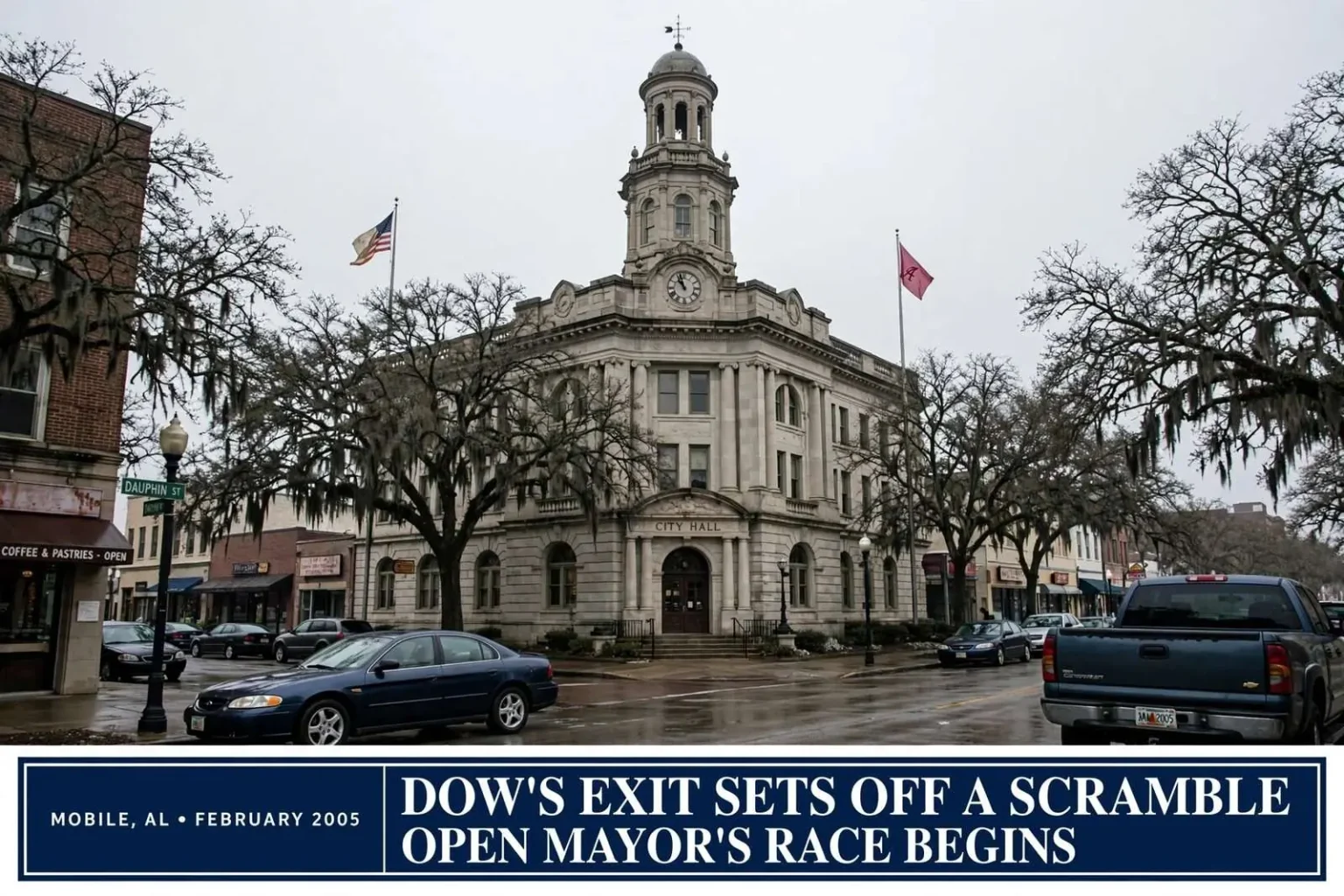
MOBILE — After months of speculation that had become one of the most closely watched open secrets in local politics, Mayor Mike Dow was preparing in mid-February 2005 to confirm what much of City Hall already assumed: he would not seek a fifth term in the municipal elections scheduled for that summer. Sources close to the mayor said an announcement was tentatively set for the end of the week, following a Thursday meeting with his executive staff.
Dow’s departure, if confirmed, would close a chapter that began in 1989, when he unseated then-Mayor Arthur Outlaw after building a fortune with his brother-in-law, Jim Busby, in the high-technology printing firm Quality Micro Systems. Sixteen years later, the mayor’s plans had become the axis on which nearly every other political calculation in the city turned. Prospective candidates had lined up their finances, their consultants and their donors — all waiting on a single decision that was not theirs to make.
A field waiting on one man
The most immediate consequence of a Dow exit was expected to be the entry of former state Sen. Ann Bedsole, who had said plainly that she preferred the incumbent seek another term and would not campaign until and unless he closed the door himself. Sources close to her operation said her announcement would likely follow within days of Dow’s, probably at a press conference the following Monday.
Her candidacy carried a second headline with it. Retired Congressman H.L. “Sonny” Callahan — a 30-year veteran of elected office at the state and federal levels, and a man who had served as both a Democrat and a Republican — was expected to serve as her campaign chairman, returning him to active political combat after his retirement from Congress. Callahan had spent years as Mobile’s voice in Washington, and his presence atop a Bedsole campaign would instantly give it the establishment credentials that matter in a wide-open municipal race.
Mobile County Commissioner Sam Jones, who had represented District 1 for nearly 18 years, had already filed his campaign papers. Associates said the filing was less a response to Dow than a message to those quietly urging him to stand down: he was in the race, and the advice was unwelcome. Healthcare executive Clarence M. Ball Jr. agreed to chair his campaign.
Questions about a councilman’s campaign fund
District 7 City Councilman John Peavy had likewise organized a committee and filed a probate court report showing more than $100,000 in his campaign account. The figure drew scrutiny. Nearly $98,000 of it came from South Alabamians for Good Government, a political action committee originally formed to support Gov. Bob Riley’s 2002 campaign. Sources said the money traced back to a bank loan guaranteed by Peavy supporters — one account described ten backers pledging $10,000 apiece.
“The issue is whether the campaign has the money,” said Peavy campaign chairman Palmer Hamilton, a Mobile attorney. “It does. The campaign doesn’t owe anybody anything.”
Mike Thompson, a local accountant associated with the PAC, said he was not able to comment and would file a report by the next deadline. The episode gave the young race its first argument about money and influence, months before a single vote was scheduled, and it guaranteed that campaign finance reports would be read as closely as press releases in the months ahead. It also illustrated how the lines between independent committees and candidate campaigns could blur when the same circle of backers financed both.
The mechanics of getting in
The formal requirements for entering the race were modest, which is one reason the field grew so quickly once Dow’s intentions leaked. Candidates had to qualify by the July 19 deadline and pay the filing fee, and a campaign committee had to be organized before money could be raised in the candidate’s name. The probate court reports, like the one Peavy filed, served as the public’s first look at who had actually begun assembling a campaign rather than merely entertaining one.
By contrast, the practical requirements — a donor network, a credible coalition, and the stamina for six months of civic club speeches and neighborhood meetings — were what separated the likely candidates from the names being floated. Bedsole, Jones, Peavy and Rich all had those networks already; the rest of the speculation depended on whether others would build them in time.
Bess Rich confirms a second run
Independent of Dow’s timetable, former City Councilwoman Bess Rich confirmed on Tuesday morning that she would run again. Rich represented District 6 on the City Council from 1993 to 2001 and lost to Dow in the 2001 mayoral race. A persistent critic of the administration’s fiscal management, she was expected to build a campaign around the argument that her warnings about the city’s finances had been borne out.
“I will have an official announcement within the next week or two,” she said. “Yes, that I will be a candidate. That’s the plan at this point.”
She declined to name a committee chair or media advisers, saying those details would come with a formal statement. Rich’s entry meant the race would feature both a former rival from the last election and a slate of candidates new to citywide campaigning, giving voters a range of choice that Mobile had not seen in 16 years.
One name off the board
County Commissioner Stephen Nodine, the subject of steady speculation, ruled himself out. “I will not be running for mayor of Mobile,” he said, adding that he was “humbled” by the appeals he had received. Nodine, who had served three years as the District 7 councilman before moving to the District 2 commission seat the previous summer, said the toll of repeated campaigns weighed heavily.
“I’ve been through five elections,” he said. “It’s taken a huge toll on my family. Five campaigns and $270,000 later, here we are.”
He argued that the demand for personal perfection was driving capable people out of public life. “We have personal lives and personal problems from the president on down,” he said. “To put some halo on us and expect us to live up to that, that’s an unrealistic expectation.” His withdrawal removed one of the better-funded potential candidates from the field and left the race’s geographic and political balance still forming.
The stakes
Veterans of local campaigns predicted spending in the 2005 race would exceed $1.5 million, surpassing the roughly $1.2 million record set in 1989. The office itself was full time and paid $89,000 a year, and the City Council had until Wednesday, Feb. 23 to adjust the salaries of officials who would be elected that year.
Qualifying deadline: July 19, 2005. Election day: Aug. 23, 2005. Qualifying fee: $500 for mayor, $125 for City Council. Those dates meant the formal campaign would be compressed into a summer sprint even though the unofficial campaign was already fully underway, with announcements timed to capture the news cycle created by Dow’s own.
The 2005 contest was shaping up as Mobile’s first truly open mayor’s race in a generation. Alabama municipal elections are officially nonpartisan, but the politics of Mobile are anything but simple: the city’s electorate is split among distinct geographic and community bases, and every citywide candidate must assemble a coalition that spans downtown, west Mobile and the traditional neighborhoods in between. A crowded field raises the odds that the August vote ends in a runoff, stretching the campaign and the spending into the fall.
For the candidates already moving, Dow’s timing shaped everything. An announcement in February would give the field nearly six months before qualifying — enough time to raise the money, hire the staff and build the names lists that modern citywide campaigns require. Waiting longer risked ceding the early airwaves and the early endorsements to whichever rival moved first.
The race also carried generational weight. Dow had presided over a period of visible change downtown and along the waterfront, and the candidates lining up to succeed him represented different answers to the question of what should come next: continued downtown-driven redevelopment, tighter fiscal management, or a broader redistribution of attention to the neighborhoods.
Dow, for his part, was expected to move into the private sector, joining a technology venture led by Busby in a sales and marketing role and as a shareholder. The return to business would bookend a mayoralty that had begun the same way — a successful businessman recruited into public life in 1989 — and would leave behind a City Hall in which every ambition, grudge and calculation of the previous 16 years was suddenly up for renegotiation.
By the time the qualifying deadline arrived on July 19, the field of February would have winnowed itself in public. But in mid-February 2005, the only certainty was that the waiting was nearly over — for Dow, for the rivals who had structured their lives around his decision, and for a city about to hold its widest-open election in a generation.