Albritton Rolls to Decisive Win Over D’Olive in Senate District 22 Runoff
Greg Albritton cruised past Harry D'Olive in Tuesday's Republican runoff for the Alabama Senate District 22 seat.
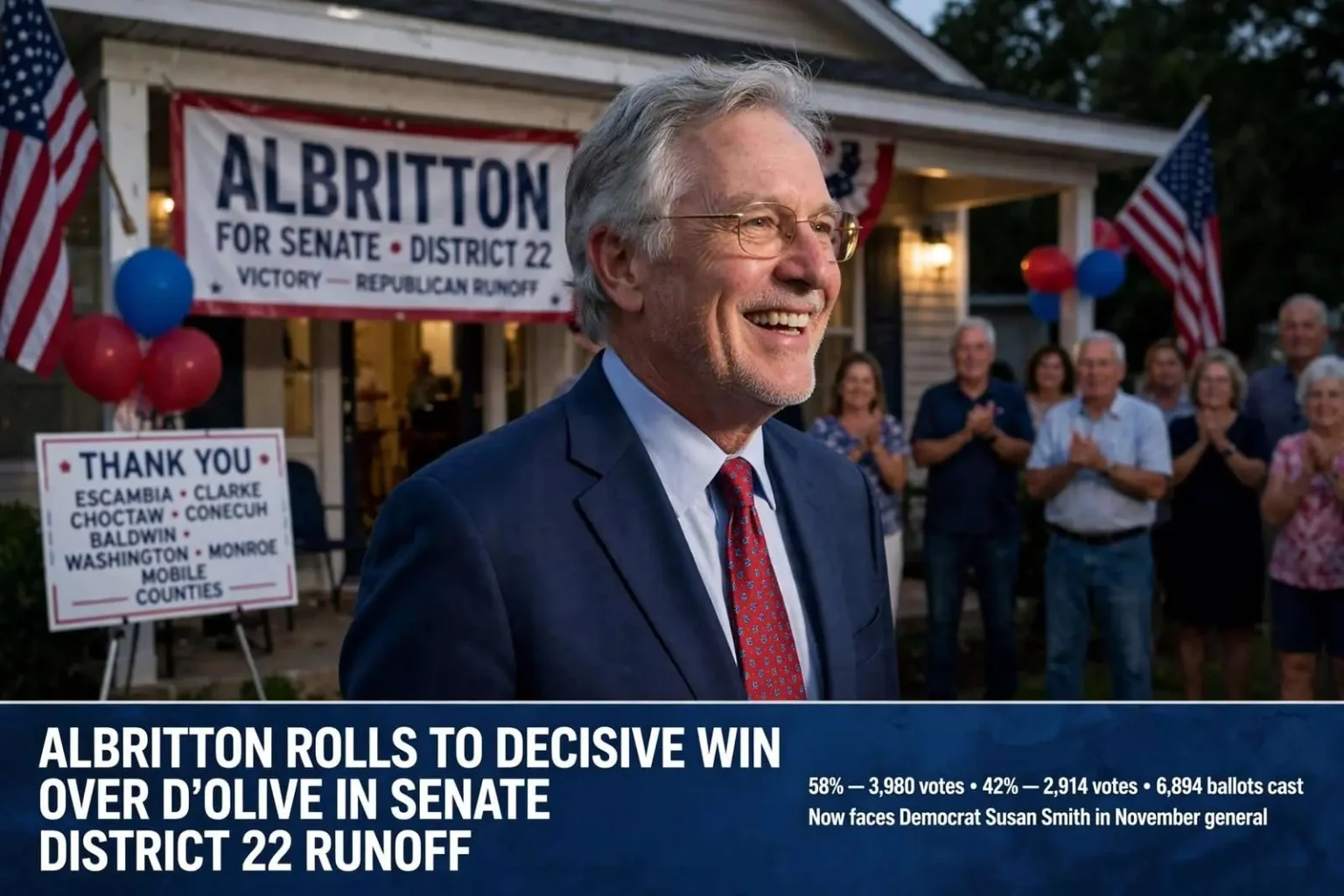
Greg Albritton withstood a lopsided loss in his opponent’s home county and rolled to a comfortable victory Tuesday in the Republican runoff for the Alabama Senate District 22 nomination, setting up a fall matchup with a Democratic challenger from Atmore.
With complete but unofficial returns counted, Albritton captured 58 percent of the vote to Harry D’Olive’s 42 percent. Albritton will now face Democrat Susan Smith, a member of the Atmore City Council, in the November general election.
“I’m happy. We’ve worked hard. People here have worked very hard,” Albritton said following the results. “It’s always better winning than losing. I’ve done both.”
Albritton and D’Olive advanced to the runoff after finishing first and second in a five-candidate primary field back on June 3. That earlier contest established a pattern that repeated itself Tuesday: D’Olive dominated in Baldwin County, winning roughly 70 percent of the vote there, but could not overcome Albritton’s strength across the rest of the sprawling district, which stretches through Escambia County and portions of Clarke, Choctaw, Conecuh, Washington, Monroe and Mobile counties in addition to Baldwin. Albritton countered with an 85 percent showing in Escambia County alone.
Official county-by-county returns showed Albritton finishing with 3,980 votes to D’Olive’s 2,914 out of 6,894 ballots cast across the eight-county district.
The geography of the result told the story of the runoff. Baldwin County, the state’s fastest-growing county and home to the largest bloc of voters in the district, produced D’Olive’s margins, but its dominance was diluted by the district’s rural interior — counties where Albritton’s Conecuh County roots, his House service and his weeks of campaigning in small communities gave him an advantage no rival could match.
Two Small-Town Lawyers, Similar Backgrounds
Despite their rivalry, Albritton and D’Olive share strikingly similar résumés. Both are solo-practice lawyers in their home communities, D’Olive in Bay Minette and Albritton in Conecuh County. Both have weathered previous political setbacks: Albritton served one term in the Alabama House of Representatives from 2002 to 2006 before losing a Republican primary re-election bid. D’Olive briefly served as Baldwin County probate judge after his father stepped down from the post in 1999, but lost a bid for a full term in 2000 and again lost the Republican nomination for the office in 2012. He also served briefly as mayor of Silverhill before leaving to attend law school.
That shared history of electoral ups and downs made the runoff a contest between two candidates who understood the demands of rural and small-town campaigning — long drives across two-lane highways, fish fries and civic club meetings, and the need to introduce themselves repeatedly in counties with few voters each. Turnout of fewer than 7,000 ballots across eight counties underscored how much the race would be decided by organization in the district’s small communities.
Shared Positions, Sharp Attacks
On policy, the two candidates found more common ground than daylight, with both opposing Alabama’s adoption of the Common Core State Standards and both supporting a right for motorists to carry loaded firearms without a concealed-carry permit. Albritton nonetheless attacked D’Olive over comments suggesting he was open to considering an Internet sales tax to help address the state budget; D’Olive later said he had simply been describing an option floated by others, not endorsing it.
D’Olive had campaigned on economic development, promising to push hard for manufacturers to locate at a large industrial site the Baldwin County Commission purchased north of Bay Minette. Albritton instead emphasized trimming state government, including eliminating boards and commissions he argued make it needlessly difficult for Alabamians to start businesses or enter licensed professions.
Albritton significantly outraised and outspent D’Olive during the runoff campaign, drawing heavy support from political action committees tied to the Poarch Band of Creek Indians and the Alabama Farmers Federation. D’Olive had raised questions about whether that Farmers Federation backing, tied to Alfa Insurance, could complicate Albritton’s ability to weigh in on future homeowners insurance reform, an argument Albritton dismissed by saying the endorsement reflected his support for farmers rather than insurers.
The money gap was evident in the campaign’s closing weeks, as Albritton’s advertising reached voters across the district’s counties while D’Olive’s campaign relied more heavily on the Baldwin County base where his name was best known. In a low-turnout runoff, that spending advantage compounded Albritton’s geographic strength outside the county that mattered most to his opponent.
For the Poarch Band, whose reservation sits within the district in Escambia County, the investment in Albritton reflected the tribe’s growing role in Alabama politics as well as its stake in issues affecting its home region. The Alabama Farmers Federation, the state’s largest farm organization, similarly spread its support among rural Republicans it viewed as allies on agricultural and property issues.
The runoff’s outcome also closed out a primary season in which Senate District 22’s five-candidate field had spread across the district’s rural counties and its Baldwin County suburbs. D’Olive’s Baldwin strength proved durable through both rounds, but the arithmetic of the district — one large, fast-growing county balanced against seven smaller ones — favored the candidate who could win everywhere else convincingly.
Redrawn following the 2010 census, Senate District 22 now leans more heavily Republican, making Albritton a clear favorite heading into November against Smith, who entered the race after longtime Democratic incumbent Marc Keahey of Grove Hill withdrew once the primary qualifying period had closed.
Keahey’s late withdrawal left local Democratic officials to turn to Smith, the Atmore councilwoman, as a replacement nominee, giving the party a credible candidate in the district’s Escambia County corner but little time to organize a districtwide campaign. Democrats had held the seat through Keahey’s tenure, and the party hoped its rural conservative base in the Black Belt counties could keep the general election competitive despite the district’s new Republican lean.
For Albritton, the general election now represents the chance to complete a political comeback that began with his 2006 House defeat — returning to elected office at the state level, this time representing a district eight counties wide. His campaign’s task between now and November, he told supporters, would be to hold together the rural coalition that won the runoff while making his case to the Baldwin County voters who chose his opponent.
Senate District 22 is one of the largest senatorial districts in Alabama by land area, wrapping around Mobile Bay’s northern rim and reaching from the Mississippi line to the Florida line. Its voters live in county seats like Grove Hill, Bay Minette and Monroeville, in small farming and timber communities, and in the Baldwin County suburbs where growth has been reshaping the electorate for two decades. Serving it, supporters of both candidates acknowledged, requires a senator comfortable with long distances and varied constituencies.
The June primary had scattered the field across that map, with the three eliminated candidates drawing votes from different corners. Their exit left Albritton and D’Olive to consolidate, and the runoff results suggested most of the departed candidates’ supporters moved toward Albritton — a pattern common in rural Alabama runoffs, where second-choice loyalties among neighbors often decide the outcome more than late advertising does.
Common Core, the multi-state education standards adopted amid fierce conservative opposition, had become a litmus test in Republican primaries across Alabama by the time the two men campaigned. Their shared opposition meant the race’s sharpest contrast came instead on taxes and government structure — the Internet sales tax question and Albritton’s push to pare back licensing boards — giving each campaign its attack line without a fundamental philosophical divide.
Firearms policy, too, functioned as a point of agreement rather than contrast. Both candidates supported unpermitted carry of loaded firearms, an issue that resonates in rural Alabama districts where opposition to permit requirements has been a recurring theme in legislative sessions. Its presence in the runoff debate reflected the district’s electorate more than any daylight between the candidates.
The general election campaign will also test whether the district’s new boundaries hold as firmly for Albritton as the map’s numbers suggest. Districts redrawn after the 2010 census shifted populations among the eight counties, and campaigns in districts this rural often turn on local loyalties — a consideration that cuts both ways for a nominee from Conecuh County running against an Atmore Democrat in November.
Albritton’s victory team planned to begin the general election push immediately, with a districtwide tour scheduled to thank the voters and volunteers who delivered the runoff and to introduce the campaign in the counties where he had yet to spend much time. Smith, whose Atmore council service made her best known in the district’s Escambia County communities, faced the parallel task of raising her profile across seven counties where no Democrat had campaigned aggressively in years.