University of South Alabama Gulf Shores
Randy McKinney Opened His Senate Bid With Education and Ethics
The Gulf Shores businessman and State School Board member entered the race for the Baldwin County Senate seat vacated by Bradley Byrne, pledging tighter ethics rules and tax relief for families.
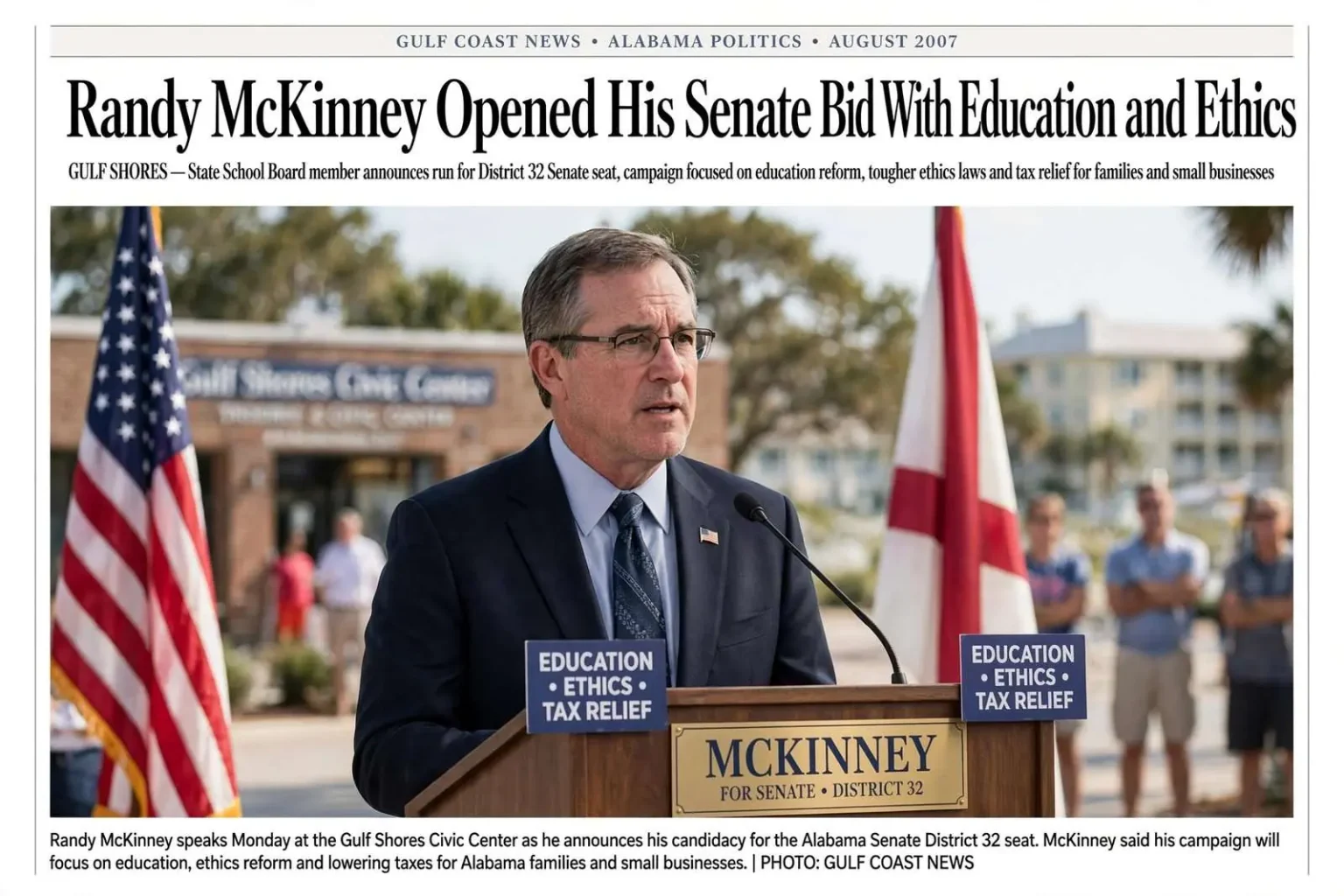
GULF SHORES — State School Board member Randy McKinney announced Monday that he would seek the Alabama Senate seat in District 32 vacated by Bradley Byrne, framing his candidacy around public education, tougher ethics laws and tax relief for Alabama families and small businesses.
Byrne had stepped down from the Baldwin County seat to become chancellor of the state’s two-year college system, an appointment made by Gov. Bob Riley in the middle of a widening scandal over hiring, contracting and no-show jobs in Alabama’s community and technical colleges. The special election to fill the seat was set for Aug. 7.
The announcement put a familiar name at the front of what was expected to become a crowded Republican field, and it tied McKinney’s candidacy directly to the reform agenda of a governor who had made the cleanup of the two-year college system the defining fight of his second term. For voters in Baldwin County, where the August special election would arrive in the middle of summer, the race was about to begin in earnest.
An ally of the governor on education
McKinney, a Gulf Shores businessman, was first appointed to the State Board of Education by Riley in September 2003 and was elected to a term of his own in 2004. He had been aligned with the governor on education questions ever since, and he made that alliance the spine of his announcement.
“I have been proud to stand side-by-side with Gov. Riley in addressing the problems in the two-year system and other areas of education, and I deeply appreciate the confidence he placed in me by appointing me to the State School Board,” McKinney said. “As a member of the State Senate, I will continue working closely with Gov. Riley as we implement the many ethical, government and education reforms Alabama so desperately needs.”
He said he would also work to lower the tax burden on families and small businesses.
The State Board of Education, on which McKinney served, oversees both the public K-12 school system and the two-year college system through its authority over the state superintendent and the chancellor. That dual role meant McKinney had spent four years with a front-row seat to the governance problems now roiling state government, and he argued that experience was precisely what the Senate seat demanded. Board members are elected from districts across the state, and the district McKinney represented stretched well beyond Baldwin County, giving him a constituency that was coastal in character but regional in reach.
Scandal as a campaign argument
The two-year college scandal was not an abstraction in the summer of 2007. It had already produced investigations, resignations and criminal referrals, and it had made ethics reform the dominant subject in Alabama politics. McKinney leaned into it.
“Scandals in the two-year college system and other areas of state government show that we must tighten the ethical requirements we demand from public officials,” he said, “and I will devote my time in the State Senate toward achieving that goal.”
The scandal, which centered on the hiring of legislators and their relatives by the two-year college system, on contracts let without competitive bidding, and on jobs that existed largely on paper, had reached into nearly every corner of state government. Chancellor posts and system jobs had gone to sitting lawmakers, and the resulting conflicts of interest had drawn the attention of federal investigators and state auditors alike. By the time Byrne accepted the chancellorship, the system had become the clearest example in Alabama of the need for a stricter ethics law, and Riley had made that overhaul a legislative priority.
McKinney’s argument to voters was that the Senate, as the body that writes and rewrites the state’s ethics statutes, was the natural next arena for that fight. He pledged to carry his experience on the state school board and what he called his passion for education into the Senate, so that Alabama’s children could receive what he described as the world-class public education they deserve. Specific policy initiatives, his campaign said, would be rolled out in the days ahead.
A long resume in law, education and real estate
McKinney was a graduate of the University of South Alabama, the New Orleans Baptist Theological Seminary and the Birmingham School of Law — an unusual combination that had served him in an unusually varied career. He had worked as an assistant district attorney in Baldwin County before moving into real estate, where his interests included title insurance, brokerage, tax-deferred 1031 exchanges and the development of real estate offices. In 1999 he was named Baldwin County Realtor of the Year.
He and his wife, Betsy, had been married 29 years and had two grown children, Clarissa and Andrew.
That resume mapped closely onto the economy of coastal Alabama. Baldwin County’s real estate market had been among the busiest in the state for years, driven by new subdivisions spreading inland from the bay, retirement communities along the Eastern Shore, and condominium construction along the beaches from Gulf Shores to Orange Beach. A candidate who had spent years in title work, brokerage and development was speaking the language of the county’s dominant industry, and the 1031 exchange business in particular had made him familiar with the investment side of a market that had drawn buyers from across the region.
His time as an assistant district attorney gave him a credential on the law-and-order side of the ledger, and his seminary training reflected the rootedness of a community where church life and civic life run together. It was a biography built for a county where voters tend to look for some combination of business experience, conservative values and public service, and the campaign clearly intended to present all three.
The shape of the race
District 32 covered a county growing faster than almost any other in Alabama, and one where the Republican nomination was widely understood to be the whole contest. Baldwin County had become one of the most reliably Republican counties in Alabama, and in a special election held in the middle of the summer, turnout was expected to be small and heavily weighted toward the party’s regular primary voters. The Democratic nominee would begin at a steep disadvantage in a county that Republican presidential and statewide candidates carried by wide margins.
McKinney was not the only candidate with a claim on the seat; the field would grow over the following weeks to include a former state senator, a county commissioner, a county party chairman and a first-time candidate from the business world. That mix — candidates with legislative experience, candidates with county government experience, candidates with party organization behind them and candidates running as outsiders — set up a classic Baldwin County primary, the kind that has historically been decided at the courthouse courting circles, fish fries and civic club meetings that make up the county’s political infrastructure.
What McKinney brought was name identification earned across a school board district that reached well beyond Baldwin, a close relationship with a popular sitting governor, and a track record in a previous Senate race — he had run a competitive campaign against Byrne several years earlier, an effort that Baldwin Republicans still remembered. That earlier race meant he had already built the donor list, the volunteer network and the countywide name recognition that most first-time candidates spend a campaign assembling, and it explained why political watchers in the county treated him as a serious contender from the day he announced.
The governor’s endorsement carried weight in that field, but it also carried risk. Riley had made enemies in the course of the two-year college cleanup, and some Baldwin County Republicans had been critical of individual appointments. Whether the alliance with the governor would be an asset at the ballot box was one of the open questions of the race.
Why the seat mattered
The timing of the announcement also mattered. A special election compressed into a few summer weeks gives an advantage to the candidate who starts with a functioning campaign, and McKinney’s announcement, coming with a statement, a biography and a promise of detailed policy positions, signaled that his operation would be ready from the first day of qualifying.
The seat he was seeking would matter beyond the county line. With the Alabama Senate closely divided and its rules a constant source of procedural warfare, a single vote from a fast-growing coastal district could shape the fights ahead over coastal insurance, education funding and the reform of the very college system Byrne had just been sent to clean up.
Coastal insurance had become the dominant pocketbook issue for Baldwin County voters, as homeowners along the bay and the beaches contended with rising premiums and insurers reducing their exposure on the coast. Education funding mattered to one of the fastest-enrolling school systems in the state, where new schools had to be built nearly every year to keep up with growth. And the two-year college system served thousands of students in the district, making the reform of its governance a matter of direct local interest.
For now, the campaign began where it promised to stay: on education, ethics and taxes, with an Aug. 7 election day drawing closer each week.