Atmore Councilwoman Susan Smith Named Democratic Nominee for Senate District 22
Alabama Democrats selected Atmore City Councilwoman Susan Smith to carry the party banner in state Senate District 22 after the incumbent abruptly withdrew from the race following the qualifying period.
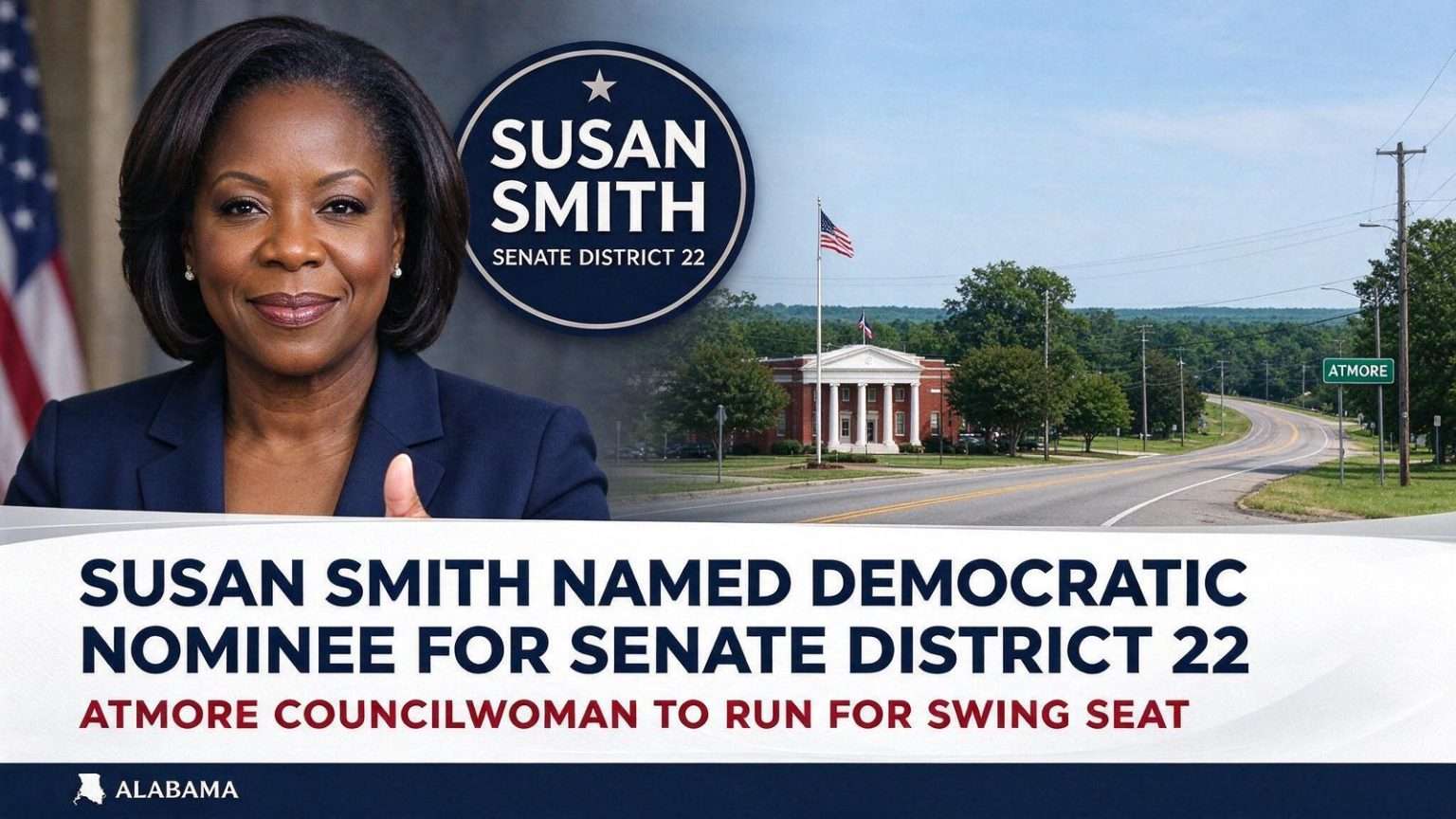
Alabama Democrats have found their candidate for one of the state’s largest legislative districts, and she comes from the Escambia County city of Atmore. Party leaders named Atmore City Councilwoman Susan Smith to run in state Senate District 22, filling a void left when incumbent Sen. Marc Keahey abruptly withdrew from the race after the regular qualifying period had closed.
State party Chairwoman Nancy Worley said Smith was the only person who applied to fill the slot. The party planned to formally designate her as its nominee when it certified the candidates who won the recent Democratic primary.
“She’s just a very intelligent woman. We think she has the background and skills to handle being a senator,” Worley said. “We were very excited when she qualified.”
The episode was an unusual one in Alabama legislative politics. Senate seats are ordinarily settled through the qualifying period, the primary and the general election, in that order. When an incumbent withdraws after qualifying closes, the party is left with a nominee problem — no primary was held for the seat, no votes were cast, and state party rules give the party’s governing bodies the task of designating a replacement candidate. That is the process that produced Smith’s name on the ticket.
The timing mattered as much as the mechanism. A general election campaign takes months of organizing, fundraising and travel across a district that is one of the largest in the state, and a candidate entering after the summer has already begun starts behind the fundraising and name-recognition curve that primary-season competitors spent the spring building.
A sprawling district
Smith, 67, will face the winner of a Republican runoff between former state Rep. Greg Albritton, of Conecuh County, and Bay Minette attorney Harry D’Olive. The seat covers an enormous swath of southwest Alabama, stretching from Choctaw County in the north all the way to the Lillian community in Baldwin County along the Florida border, and from the Mississippi state line in the west to the Covington County border in the east. In all, the district takes in all or parts of eight counties.
Geography like that defines the job. A state Senate district that size encompasses small farming communities in the Black Belt’s southern edge, timber country in the piney woods, mill towns along the rail lines, and the fast-growing southern reaches of Baldwin County near the coast. The drive from one end of the district to the other runs well over a hundred miles, and the concerns at each end — schools, hospitals, roads, jobs — differ in emphasis even when they share a name.
Lillian, at the district’s southern tip, sits in one of the fastest-growing corridors in Alabama, where retirees and commuters have transformed a quiet fishing community into a suburb of Pensacola. Choctaw County, at the northern end, has watched its population decline for decades as its young people left for industrial work elsewhere — a pattern repeated across the district’s rural counties. Between them lie courthouse towns, volunteer fire departments, country churches and the two-lane highways that bind it all together.
Representing that mix, Smith said, requires presence everywhere — not just in the largest towns. “I’m very concerned about that district,” she said. “I’m really concerned everybody will get fair representation.”
The candidates and the runoff
The Republican side of the race had already produced a hard-fought runoff. Greg Albritton, the former state representative from Conecuh County, offered years of legislative experience and deep familiarity with the district’s rural counties — the kind of institutional knowledge that matters in a part of the state where a senator’s ability to navigate Montgomery often decides whether a road project or a volunteer fire department grant comes home. Harry D’Olive, the Bay Minette attorney, brought the strength of the Baldwin County end of the district, where population growth has been shifting the district’s political weight for years.
That geographic tension ran through the whole race. The district’s population is growing fastest in Baldwin County, while its traditional political leadership has historically come from the rural counties to the north and west. Whoever emerged from the runoff would carry a natural base in one part of the district and a challenge in the others — the same balancing act Smith was promising to perform.
For Democrats, the decision to field Smith at all was significant. In a district that leans conservative in federal races, parties have sometimes declined to nominate anyone for legislative seats viewed as unwinnable, effectively conceding the general election. By designating a candidate with local standing and a professional background that travels well across party lines, state leadership signaled it intended to compete rather than abstain.
Where she stands
On the broad strokes, Smith echoed her Republican rivals, identifying education and economic development as the district’s most pressing needs. “These are the two driving concerns across the district,” she said, framing them as inseparable: schools that can prepare young people for work, and jobs that give them a reason to stay.
Both themes are straightforwardly rural. District 22’s counties have watched schools consolidate, industries close and populations age, and every courthouse town in the district has a version of the same story: the graduates leave for Mobile, Pensacola, Montgomery or the industrial corridors beyond, and the towns they leave behind struggle to fund the services that would attract employers in return. A state senator from this district works, in large part, on the plumbing of that problem — school funding formulas, industrial recruitment incentives, rural broadband, water and sewer infrastructure, and the highway projects that connect the district’s towns to the interstates.
Healthcare runs alongside both. The district’s rural hospitals and clinics operate under chronic financial pressure, and the closure or downsizing of medical services in small counties has become one of the defining rural issues of the decade. A candidate whose career was spent in healthcare administration enters the conversation with practical standing on the subject that few legislators can match.
A résumé built for the district
Smith retired on June 1 as nursing supervisor for the Escambia County Board of Education, capping a career spent in the institutions that hold rural communities together. She said she would draw on earlier experience as a blood service supervisor and account manager for the American Red Cross, a role in which her territory once included the same counties that now make up District 22.
That Red Cross territory is worth noting: it meant Smith had spent years organizing blood drives, managing logistics and building relationships across literally the same geography a senator from the district must cover. Candidates for large rural districts usually have to learn its map on the campaign trail; Smith, by her account, already knew it from the working side.
Her service on the Atmore City Council added the municipal dimension — budgets, utilities, streets and public safety — that county- and city-level experience gives legislative candidates. Atmore, a city of modest size on the rail line near the Florida state line, faces the challenges typical of its peers: maintaining infrastructure on a small tax base, attracting industry, and keeping young families from drifting away.
The road to November
The campaign ahead would test whether a late-starting nominee could close the gap. Smith’s path runs through the district’s Democratic-leaning precincts — the Black Belt counties at the district’s northern end, the courthouse towns with long Democratic traditions, and the union and education households scattered through the timber counties — while competing for the middle-of-the-road voters who split tickets in local races.
Her profile was built for that appeal. A retired school nurse and healthcare administrator with decades of service in Escambia County does not read as a partisan professional, and in rural Alabama legislative races, that kind of biography is often worth more than any party label. Candidates in these districts win by showing up — at fish fries, fire department suppers, church homecomings and courthouse square campaign stops — and a councilwoman from Atmore starts with a network of exactly those relationships across her home county.
The financial picture was another matter. Candidates who emerge after qualifying closes begin fundraising months behind their opponents, and a district this size demands travel: fuel and advertising across multiple media markets — Mobile and Pensacola television, small-town newspapers, radio — all add up. State parties and political action committees typically weigh in once a nominee is designated, but the early money in a race like this one belongs to the candidate who qualified on time.
What the seat means in Montgomery
A state Senate seat covering southwest Alabama carries influence disproportionate to its population. Senators in Alabama hold significant power over the state budget process, local legislation and appointments, and a district stretching from the Mississippi line to Baldwin County has long depended on its senator to steer money for roads, bridges, schools and economic development projects back to counties that cannot fund them alone.
The district’s needs are the classic list of rural south Alabama: farm-to-market roads and bridges, volunteer fire department funding, rural hospital support, water and sewer systems for towns too small to finance their own, and industrial recruitment for the timber, agriculture and manufacturing employers that anchor its economies. The Baldwin County end adds growth issues — school construction, traffic on U.S. 90 and the state highways, and the infrastructure demands of one of the fastest-growing counties in the state.
Keahey’s withdrawal removed an incumbent with years of accumulated seniority and relationships, which meant the next senator — whoever won — would start the climb from the bottom of a 35-member body. In a legislature where seniority and committee assignments shape what a district gets, that reset was itself a consequence of the race’s late chaos.
For the voters of the eight counties, the choice would come down in November to two candidates with deep local roots but different bases: a Republican runoff winner carrying the rural conservative tradition of the district’s interior, and a Democratic nominee offering a healthcare-and-education résumé and a promise that every corner of the district — from Choctaw County to Lillian — would see its senator more than once an election cycle. In a district this large, that promise is the campaign.