Baldwin County Declines to Fund 2015 Alabama Bass Trail Event at Live Oak
Baldwin County commissioners declined to help fund a 2015 Alabama Bass Trail tournament at Live Oak Landing, but the trail's director said she still planned to bring the event to Bay Minette.
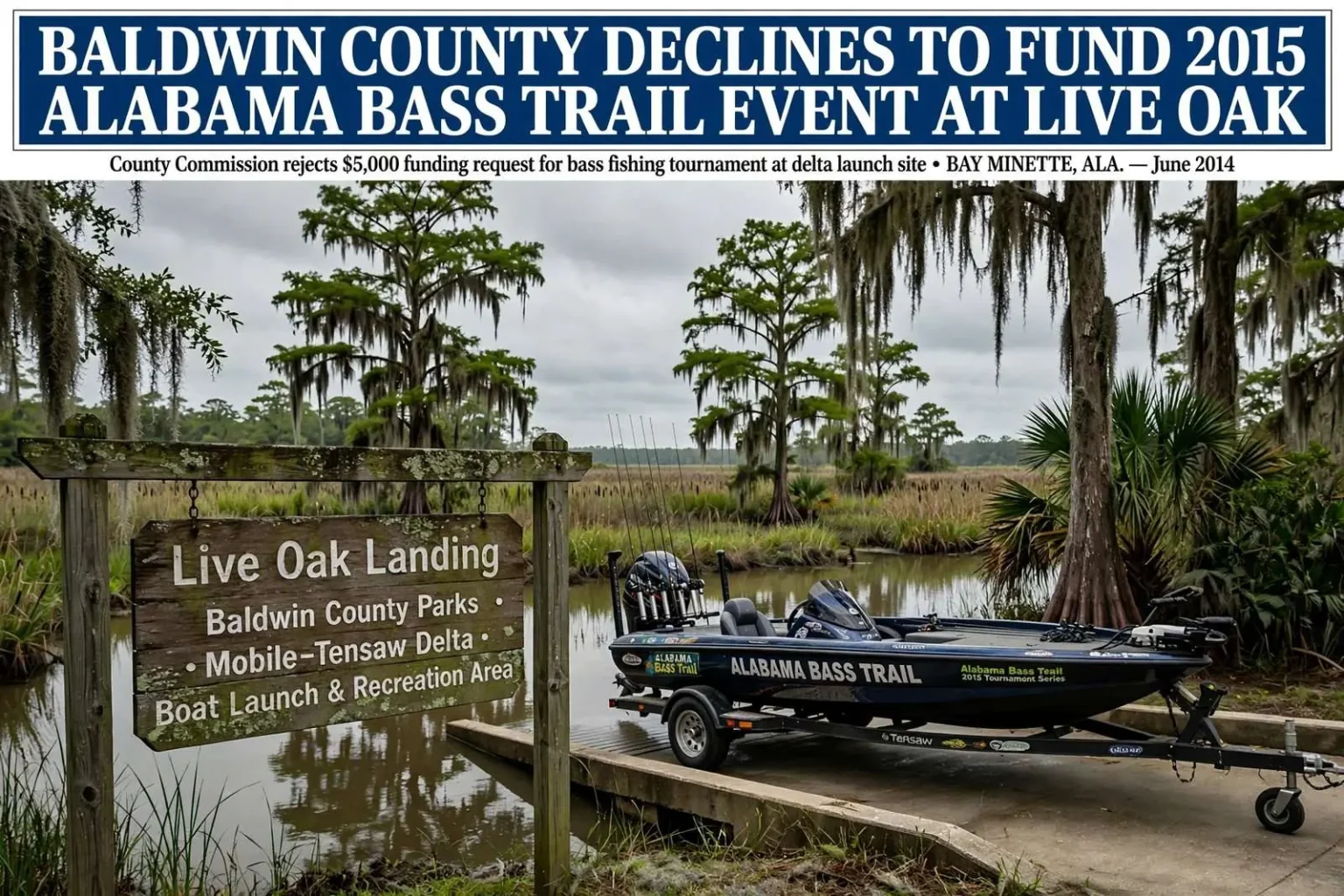
BAY MINETTE, Ala. — A promoter of the Alabama Bass Trail said in June 2014 that she still planned to hold a 2015 bass fishing event at Live Oak Landing, even after the Baldwin County Commission declined to help pay for it. Bass Trail Program Director Kay Donaldson, state Rep. Randy Davis and others attended that Tuesday’s commission meeting and unsuccessfully urged commissioners to share in the cost of staging tournament events at Live Oak from 2015 through 2018. The county’s share would have been $5,000 in each of the four years.
Commissioners Balk
Commissioner Bob James questioned singling out one event for support. “We have numerous tournaments that come into this county,” James said. “I have a problem treating one superior to another, and I’ve just got to get justification as to why we would do that.”
Commissioner Tucker Dorsey made a motion to approve the proposal, but it died for lack of a second. James asked that the matter be placed on the next week’s work session agenda so more could be learned about the economic impact of the event and other tournaments, but Dorsey told the chairman not to bother. “I am not going to do a dog and pony show of math on a $5,000 discretionary funding,” Dorsey said.
Commissioner Frank Burt Jr. also objected. “I can’t support paying somebody to come here to bass fish out of one of the most beautiful places there is in the world,” Burt said.
The exchange captured a recurring tension on the Baldwin County Commission, whose members have historically guarded discretionary spending closely. A $5,000 annual commitment is small by the county’s budgetary standards, but the principle was not: the county hosts fishing tournaments, bike rides, road races and festivals across its territory every year, and any one of them can make a case for a subsidy. Once one event is singled out for county money, the argument runs, the next organizer through the door inherits a precedent.
The procedural path of the request was as telling as its rejection. A motion without a second cannot even reach a vote under the commission’s rules, and Dorsey’s refusal to schedule the further study James requested closed the door on a slower, deliberative route. Whatever the merits, the request was over in a single meeting — a speed that surprised no one familiar with how the commission handles contested spending items.
What the Money Would Have Covered
The Alabama Bass Trail is a public-private partnership that promotes 11 lakes and rivers across the state as fishing destinations in hopes of drawing tourists. Its inaugural tournament had been held in 2014. For a 2015 event at Live Oak, the commission had been asked to provide $12,290 toward costs such as a host fee, partner fee, hotel rooms, ramp fees, portable restrooms and chairs.
The line items illustrate what it actually costs to stage a competitive fishing event at a river landing. Host and partner fees compensate the trail organization and local partners; ramp fees cover the use of the launch facilities that send more than a hundred boats onto the water in staggered order; and the portable restrooms and rented chairs are the unglamorous infrastructure of an event whose spectators spend hours on a riverbank with no grandstand in sight.
The county had paid $13,562 to host a tournament event at Live Oak that March, an event estimated to have had roughly a $118,000 impact on the county. That arithmetic — a nine-to-one return, by the estimate circulated at the time — formed the core of the pitch Donaldson and her allies carried into the meeting, and it is the standard argument tournament organizers make everywhere: anglers arrive days early to practice, book hotel rooms, eat in local restaurants, buy fuel and tackle, and bring family members who do not fish at all.
Baldwin County had spent the years before the debate building a tourism economy around its beaches, and the Bass Trail pitch was in part an argument that the county’s northern tier — the rivers, delta and rolling farmland around Bay Minette and Stockton — deserved the same promotional attention the coast received. Tourism dollars that stop at the Interstate 10 corridor, the argument goes, bypass a substantial share of the county’s geography and its small towns.
The Trail and Its Tournament Circuit
The Alabama Bass Trail’s eleven promoted waters span the state, from large reservoirs in the Tennessee Valley to the river systems of the Black Belt and the delta country at the edge of Mobile Bay. The trail’s model borrows from states such as Arkansas and Kentucky that turned their fisheries into named destination brands, pairing a marketing identity with a tournament series that gives anglers a reason to visit each water in turn.
Tournament fishing had grown by 2014 into a significant travel sector. Regional circuits draw boats and crews from multiple states to a single weekend, and the economics favor communities that can offer a capable launch site, nearby lodging and enough water to hold a field of competitors. Live Oak Landing, on the Tensaw River north of Mobile Bay, offered all three, along with a fishery whose backwater sloughs and oxbow lakes are regarded among Alabama anglers as some of the state’s most productive.
The landing itself is a Baldwin County park — a public boat launch and recreation site in the Mobile-Tensaw Delta near Stockton — which placed the county in the unusual position of declining to support a tournament at a facility the county itself owns and operates. That fact cut both ways in the debate: supporters saw county money going to an event on county ground as an easy call, while opponents saw no reason to pay a host fee to bring anglers to a launch they already provide free of charge.
A Regional Pitch
Dorsey had reached out to the Mobile Sports Authority, Bay Minette Mayor Bob Wills and others about sharing the cost. “It would show some regionalism,” he said. “It would show both sides of the bay are working to preserve and bring attention to the Mobile-Tensaw Delta.”
The regional framing reflected Dorsey’s district, which includes the delta’s Baldwin County side, and his long-standing argument that the wetland region between the two counties is an underdeveloped tourism asset. The Mobile-Tensaw Delta is one of the South’s great natural features — a vast tangle of rivers, bayous, bottomland hardwoods and marsh that funnels the Alabama and Tombigbee rivers toward Mobile Bay — and it hosts fishing, hunting, paddling and birding that draw visitors from across the region even without formal promotion.
Mobile Sports Authority Executive Director Danny Corte said his group was willing to discuss putting $5,000 toward the tournament, but only in years when anglers’ lodging and meetings would take place in Saraland. “We are still very supportive of what the Alabama Bass Trail wants to do,” Corte said. “It’s just a question of working out the details.”
Corte’s condition illustrated the fragmentary economics of regional tourism promotion. The Mobile Sports Authority exists to fill hotel rooms and event venues in Mobile County, and its willingness to fund a tournament hinged on whether the spending actually landed on its side of the bay. A tournament that launched from Live Oak but lodged its anglers in Baldwin County offered the authority little to bank; one whose banquets and block rooms sat in Saraland did. The distinction between launching a boat and lodging its crew became, in effect, the negotiating line between the two counties’ promotional budgets.
State Rep. Randy Davis, whose district reaches into the delta country of eastern Baldwin County, lent his presence to the request as well, a signal that the pitch had support beyond the trail’s own staff. Lawmakers routinely appear before county commissions on behalf of economic development projects, and Davis’s attendance underscored that the tournament proposal was being advanced as economic development rather than as recreation.
The Promoter Presses On
Donaldson called the commission’s decision disappointing but said she still intended to bring a 2015 event to Live Oak, which had already been announced as a tournament site. She said she believed others were willing to make the needed contributions, though she declined to name them.
“Just like other tournament organizations, we will continue to look for communities that want to be partners,” she said. “It’s got to be a win-win for everybody.”
The statement laid out the trail’s leverage. Tournament circuits are mobile by design: a series that visits eleven waters across the state can swap one host community for another without disturbing the rest of the schedule, and communities that want the traffic have learned that the difference between a tournament landing nearby or somewhere else often comes down to a few thousand dollars of host support. Donaldson’s warning that the organization would keep shopping for partners was, in substance, a competitive threat delivered politely.
Her refusal to name the prospective contributors was equally characteristic of how such deals are assembled. Local chambers of commerce, municipal tourism boards, lodging operators and private sponsors typically negotiate quietly before any public commitment is announced, and a promoter who names a contributor before the check clears risks losing both. The model she described — a patchwork of contributions replacing a single county appropriation — has become the standard funding pattern for mid-sized fishing events, which rarely fit neatly inside any one government’s tourism budget.
What the Debate Left Behind
The commission’s decision left the 2015 event’s fate resting on private and municipal support rather than county money, and it left unresolved the larger question James had raised: how a county decides which events deserve public support and which must stand on their own. No policy emerged from the meeting — no rubric for economic impact, no standing fund for tournament hosting — which meant the next organizer would arrive to argue the same case from scratch.
For the delta’s advocates, the meeting was a familiar disappointment. The region’s promoters have long argued that the wetlands between the bay and the rivers generate millions in recreational spending that no agency actively courts, and that a modest hosting subsidy is among the cheapest economic development tools available. The commission’s majority, for its part, had articulated a different principle: that the county’s beauty is its own invitation, and that paying visitors to enjoy what is already free undervalues the asset.
Both positions had their arithmetic. The tournament had, by the estimate presented, returned roughly nine dollars for every dollar the county had spent the previous March. Against that stood a commission wary of establishing a subsidy queue it could not close. The 2015 event, whatever support it ultimately found, would proceed — as Donaldson promised — under the trail’s founding logic: the fishing, and the fishery, remain the constant; only the partners change.