Alabama to Borrow Nearly $200 Million for $900 Million Escambia County Prison Project
The Alabama Corrections Institution Finance Authority approved borrowing up to $195 million for a new 4,000-bed prison in Escambia County, raising the project budget to $900 million.
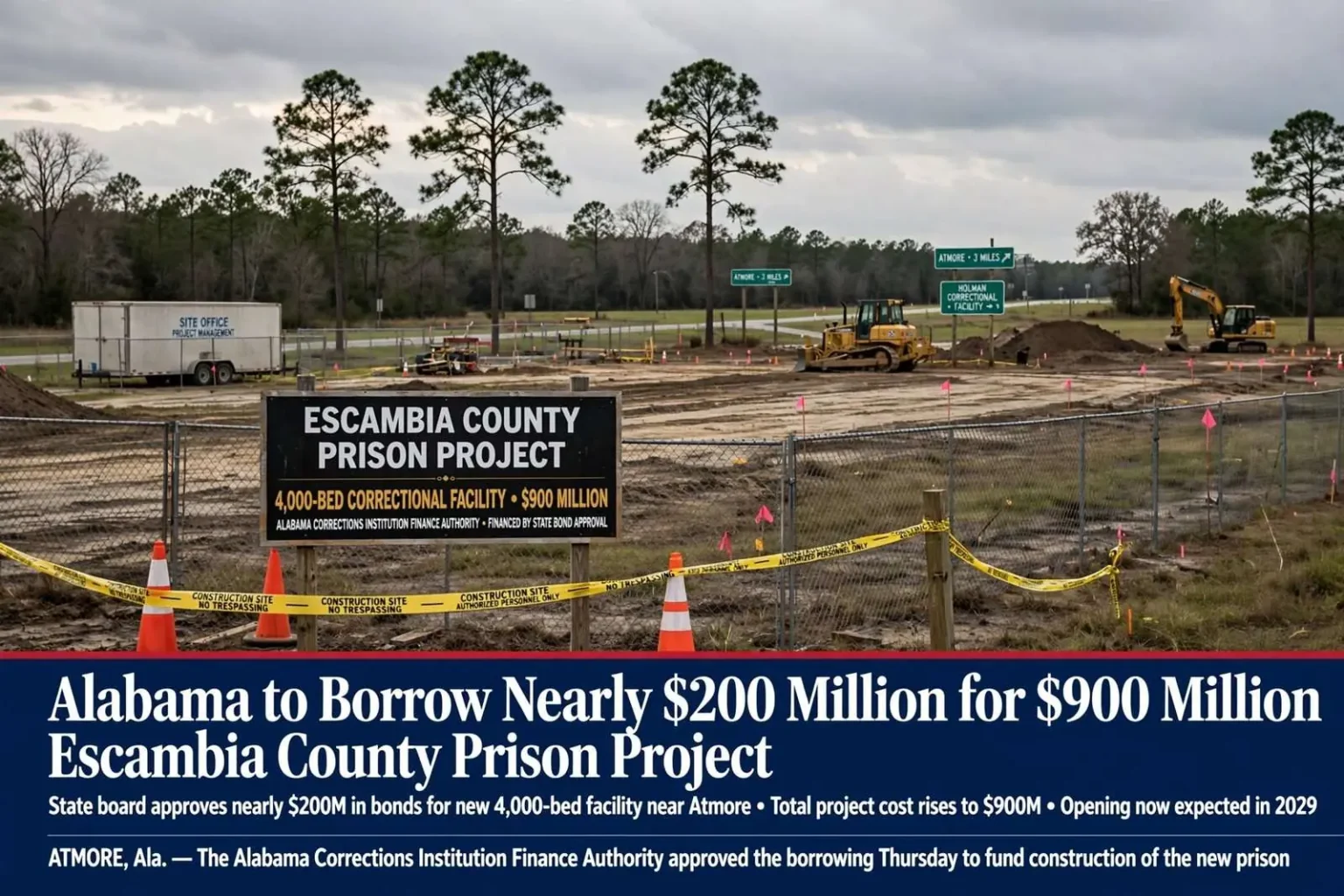
ATMORE, Ala. — A state board on Thursday agreed to borrow almost $200 million to build a new 4,000-bed prison in Escambia County, pushing the total price tag for the project to $900 million. The decision came at a meeting of the Alabama Corrections Institution Finance Authority, the state board charged with overseeing the financing of Alabama’s prison construction program.
The Alabama Corrections Institution Finance Authority’s decision increases the budget for the Escambia construction project from $700 million to $900 million, on top of the more than $1.25 billion spent to build another 4,000-bed prison in Elmore County. Combined, the two projects represent one of the largest public works efforts in modern Alabama history, and they will reshape the state’s correctional system for decades to come.
Sen. Greg Albritton, R-Atmore, a member of the authority and the outgoing chair of the Senate Finance and Taxation General Fund Committee, said the borrowing for the prison in Atmore was “a long time in coming, but we got it done.” Albritton, whose district includes the Escambia County site, has been one of the most persistent voices in Montgomery advocating for the project’s progress.
A plan years in the making
“The principal thing we are doing is we are starting the Atmore facility,” he said. “This allows us to actually move forward with the Escambia facility.” The Alabama Legislature in 2021 approved a total of $1.3 billion to build two new prisons, which supporters said would be safer for inmates and correctional officers and would allow the Alabama Department of Corrections to shut down older facilities, saving the department money.
The process, however, has been rocky. The Elmore County prison, named the Gov. Kay Ivey Correctional Complex, has consumed nearly all of the money originally appropriated for the project, and lawmakers have not committed to shutting down any existing prison. The escalating cost of the Elmore facility has been one of the most closely watched budget stories in Montgomery over the past several years, with corrections officials returning to the Legislature repeatedly to explain overruns and request additional funding.
Corrections officials declined to comment on Thursday. The authority also approved a resolution covering the design, construction management and other services, along with a measure to advertise bids for construction of the Escambia prison. The three resolutions together represent the procedural groundwork needed to keep the project moving through the end of the year.
Ownership questions and a major transfer
A third resolution approved the transfer of the Ivey complex from ADOC to the finance authority. That prison is scheduled to be completed in October. “There is a small portion of land on which we have facilities where there is a question as to ownership or rights, so we are correcting that,” Albritton said.
The bond resolution allows investors to bid on a maximum total of $195 million. Investors will bid on the amount they want to invest and the interest rate they expect to earn, providing the money needed for the construction project. The structure has been used for other large state projects in Alabama and is designed to balance competitive pricing with predictable financing costs over the life of the bonds.
Timeline and cost
Albritton said the first steps are securing investors for the bonds and receiving bids from contractors for construction. He anticipates the project will take about 30 months to complete once construction begins on the site, which is anticipated for October. That timeline means the Escambia facility would open in the second half of 2028 under the most optimistic scenario, and that any delays in bonding or construction could push that opening later.
He expects the Escambia prison to cost less than the roughly $1.3 billion spent to build the Elmore facility. “The Alabama Legislature, working with the Governor’s Office and ADOC and others, were able to search the sofa cushions to pull forth from areas that we needed to for a number of years,” he said. “There was some intentional penny-pinching along the way, and that is why we are where we are.” Albritton’s comments reflect a recurring frustration among legislators who have watched the cost of the original two-prison plan balloon far beyond its 2021 projections.
Replacing beds, not adding them
According to materials provided by ADOC, the new prison construction will replace beds rather than add capacity. The Escambia prison is planned to be built in two parts. The first phase will cover 195 acres on property located next to Fountain Correctional Facility near Holman Correctional Facility in Atmore, comprising more than 2,000 beds and 26 buildings.
“Ultimately Fountain will be demolished and removed from service in connection with the construction and opening of the new Escambia County facility,” according to a media sheet provided by ADOC at the meeting. That commitment, if carried through, would represent the most significant prison closure in Alabama in decades and would address one of the long-standing criticisms of the state’s corrections system: the operation of aging facilities that are costly to maintain and difficult to staff safely.
What it means for the region
Atmore has been closely tied to the trajectory of Alabama’s prison system for generations. The community sits at the heart of a corrections landscape that includes Holman Correctional Facility, Fountain Correctional Facility and other state-run institutions that have provided jobs and shaped the local economy for decades. The new 4,000-bed prison represents both an opportunity and a challenge for the region, with construction jobs flowing through the area over the next 30 months and, eventually, permanent staffing needs tied to the facility’s long-term operation.
The Escambia project has been among the most anticipated pieces of Alabama’s prison construction program, which state leaders have framed as a response to longstanding problems with aging, overcrowded facilities. Whether the new prisons lead to the closures lawmakers once promised remains an open question in Montgomery. Supporters say the new facilities will allow the state to consolidate operations and shutter older prisons that have posed safety and operational concerns. Skeptics note that no firm closure plan has been put in writing, and that the Elmore complex’s ballooning budget suggests the state may not be able to follow through on those promises without additional borrowing or revenue.
Looking ahead
For now, the finance authority’s decision moves the Escambia project from planning into active financing and bidding. The coming months will determine how much of the $195 million bond capacity is ultimately used, what interest rates investors demand and which contractors step forward to build the facility. Each of those decisions will shape the project’s final cost and timeline, and corrections officials are expected to provide regular updates to the authority as construction progresses.
For residents of Atmore and Escambia County, the project will be a defining piece of the region’s economic landscape for years to come. From the hiring of construction crews to the eventual staffing of the prison itself, the new facility will be a significant presence in a community that has long lived with the consequences — both good and bad — of being home to some of Alabama’s largest correctional institutions.
How the bond financing works
The Alabama Corrections Institution Finance Authority is one of several state entities empowered to issue bonds on behalf of public construction projects. By using bond financing rather than direct appropriations, the state is able to spread the cost of major projects over decades, matching repayment against the long useful life of the facilities being built. Investors who purchase the bonds receive regular interest payments and the return of their principal at maturity, while the state receives the upfront capital it needs to begin construction.
The competitive bidding process for the bonds allows underwriters and investors to propose the interest rates and terms they are willing to offer. The finance authority then selects the combination that produces the lowest overall cost to the state, after accounting for both the interest rate and any fees associated with issuing the bonds. The structure is designed to produce transparent pricing and to limit the long-term cost of borrowing.
A long road to construction
For the Escambia project, the path from legislative approval to actual construction has been longer than originally projected. Site preparation work, environmental reviews and design decisions have all contributed to delays, and the latest bond approval is meant to clear the financial hurdle that has stood between planning and building. With construction now scheduled to begin in October, the project will move from a series of boardroom discussions into something the surrounding community can see take shape on the ground.
That transition will be watched closely in Montgomery and in Atmore alike. Lawmakers who supported the original two-prison plan will be looking for signs that the Escambia facility stays within its revised $900 million budget. Local residents will be looking for the construction jobs and long-term employment opportunities the facility promises. And corrections advocates across the state will be watching to see whether the new prisons truly replace the old ones, or whether Alabama’s corrections system ends up larger — and more expensive — than it was before the 2021 plan took shape.
Update: Opening Not Expected Before 2029
With plans for the prison on the books for several years and no specific date set for construction to begin, the facility is not likely to open until sometime in 2029.
Construction is anticipated to begin in Atmore in October, and the work will take place in two parts. The first phase will occupy nearly 100 acres adjacent to Fountain Correctional Facility and will form a complex of 26 buildings providing 2,000 beds.
Although the completed facility will ultimately house 4,000 prisoners, it will not provide additional system-wide capacity for that purpose — once finished, the new facility would bring about the demolition and removal of the Fountain complex.
Steps Still Remaining
Although the path to construction is moving forward, steps remain before full funding is in place. According to published reports, the next step is to secure investors for the $195 million bond approval and to advertise for and receive bids from contractors for the project.
The expected cost of the Escambia County facility is estimated in the $1.3 billion range, according to documentation. The state is nearing completion of a similar project in Elmore County carrying a price tag of $1.25 billion.
Sen. Greg Albritton, R-Atmore, a member of the authority and the outgoing chair of the Senate Finance and Taxation General Fund Committee, said the borrowing for the Atmore prison was “a long time in coming, but we got it done.”
“The principal thing we are doing is we are starting the Atmore facility,” Albritton said. “This allows us to actually move forward with the Escambia facility.”