Alabama Port Authority Enters the Federal Fight Over an $85 Billion Union Pacific-Norfolk Southern Merger
The Alabama Port Authority filed a notice of intent to participate in the Surface Transportation Board's review of the proposed Union Pacific-Norfolk Southern merger, saying the deal as proposed could raise costs for the state's rail-reliant industries.
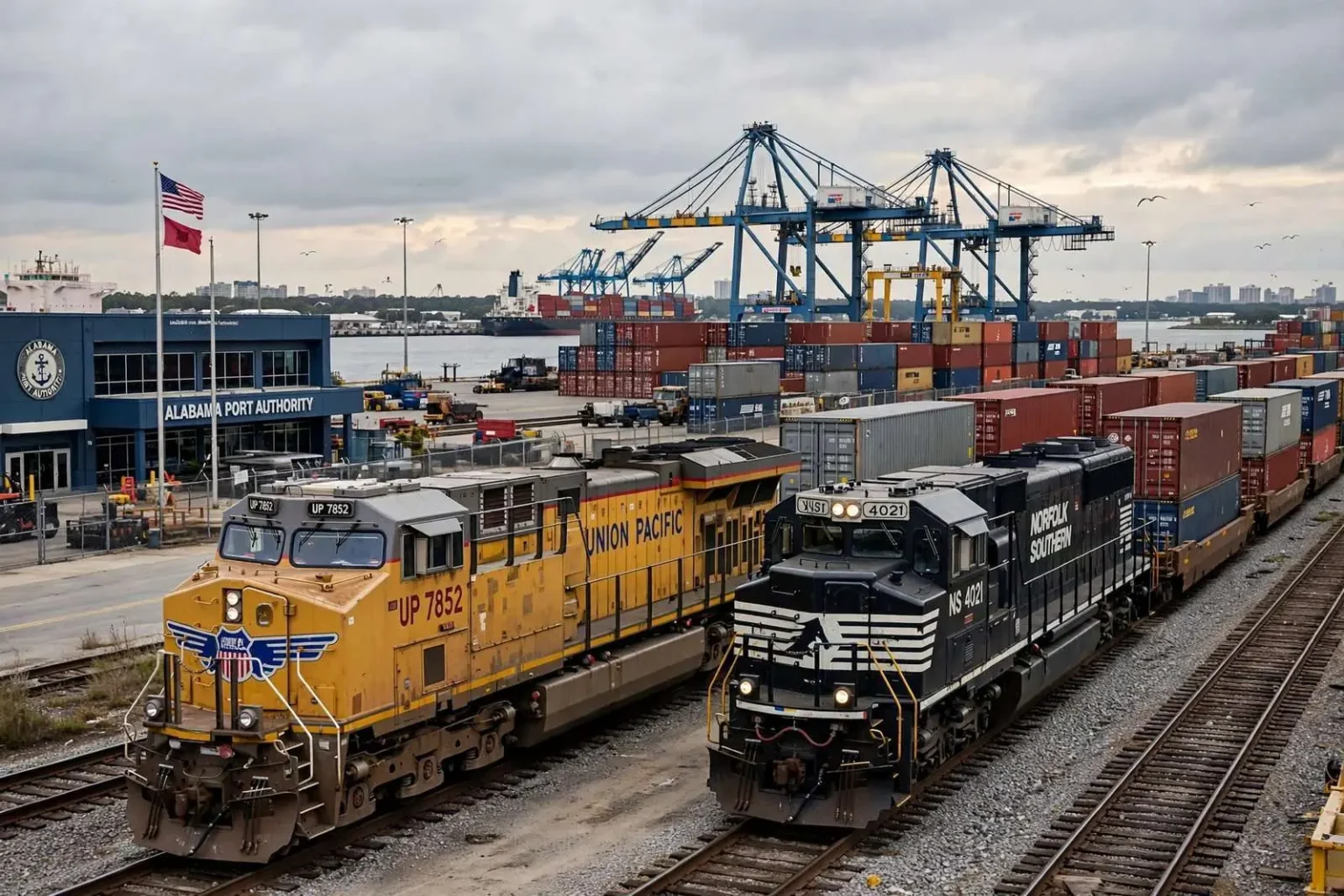
MOBILE, Ala. — The Alabama Port Authority has formally entered the federal review of a proposed $85 billion merger between Union Pacific and Norfolk Southern, filing a notice of intent to participate with the Surface Transportation Board and warning that the deal as currently structured could damage the state’s economic interests.
The filing, submitted Tuesday, Sept. 8, is a procedural step that preserves the Port Authority’s ability to participate as a party of record as the proceeding moves forward. It does not itself constitute opposition. But the accompanying statement left little doubt about the agency’s posture.
“Our customers, including some of Alabama’s largest industries, depend on rail connections to reach domestic and global markets,” said Alabama Port Authority Director and CEO Doug Otto. “As an economic development engine for the state, the Alabama Port Authority has a responsibility to advocate for the businesses we serve and the transportation network they need to grow. We have serious concerns about any railroad consolidation that would limit competition, create the potential for supply chain disruptions and expose businesses to higher transportation costs, particularly at a time when they are already operating on tight margins.”
An initial review by the agency indicates that the merger, as currently proposed, could be detrimental to Alabama’s economic interests and to many of the state’s rail-reliant industries. Over the coming weeks, the Port Authority said it will continue engaging with its railroad partners, Alabama business leaders and other stakeholders as it finalizes its comments to the board.
What Is Being Proposed
Union Pacific is seeking to acquire Norfolk Southern and combine the two railroads’ operations into what the companies describe as the nation’s first coast-to-coast freight railroad. The transaction would link Union Pacific’s western network with Norfolk Southern’s eastern network, producing a single system stretching across much of the country.
The companies value the deal at approximately $85 billion. Under the merger agreement, Norfolk Southern shareholders would receive one Union Pacific share plus $88.82 in cash for each Norfolk Southern share they own.
The Case the Railroads Are Making
Union Pacific and Norfolk Southern argue that a combined network would reduce the need for freight to be handed off between railroads, producing faster single-line service and pulling more freight off the highways.
They project the merger could add nearly 1.9 million annual rail carloads and intermodal units through traffic diverted from trucks and from other railroads.
The interchange argument is a real one. When a shipment must move from one railroad’s network to another’s, it passes through an interchange point where cars are switched between carriers. Those handoffs add time, introduce points of failure, and require coordination between companies with different operating practices and competing commercial interests. A single-line move from origin to destination eliminates that friction.
The Case Against
The proposal has drawn opposition from a notably broad coalition: competing railroads, shippers, chemical and agricultural industries, labor unions and several state attorneys general.
The core objection is about competition. American freight rail has consolidated dramatically over the past four decades. Following deregulation under the Staggers Rail Act of 1980, dozens of Class I railroads merged into a handful. A Union Pacific–Norfolk Southern combination would push that consolidation further, and critics argue it would leave some shippers with fewer transportation choices and eventually produce higher freight costs or weaker service.
The concern is most acute for what the industry calls captive shippers — facilities served by only one railroad, with no practical alternative. A chemical plant, a grain elevator or a manufacturing facility connected to a single carrier has limited leverage over rates and service quality. Reducing the number of large carriers reduces the odds that any given facility has a competitive option.
Why Alabama Has Standing Here
The Port of Mobile is not an incidental participant in this proceeding. It is one of the nation’s fastest-growing seaports, and its value to shippers depends substantially on the rail connections that move cargo between the docks and inland markets.
The Port Authority describes the Port of Mobile as supporting one in seven jobs in Alabama and generating more than $415 billion in economic impact across the state since 2019. Its business model rests on a growing network of inland multimodal transportation assets — the intermodal terminals and rail links that extend the port’s reach far beyond the coastline.
Alabama’s rail-reliant industries are the state’s heaviest: steel, chemicals, forest products, automotive manufacturing, coal and agriculture. These are precisely the commodities that move by rail because no other mode is economical at the volumes involved, and precisely the shippers whose transportation costs are set by how many carriers can bid for their business.
For a port authority, the calculation is direct. Cargo routes itself according to total delivered cost. If rail rates from the Port of Mobile to inland destinations rise relative to rates from competing Gulf and East Coast ports, cargo moves. The concern is not abstract regulatory principle; it is market share.
How the Surface Transportation Board Review Works
The Surface Transportation Board is the federal agency with authority over railroad mergers, and its process for major transactions is deliberately demanding.
The board first determines whether an application is complete enough to accept for consideration. In this case, it initially rejected an earlier version of the application as incomplete, then accepted a revised application in May while requiring more information on competition, shipper access, service assurances and potential effects on other railroads.
Formal comments and opposition filings are due Nov. 18. That date is the practical deadline for parties of record — including the Alabama Port Authority — to place substantive arguments and evidence before the board.
The standard the board applies to major mergers is whether the transaction is consistent with the public interest, an assessment that weighs competitive effects, service impacts, safety, employment consequences and the financial condition of the carriers. The board can approve a merger outright, deny it, or approve it subject to conditions — and conditions are historically the most common outcome in contested proceedings.
Those conditions can be substantial: mandated trackage rights that let a competing railroad operate over the merged carrier’s lines, required divestitures of specific routes, service performance commitments with reporting obligations, or gateway protections that preserve a shipper’s ability to route traffic via a particular interchange point.
Why Participation Matters More Than Opposition
The Port Authority’s filing is a notice of intent to participate, not a protest. That distinction is worth understanding, because it reflects how these proceedings actually work.
A party of record has procedural rights: to file evidence and argument, to see and respond to filings by other parties, and to be heard on the shape of any conditions the board might impose. An entity that does not establish itself as a party of record early can find itself watching a proceeding that will determine its economic environment without a seat at the table.
The most consequential work in a merger proceeding of this scale is frequently not the up-or-down question of approval but the negotiation over conditions. For a port authority, a well-crafted condition protecting competitive access to its terminals may matter far more than whether the merger is approved at all.
What Comes Next
The Alabama Port Authority said it will engage with railroad partners, Alabama business leaders and other stakeholders as it develops its formal comments ahead of the Nov. 18 deadline.
The Surface Transportation Board’s review of a transaction of this magnitude typically extends well beyond the comment deadline, with evidentiary phases, rebuttal filings and potentially oral argument before a decision issues.
South Alabama News will follow the proceeding and the Port Authority’s filings as they are submitted.