Port of Mobile Pushes Back as Amtrak Presses Ahead on Passenger Rail Timeline
Amtrak says it will push ahead with restoring Mobile-to-New Orleans passenger service in 2022, but Alabama Port Authority officials warn the move could disrupt freight operations serving nine railroads at the Port of Mobile.
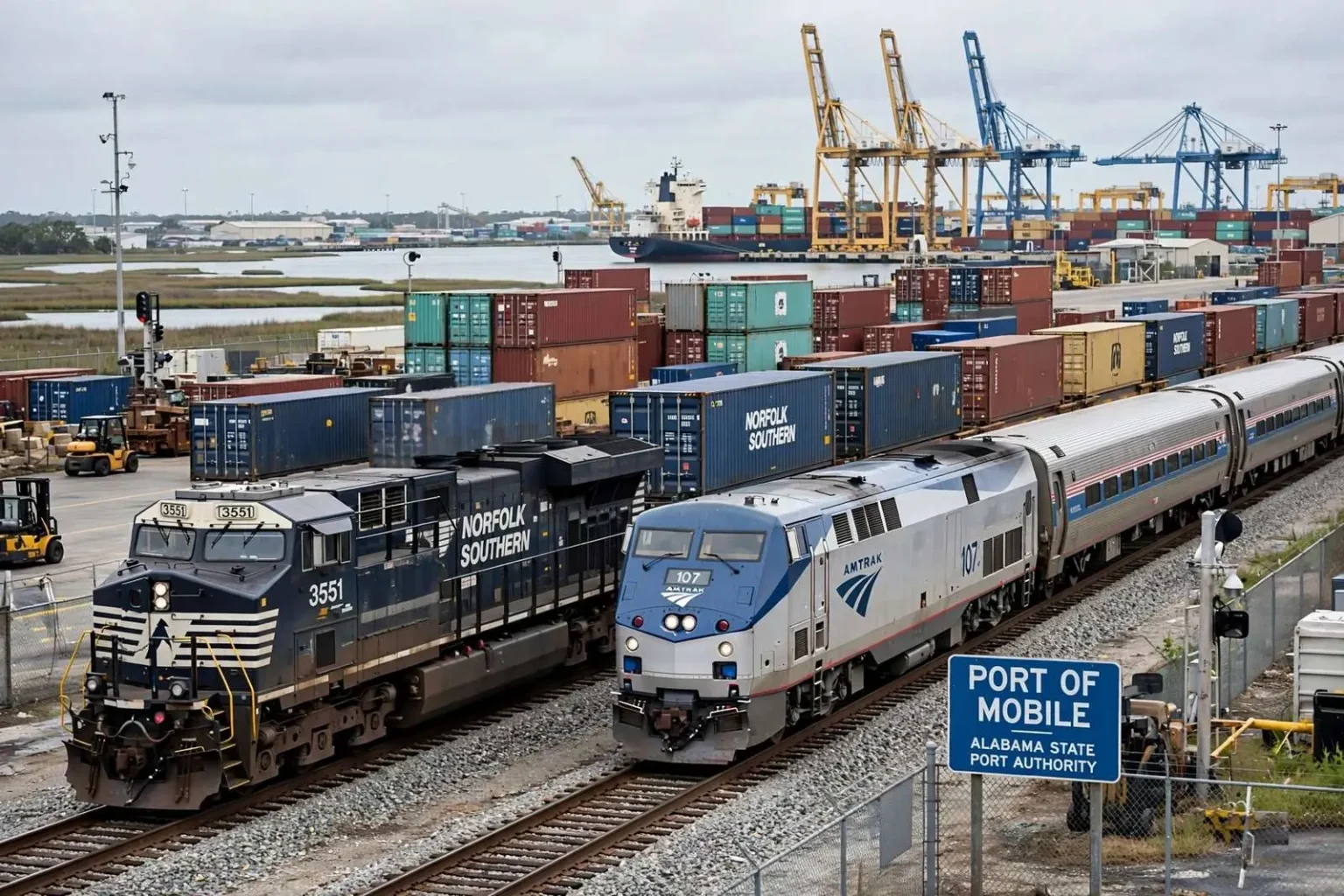
A dispute over the pace of restoring Amtrak passenger service to Mobile intensified this week, as the railroad’s plans to begin running trains next year collided with concerns from state port officials that a rushed timeline could snarl one of the region’s busiest freight corridors. The disagreement surfaced just a day after the Mobile City Council delayed a vote on funding for a study tied to the location of a new downtown train station.
Despite that delay, an Amtrak spokesman confirmed the company intends to move forward with restoring passenger service between Mobile and New Orleans in 2022, regardless of whether a long-running study on shared freight and passenger use of the tracks is ever completed. Amtrak spokesman Marc Magliari said the railroad has notified freight partners CSX and Norfolk Southern of its intention to begin service next year, arguing that the joint study process has dragged on far longer than it should have.
“We have notified the freight railroads of our intention to begin service next year,” Magliari said in a statement. “We have again asked the freight railroads where they believe there are more issues. We safely and successfully operate together elsewhere in the United States, with dependable freight service coexisting with reliable and relevant Amtrak service. That’s what the Gulf Coast deserves, too.”
According to Magliari, the study was originally supposed to take about two months to complete but had not been finished nearly a year after it began. He said the agreement governing the study has since expired. “Something that should have taken seven months was far from completion after a year,” he said. “In fact, discussions have been underway for five years. There was no sign of any conclusion in sight.”
Magliari pointed to roughly $33 million in federal grant money held by the Southern Rail Commission for track improvements, along with an earlier feasibility study, as evidence that the restored route is ready to move forward.
“The Gulf Coast needs and wants Amtrak service, particularly after the 2017 study showed where freight railroad improvements are needed and since 2019, the Southern Rail Commission has had $33 million in federal grants to pay for them,” Magliari said.
State port officials, however, are far less confident that the timeline is workable. Alabama Port Authority spokeswoman Judy Adams said port leadership met with Amtrak officials roughly two weeks ago and asked that the joint study continue, citing worries that adding passenger trains to the corridor could disrupt operations serving nine separate freight railroads that move cargo in and out of the port. “They seemed surprised that we serve nine railroads here,” Adams said. “Even at our meeting, they didn’t know trains ran on the tracks.”
Adams also disputed Amtrak’s characterization of the 2017 feasibility study, which the railroad has cited as proof the route can accommodate both types of service. “We requested in the meeting that they finish the study,” she said, adding that port officials had been told the analysis was only about two months from completion. She described the earlier study as “devoid of facts.”
Port officials say their biggest concern is congestion. Adams said that if passenger trains are given priority over freight movement, the resulting delays could ripple through the port’s operations.
Compounding the issue, she said, existing rail sidings are not long enough to accommodate the freight trains that currently move in and out of the port, a problem that predates any discussion of restoring passenger rail. The Port of Mobile has grown substantially since the last time Amtrak served the city, a trend Adams attributed in part to congestion at larger ports along the West Coast, which has pushed more shipping traffic toward the Gulf Coast and the Port of Mobile’s growing trade relationships with markets in the Far East.
While she acknowledged that other American cities manage to run substantial passenger rail service alongside major ports, she said those regions typically have multiple rail lines feeding in and out of port facilities, unlike Mobile’s more limited infrastructure. “Along the East Coast, the infrastructure is much better suited for a symbiotic relationship between passenger and freight rail,” Adams said, contrasting those systems with the single line serving Mobile’s port.
Norfolk Southern also weighed in this week, confirming that it had asked Amtrak to continue the joint study rather than abandon it. In a statement, Norfolk Southern spokesman Jeff DeGraff described the study as part of a well-established process for introducing new passenger service onto existing freight corridors.
“There is an established process for introducing new passenger rail service on freight rail lines recognized by both the freight and passenger railroad industries,” DeGraff wrote. “It involves identifying, through a data-driven study, what infrastructure is necessary to ensure that the new passenger service is transparent to freight operations and doesn’t negatively impact the freight rail customers.”
The standoff leaves Mobile officials in a difficult position, caught between a passenger rail advocate eager to relaunch service after more than a decade without it and the freight interests whose cooperation is essential to keeping one of the region’s economic engines running smoothly.
Background and What Followed
Amtrak’s Sunset Limited served Mobile and the Gulf Coast east of New Orleans until Hurricane Katrina damaged the tracks in 2005, and service was never restored. The Southern Rail Commission, a panel from Alabama, Mississippi and Louisiana, pushed for years to bring passenger trains back to the corridor.
In March 2021, a few weeks after this dispute surfaced, Amtrak asked the federal Surface Transportation Board to order CSX and Norfolk Southern to allow the service. The case ended in a settlement between Amtrak, the freight railroads and the Alabama State Port Authority. Amtrak’s Mardi Gras Service between New Orleans and Mobile started running twice daily on Aug. 18, 2025.