GoDaddy Bowl Teams Bring Holiday Cheer to Mobile Children’s Hospital Patients
Football players from the GoDaddy Bowl's Toledo and Arkansas State squads visited young patients at USA Children's and Women's Hospital in Mobile.
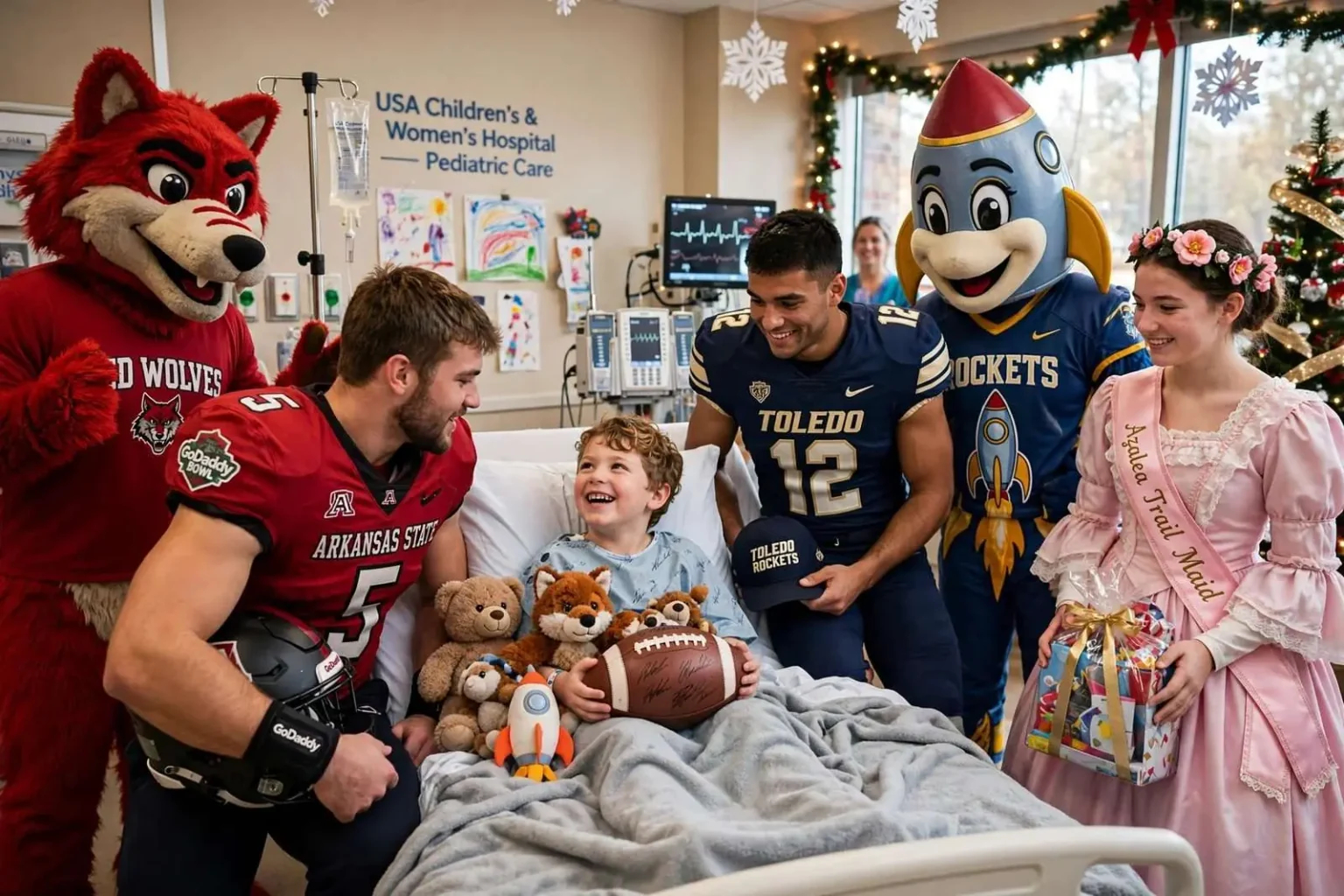
Two days before taking the field at Ladd-Peebles Stadium, players from the Toledo Rockets and Arkansas State Red Wolves traded playbooks for hospital gowns, spending a morning visiting young patients at USA Children’s and Women’s Hospital in Mobile as part of an annual tradition tied to the GoDaddy Bowl.
The visit, arranged by bowl organizers, brought dozens of players, coaches and team mascots through the hospital’s halls, along with a delegation of Azalea Trail Maids bearing gifts for children undergoing treatment. For at least one patient, a 6-year-old boy being treated at the hospital, the surprise appearance turned a quiet Friday morning into what his mother described as the highlight of his week. He spent the rest of the visit tossing a football around his room, beaming over a signed ball and a pile of stuffed animals left behind by the players.
Bowl week in Mobile has always been about more than the game itself. In the days leading up to kickoff, the visiting teams are shuttled through a schedule of banquets, practices, community service stops and downtown appearances designed to immerse them in the host city and give Mobile residents a chance to meet the players who will occupy their stadium on game night. The hospital visit is among the most anticipated stops on that schedule, and among the most demanding emotionally for the young athletes who make it.
USA Children’s and Women’s Hospital is the Gulf Coast’s referral center for pediatric care, drawing young patients from across south Alabama, the Florida Panhandle and southern Mississippi. Its wards include children facing weeks or months of treatment — long stretches of routine in which a morning interruption from a room full of college athletes, cheerleaders and mascots is a welcome break for patients and families alike.
A quiet morning interrupted
In the hospital’s Pediatric Intensive Care Unit, Arkansas State’s quarterback and several teammates stopped to visit a 10-year-old patient wrapped in a blanket. One player later said the moment hit close to home, recalling a cousin who was also battling a serious illness, and described the exchange as deeply emotional despite his nerves heading into the room.
The intensive care unit is the hardest stop on any hospital tour. Players preparing for the biggest game of their season walked past monitors and machinery that most of them had never seen outside a family crisis, then sat or knelt at bedsides to talk, sign autographs and hand over gifts. Several emerged from the rooms visibly moved, according to those on the tour, and more than one had to compose himself before moving on to the next room.
For the players, the stop demanded a kind of presence that no practice schedule requires. There is no script for meeting a seriously ill child, no way to know from the door whether a patient wants noise and laughter or a quiet visitor who will sit still for a few minutes. The players’ willingness to enter rooms they found intimidating, hospital staff noted, is what makes these visits matter — the children do not remember the playbooks, but they remember who showed up.
Connection over gifts
Older patients connected with players over shared interests rather than gifts. One 18-year-old patient spent time talking video games, football and basketball with several Red Wolves players, saying afterward that the conversation lifted his spirits during a difficult hospital stay.
Teenage patients occupy a particular place in pediatric wards — old enough to feel the weight of long hospitalizations, young enough to be starstruck by college athletes only a few years older than they are. For an 18-year-old spending days in treatment, an unscripted conversation about games and sports with players he had watched on television can restore a sense of ordinary life, however briefly. Hospital child-life specialists, who work to keep young patients engaged and emotionally supported during treatment, view visits like these as a meaningful complement to medical care rather than a decorative add-on.
Players from both teams said the hospital stop carried more weight than any pregame walkthrough. A defensive back from the Red Wolves, a Hoover native, said watching a sick child’s face light up motivated him to play harder on gameday, since the kids he met couldn’t take the field themselves.
A bowl tradition in Mobile
The teams squared off two days later in the GoDaddy Bowl at Ladd-Peebles Stadium, with Arkansas State representing the Sun Belt Conference against Mid-American Conference opponent Toledo in an 8 p.m. kickoff. The matchup paired two programs far from home with a bowl experience built around Mobile’s hospitality — an event that has become a December-to-January fixture in the city’s calendar and one of the ways Mobile promotes itself to visiting fans and television audiences alike.
Ladd-Peebles Stadium, the aging but storied venue west of downtown, has hosted Mobile’s postseason college football for decades, and bowl organizers have long leaned on community involvement to distinguish their game from the growing roster of postseason contests. The hospital visit, the Azalea Trail Maids’ participation and the involvement of local volunteers are all part of that formula: a bowl game that presents itself as a civic event first and a football game second.
The Azalea Trail Maids, the city’s iconic group of high school seniors in antebellum-style gowns who serve as Mobile’s official ambassadors, brought their own layer of local tradition to the tour. Dressed in pastel colors and carrying gifts for the children, the maids represented a formality and pageantry that contrasts sharply with the football pads and team gear down the hall — a reminder that the event drew on the whole breadth of Mobile’s civic culture, from football to Carnival-season tradition.
For the mascots who toured the wards, the visit offered a chance to be silly in the best sense — posing for photographs, staging mock games in hallways and giving children who might be too shy to talk with strangers a low-stakes way to join in. Hospital staff said the mascots’ appearances regularly produce some of the loudest laughter of the day.
What the players took away
Players from both teams said the morning changed the texture of bowl week. Practices, team meetings and Media Day obligations fill the days before a bowl, but most of those activities center on the game itself. The hospital stop forced the players to think about the community that hosts them and about people whose weeks are defined by something far more serious than a football score. Several players said they had volunteered for the visit expecting to cheer patients up, only to find their own perspective altered by the courage they saw in the rooms.
Coaches on both staffs have historically treated the tour as part of the bowl experience rather than an obligation attached to it, and the turnout of dozens of players from both rosters suggested the teams embraced it. For programs whose players spend the rest of the year in the insulated rhythm of practice, classes and games, a morning in a pediatric hospital is one of the few occasions that puts football’s place in the world into proportion.
Hospital staff said the visits have become a fixture of bowl week in Mobile, giving patients facing long stays a break from treatment routines and giving visiting teams a chance to connect with the community hosting their game. The relationship between the bowl and the hospital extends across years, with each new pair of visiting teams continuing a tradition their predecessors established — often without realizing, on the day, how much the stops mean to the families on the receiving end.
For families navigating a child’s hospitalization over the holidays, the unexpected appearance by two college football teams offered a welcome distraction, if only for a morning. Parents watching their children’s reactions — a 6-year-old hurling a football across his room, a teenager deep in conversation about video games — described the day as a gift in its own right, separate from anything that would happen under the lights at Ladd-Peebles Stadium two days later.
The visit also carries practical weight for the hospital itself. Tour days like this one generate photographs, stories and goodwill that help the hospital tell the story of its mission across the region it serves, and they introduce Mobile’s pediatric facility to visitors from Ohio and Arkansas who may never have heard of it before bowl week. In a city that markets itself on hospitality, the image of college athletes and Azalea Trail Maids walking pediatric wards is among the most authentic advertisements bowl week produces — unpaid, unscripted and remembered far longer by the families in those rooms than by the cameras that follow the teams through the doors.
But for the players who spent that Friday morning at USA Children’s and Women’s Hospital, the trip left an impression that outlasted the final score, a reminder of the reach a bowl game built around Mobile’s hospitality can have beyond the stadium.