University of South Alabama Mobile
USA Health Is Bringing a First-of-Its-Kind Medical Symposium to Downtown Mobile So MS Patients Stop Having to Travel for Answers
USA Health's Department of Neurology will host a first-of-its-kind Neuroimmunology Symposium Aug. 13-15 in downtown Mobile, bringing specialized MS and autoimmune care resources to South Alabama.
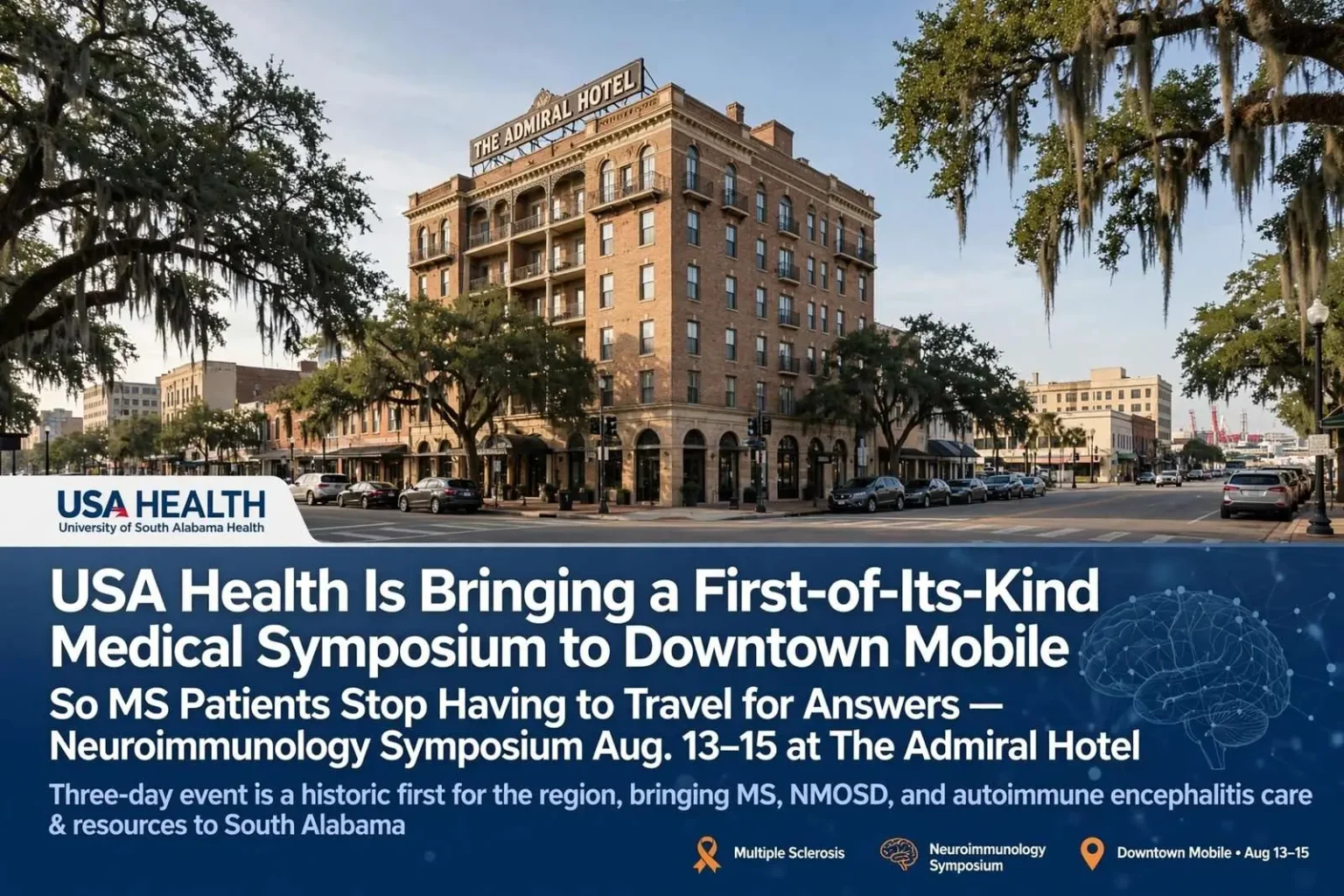
The University of South Alabama’s Department of Neurology will host a Neuroimmunology Symposium Aug. 13-15 at The Admiral Hotel in downtown Mobile, a three-day event organizers are calling a historic first for the region.
The symposium brings together medical experts to advance care for patients with multiple sclerosis, neuromyelitis optica spectrum disorder and autoimmune encephalitis — complex neurological conditions that historically required patients in South Alabama to travel to major medical centers elsewhere for specialized care and resources. Programming will include clinical updates for providers, caregiver education sessions, and connections to local and national patient resources.
Dr. William Kilgo, associate professor of neurology at the Whiddon College of Medicine and chief of the Neuroimmunology Division at USA Health, said the conditions covered by the symposium are notoriously difficult to manage. “These conditions are highly complex and manifest differently in every individual,” Kilgo said, calling the symposium “a historic first for our region” and noting that “we are living in an era of unprecedented progress” in neuroimmunology treatment options.
The program is aimed at a broad swath of the medical community treating these conditions: neurologists, primary care providers, rheumatologists, nurses, pharmacists, social workers, residents, students and allied health professionals are all invited, with core objectives including reviewing updated diagnostic criteria, evaluating FDA-approved therapies, and identifying patient assistance programs for those struggling to afford treatment.
Registration costs $150 for USA faculty and $75 for other attendees, with complimentary registration available for residents, students, and MS patients along with their families. Sessions include meals and evening receptions, with registration handled through CME Tracker. Featured speakers will include faculty from both USA and the University of Alabama at Birmingham, spanning neurologists, specialists, residents, pharmacists and support staff.
The conditions
All three conditions are autoimmune disorders in which the immune system attacks the central nervous system. In multiple sclerosis, it damages myelin, the protective coating around nerve fibers in the brain and spinal cord. Neuromyelitis optica spectrum disorder mainly targets the optic nerves and spinal cord and is often associated with antibodies against a protein called aquaporin-4. Autoimmune encephalitis occurs when the immune system attacks the brain itself, causing symptoms that can include confusion, seizures and changes in behavior.