A 71-Year-Old Bus Rider Has 1,200 Signatures Trying to Stop Mobile From Changing How She Gets to Work
A longtime Mobile bus rider has gathered 1,200 signatures opposing changes tied to the city's rollout of Second Line Transit, the rebranded system replacing Wave Transit this month.
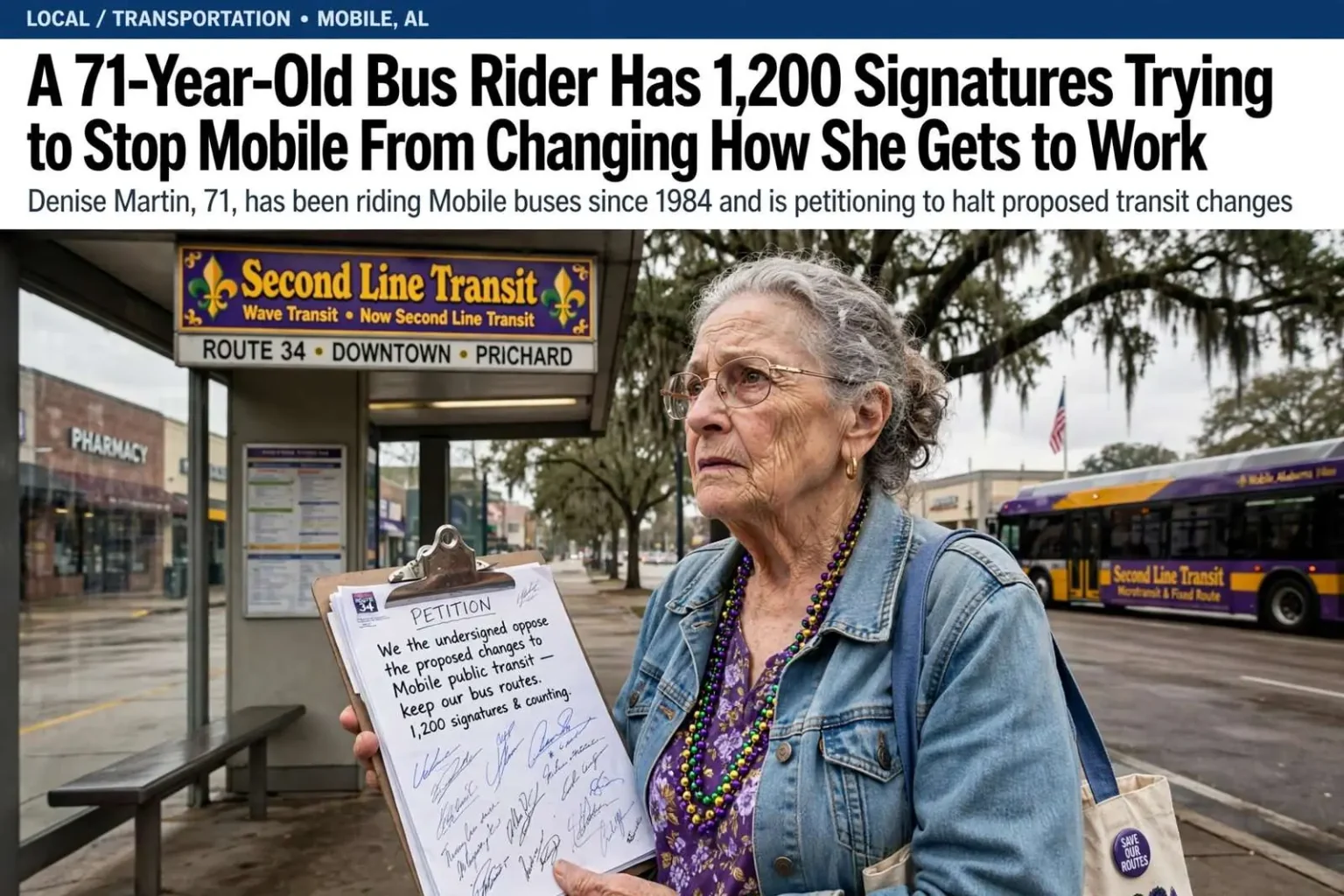
As Mobile prepares to roll out a rebranded public transit system this month, a 71-year-old rider who has depended on the city’s buses since 1984 is pushing back, warning that planned changes could radically alter how low-income and elderly Mobilians get around the city.
Denise Martin has gathered 1,200 signatures on a petition asking the city to halt changes tied to the rollout of Second Line Transit, the new brand replacing Wave Transit, which she says could come as soon as within six months. “I’ve mostly rode the bus for most of my life,” Martin said. “Now they are — the mayor and the council members — want to change and cut routes. Some people used the bus to go to work. I’m trying to stand up for us to understand the value of it.”
Second Line Transit was branded in April following a community survey conducted in March, adopting a Mardi Gras-inspired name and identity for the system. The change stems from concerns over large buses running with low ridership; the city partnered with New York-based Via Transit LLC under a $12.1 million annual contract, approved in 2025, to reimagine the transit system by replacing Wave’s larger buses with smaller vehicles and integrating trolleys, fixed routes, microtransit and paratransit service under one coordinated platform.
City officials point to operational improvements already underway under Via’s management. Dale Liesch, a spokesperson for Mayor Spiro Cheriogotis’s administration, said Via has operated Wave since October 2025 and has already addressed reliability problems: before Via took over, about 20% of Wave’s scheduled buses did not run as planned, a figure that has now dropped to “approaching zero.” Wave is now fully staffed after a hiring and training push eliminated a prior driver shortage, and software improvements have cut dispatcher trip-scheduling time by 75%, according to Liesch, who said all previous Wave bus stops will be honored under the new system.
Councilman Cory Penn said he plans to request a start-date update from the administration at an upcoming City Council preconference meeting, noting the goal is to reduce wait times for riders. Penn said the city “cannot dictate” the outcome of the new system but “can be an advocate” if it doesn’t work as intended, comparing early resistance to the change to his own mother’s initial resistance to smartphones.
How microtransit and paratransit work
Microtransit is an on-demand form of public transportation. Instead of waiting at a stop for a bus on a fixed schedule, riders book a trip by app or phone and are picked up by a smaller shared vehicle serving a defined zone, with software grouping passengers headed in similar directions. Transit systems often use it where full-size buses carry few riders, while keeping fixed routes on busier corridors.
Paratransit is a separate service required by federal law. Under the Americans with Disabilities Act, public agencies that operate fixed-route buses must also provide comparable curb-to-curb or door-to-door service for riders whose disabilities prevent them from using the regular buses, generally for trips within three-quarters of a mile of those routes and during the same service hours.