Delaware Finalist Downs 52 Oysters to Win Distinguished Young Women Contest at Wintzell’s
A Delaware finalist ate 52 oysters in five minutes to win the Distinguished Young Women oyster contest at Wintzell's in Mobile.
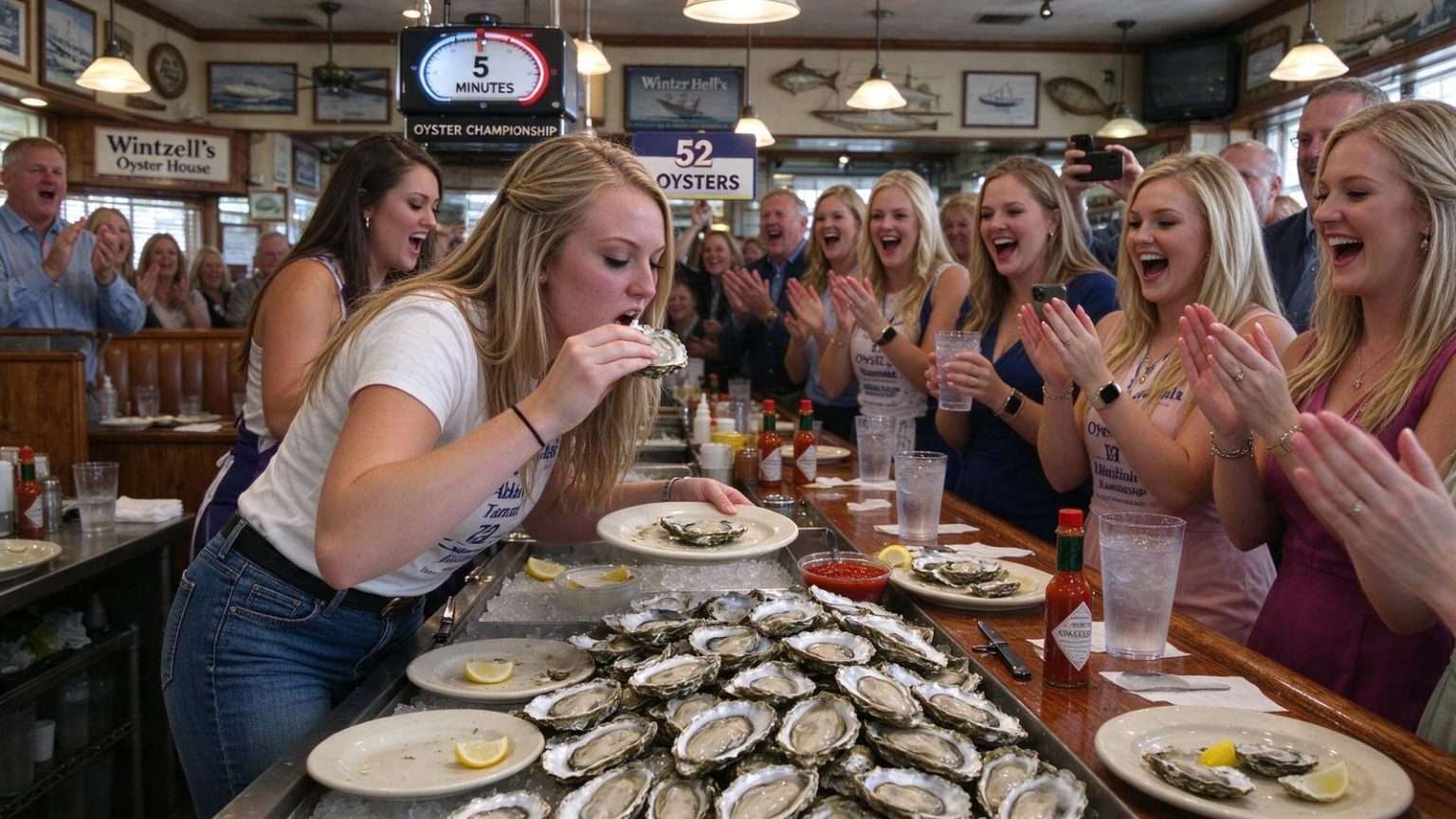
MOBILE, Alabama — Grab an oyster, toss it back, repeat. That simple rhythm carried Abby Marie Chow of Delaware to victory in this year’s Distinguished Young Women oyster eating contest at Wintzell’s Oyster House in downtown Mobile. What looks like a simple party trick is, at the national finals level, a genuine athletic contest of pace, nerve and stomach, and Chow proved herself the best in this year’s field.
Chow put away 52 oysters in five minutes, a strong showing though well short of the 80-oyster record set the previous year by a finalist from New Mexico. She said her strategy started with the biggest oysters before speed took over. Hot sauce, she said, helped her keep pace once the contest turned into a race against the clock. The approach of clearing the largest bivalves first while her hands were steady, then shifting gears into pure speed, is the kind of planning that separates champions from also-rans in timed eating events.
The contest takes place each year while the Distinguished Young Women national finals bring 50 contestants to Mobile from every state, turning the city’s streets, restaurants and theaters into a two-week celebration of the program. The competition, which began in Mobile in 1958 under its original name America’s Junior Miss, judges young women on scholastics, interview, talent, fitness and self-expression, with college scholarships on the line.
A dozen contestants take the challenge
Of the 50 young women competing in this year’s national Distinguished Young Women program, 12 volunteered for the oyster challenge on a Monday afternoon at the restaurant, drawing representatives from states including Wyoming, Washington, Florida, Vermont, New Hampshire, Texas, New Mexico, Kansas, Georgia, South Carolina and Wisconsin. Volunteering is entirely optional, which makes the lineup a self-selected band of the adventurous — young women who arrived in Mobile for a scholarship competition and found themselves standing at an oyster bar with a five-minute clock ticking.
Some contestants swallowed their oysters whole without hesitation, while others chewed slowly with visibly pained expressions, all while their fellow competitors crowded around the oyster bar cheering them on. The crowd of fellow finalists, host families and restaurant regulars added to the noise, and the cheering section around the bar grew louder with every plate that came back empty.
Wintzell’s Oyster House, a downtown landmark on Dauphin Street, has been slinging oysters to Mobilians since 1938, its walls papered with decades of folksy signs and memorabilia. The restaurant’s familiarity to generations of contestants makes it a natural stage for the program’s most lighthearted tradition.
A close second
Kristina Tubera, representing Texas, gave Chow the stiffest competition, finishing with 49 oysters. Tubera said her friends had urged her on by invoking state pride and the families hosting her during the competition, and the encouragement kept her going far longer than she expected. Three oysters separated the champion from the runner-up, and Tubera’s late surge — powered by the shouting section of fellow Texans and host family members — nearly closed the gap entirely.
Fellow contestant Josie Marie Lydick of New Hampshire said she was proud of both leaders and impressed by how enthusiastically everyone, regardless of how many oysters they managed, threw themselves into the event. Her comments captured the spirit organizers hope for: a contest where the point is participation and laughter as much as the final count.
A Mobile tradition since 1958
Wintzell’s Oyster House has sponsored the Distinguished Young Women program continuously since 1958, according to restaurant owner Buffy Donlon, who joked that the contest likely creates a few new oyster fans each year, along with a few people who may never eat one again. Few businesses anywhere in Alabama can claim a partnership with a civic program that has run unbroken for more than half a century, spanning every era of the competition’s history from America’s Junior Miss to its modern incarnation.
Wintzell’s communications director Clay Omainsky said the annual event consistently draws a crowd, with spectators arriving as early as 11 a.m. to claim seats near the oyster bar. The lunchtime rush blends with contest spectators, giving the restaurant one of its liveliest afternoons of the summer and giving contestants an audience well beyond their host families.
Longtime audience member Rosemary Williams, who hosted contestants in the program for seven years but had never previously attended the oyster contest, said she stumbled upon it by accident this year and found it thoroughly entertaining. Her husband, Mark Williams, said he loves oysters himself but admitted he could never manage the pace Chow set on her way to the title.
Host families like the Williamses are the backbone of the national finals experience. Each year, dozens of Mobile-area households open their homes to contestants for the two weeks of competition, shuttling them to rehearsals and events and, in the process, forming friendships that often last long after the finals end. The oyster contest gives those families a chance to cheer their contestants on in a setting far more relaxed than the stages of the Mobile Civic Center.
Why the contest matters to the city
The oyster eating championship occupies a unique place in the Distinguished Young Women calendar precisely because it is unabashed fun between the high-stakes portions of the program. Contestants spend most of their Mobile visit in rehearsal and competition, and the contest offers a Monday afternoon where the pressure lifts and the city gets to see the finalists simply enjoying themselves.
It is also good business for downtown. The national finals fill hotels and restaurants during what would otherwise be a quiet stretch of late summer, and traditions like the oyster contest give visitors a specific reason to return with their families in future years. Local organizers describe the program as one of Mobile’s signature summer events, alongside Mardi Gras and the Senior Bowl, that puts the city on a national stage annually.
Chow’s 52-oyster title now goes into the record alongside the 80-oyster mark that still stands from the previous year, a number this year’s field could not approach. Whether next year’s crop of finalists can mount a run at the record is unknown, but based on the volume of cheering, hot sauce and half-shell heroics witnessed Monday at Wintzell’s, no one doubts that a dozen new volunteers will step up to the bar and find out.
The championship also crowned a contest veteran of sorts in the making. Contestants say word of the oyster challenge travels fast among state programs, and by the time the national finals arrive each summer, many finalists already know whether they plan to step up to the bar. Chow’s combination of strategy and stomach placed her in rare company, and her biggest-first, hot-sauce-assisted method is likely to be studied — or at least joked about — by next year’s Delaware representative.
Oysters and Mobile identity
The choice of oysters as the contest’s centerpiece is no accident in a city that has eaten them for generations. Mobile sits at the edge of one of the country’s great oyster regions, with Gulf harvests feeding restaurants from Dauphin Street to the Eastern Shore, and the bivalve shows up in everything from summer gumbo to half-shell platters at Mardi Gras balls. Wintzell’s motto about oysters has greeted diners since before World War II, and the restaurant remains one of the most photographed storefronts downtown.
The connection between the restaurant and the scholarship program has deepened over the decades. Sponsorship from 1958 onward means Wintzell’s has supported contestants in every era of the program’s history, through name changes, television broadcasts and the growth of the national finals into the summer staple it is today. Owners say the partnership is as much about community as commerce, a way for a family business to stay woven into a civic tradition.
Program officials use events like the oyster contest to remind Mobilians what the finals week is actually for: scholarship money. Distinguished Young Women and its predecessors have distributed millions of dollars in educational support to young women across six decades, with contestants leaving Mobile each year carrying cash awards and college-funded scholarships earned through weeks of preparation in their home states.
For the twelve who competed Monday, the contest will likely be one of the memories they carry home from Mobile, alongside the rehearsals, the host family dinners and the final night of competition. Tubera’s 49 oysters and Lydick’s sportsmanship made the afternoon a group achievement as much as an individual one, and the cheering that echoed around the oyster bar was for every contestant who picked up a shell — not just the two at the top of the count.
As for Chow, she leaves Mobile with a national title of an entirely unofficial kind, a story she will tell for years, and, perhaps, a lasting taste for Gulf oysters. Her 52 shells stand as this year’s benchmark at a restaurant that has been benchmarking oyster appetites since 1938, and if history is a guide, somewhere next summer a new group of fifty finalists will arrive in town, hear about the record, and decide that this, too, is a challenge worth accepting.