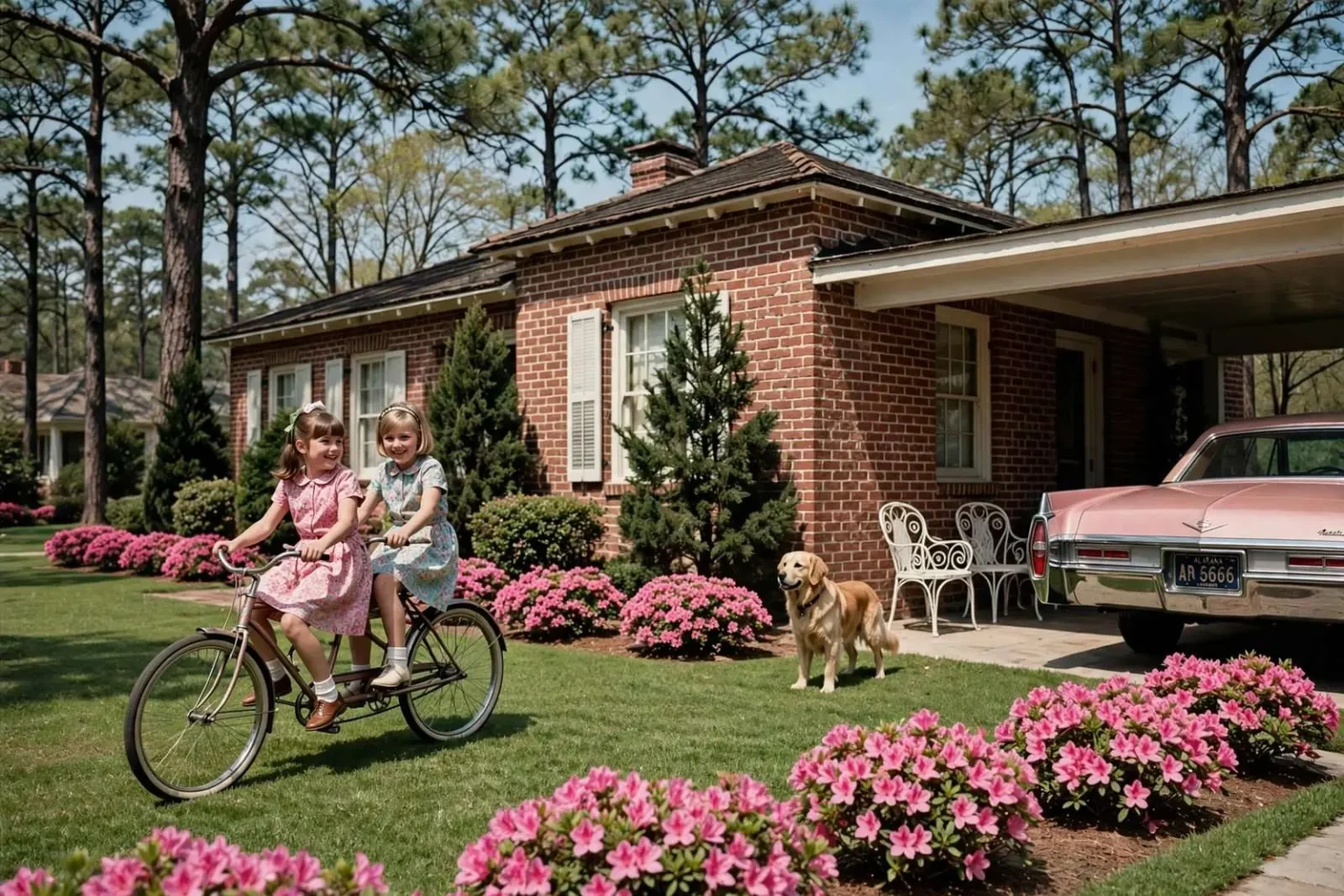
Southern Living magazine is turning to the public for help tracking down a piece of its own history, and the trail leads straight to Mobile. The Birmingham-based publication is searching for the owners, past or present, of a brick home with a sprawling, manicured lawn that appeared on its debut cover in February 1966.
The magazine shared an image of that first cover on social media, reigniting interest in the property nearly five decades later. Back then, the publication was still finding its identity as an offshoot of The Progressive Farmer and sold for just 25 cents an issue. Southern Living has since grown into one of the most recognized lifestyle magazines in the region, but its very first cover image has apparently gone unidentified for years.
The photo shows a lush, green front yard bordered by tall pine trees and rows of azaleas in full bloom, a scene instantly familiar to anyone who has spent a spring in coastal Alabama. Two young girls pose on a bicycle built for two while a dog stands watch near a pair of white wrought-iron chairs. The rear end of a vintage Cadillac peeks out from what appears to be a one-car carport or garage along the side of the home.
Since the image resurfaced, longtime Mobile residents and magazine fans have floated several guesses about where the home might be located. Names that have come up include the Spring Hill area near the Country Club of Mobile, the Skyline neighborhood near Government Boulevard and Azalea Road, and the Delwood subdivision near Airport Boulevard and Florida Street. All three are established, tree-lined Mobile neighborhoods known for exactly the kind of landscaping featured in the photo.
The cover itself is something of a time capsule for the era, touting a feature on the 1,000-Mile Azalea Trail, a regional promotional route that once wound through Mobile and other Gulf Coast communities famous for their spring blooms. Other cover teasers point to stories on Southern furniture makers, lawn fertilizer tips, and a recipe feature on chicken, party style, giving a glimpse of the magazine’s early focus on Southern home life and hospitality.
Southern Living has asked anyone with information about the home’s location or its original owners to reach out directly to the magazine. For longtime Mobile residents, the search offers a chance to help solve a small mystery tied to the city’s landscaping history and, potentially, to see a piece of local architecture recognized on a national stage nearly 60 years after it first appeared in print.
Mobile is the county seat of Mobile County in southwest Alabama and the state’s only saltwater port. Situated where the Mobile River meets Mobile Bay near the northern Gulf of Mexico, the city has long served as a commercial and cultural gateway between Alabama and the wider Gulf Coast. Founded in 1702 as Fort Louis de la Louisiane and ruled in turn by France, Britain, and Spain before joining the United States in 1813, Mobile carries a layered heritage distinct from the rest of the state.
Today Mobile anchors a metropolitan area spanning Mobile County and neighboring Baldwin County, and it remains a center for shipping, aerospace, healthcare, and higher education in the region. Its downtown and waterfront have seen sustained revitalization, while historic neighborhoods preserve architecture from its colonial and antebellum past. The city’s identity is shaped as much by its working port and industrial base as by its festivals and food culture, making it a frequent focal point for news about growth and change in southern Alabama.
The Gulf of Mexico borders Alabama’s southern edge and defines much of the state’s coastal identity. Alabama’s Gulf coastline, centered on Dauphin Island, Gulf Shores, and Orange Beach, supports a tourism industry built around beaches, charter fishing, and marine recreation, while offshore waters host shipping lanes and energy interests.
The Gulf’s warm, shallow shelf and exposure to hurricanes make weather and disaster preparedness recurring concerns for communities from Mobile to Baldwin County. The marine environment also underpins commercial seafood harvests that have sustained Gulf Coast families for generations, tying the region’s economy and culture closely to the water.
Alabama is a state in the southeastern United States bordered by Tennessee, Georgia, Florida, the Gulf of Mexico, and Mississippi. Often called the Heart of Dixie, it spans Appalachian foothills in the north and flat coastal plains in the south. Its largest cities include Birmingham, Montgomery, Huntsville, and Mobile.
Alabama’s history encompasses Indigenous roots, Spanish and French colonial settlement, a cotton-plantation economy, the Civil War and Reconstruction, and the Civil Rights Movement of the 1950s and 1960s, followed by a shift toward manufacturing, aerospace, and technology. Local news across the state frequently reflects this mix of tradition and change.
The natural environment is central to life on the Gulf Coast, where barrier islands, bays, rivers, and wetlands support fisheries, recreation, and storm protection. Coastal Alabama faces challenges common to low-lying regions, including hurricane exposure, erosion, and the management of fragile ecosystems.
The Mobile-Tensaw Delta, one of the largest river deltas in the country, is a particularly significant natural asset. Conservation efforts, fisheries regulation, and shoreline restoration are frequent points of collaboration among state agencies, federal bodies like the Army Corps of Engineers, and environmental groups.
How the region plans for growth while protecting its natural assets is a recurring theme in local reporting. The tension between development pressure and ecological stewardship plays out in zoning fights, infrastructure projects, and disaster-recovery decisions that shape the coast for generations.
The economy of the Mobile region is diversified across shipping and logistics, aerospace and shipbuilding, healthcare, tourism, and manufacturing. The Port of Mobile is one of the nation’s busiest seaports and a cornerstone of the local and state economy.
Major employers in aviation and defense contribute to a skilled workforce, while economic-development organizations aim to attract investment and jobs through incentives and infrastructure improvements. Small businesses, from restaurants to professional services, form the backbone of neighborhood commerce.
The health of the regional economy is a frequent subject of public discussion and reporting. Workforce development, recruitment of industry, and the fortunes of local retailers all feed into a broader picture of how the Gulf Coast competes and adapts in a changing national economy.
The history of South Alabama is shaped by its position at the crossroads of cultures and waters. Indigenous peoples, including the Muscogee (Creek) and Choctaw, lived in the region for centuries before European colonization by French, British, and Spanish powers.
The cotton economy and the Civil War left deep imprints, as did the Civil Rights Movement, in which Alabama played a defining role. Understanding present-day debates in the region often requires appreciating this layered past, in which port commerce, racial history, and coastal geography have long intertwined.
That inheritance is visible in the architecture, street names, and institutions of the area. Public memory of the past informs contemporary conversations about growth, equity, and identity, and it frequently surfaces in coverage of local events and policy.
Healthcare in the Mobile area is anchored by several hospital systems and provider networks that serve patients across southwest Alabama, the Gulf Coast, and into parts of Mississippi and Florida. Large employers in the sector include regional health systems operating hospitals, clinics, and specialty centers, alongside university-affiliated providers.
Access to care, the financial health of nonprofit hospitals, and the integration of behavioral and physical health are ongoing priorities. As in many parts of the country, local healthcare institutions navigate workforce shortages, changing reimbursement models, and the particular demands of serving both dense urban neighborhoods and far-flung rural communities.
The ties between healthcare and the local economy are strong. Hospitals are among the region’s largest employers, and decisions about service lines, expansion, or closure reverberate through surrounding neighborhoods, making health-system news a staple of regional journalism.
Local government in the Mobile area operates through a combination of mayor-council or commission structures at the municipal level and a county commission in Mobile County, with elected officials handling budgets, public safety, infrastructure, and zoning. Baldwin County has its own commission and a collection of incorporated municipalities.
Decisions made in council chambers and commission meetings affect roads, school funding, economic development, and quality of life, which is why coverage of local government is a staple of regional journalism. The interplay between city, county, and state authorities often determines how effectively the area can address shared challenges.
Because many services residents rely on are delivered at the local level, the choices of elected officials have direct, everyday consequences. Budget priorities, in particular, reveal a community’s values and shape the trajectory of growth and public welfare for years to come.
Local journalism serves as the connective tissue of communities like those across South Alabama, informing residents about government, schools, public safety, and the events that shape daily life. Outlets covering Mobile and Baldwin County help hold institutions accountable and give voice to neighborhood concerns larger media may overlook.
In an era of shifting advertising revenue and the rise of digital platforms, community news organizations have had to adapt how they gather and deliver information. The persistence of regional reporting remains important for civic engagement, particularly on issues such as coastal development, education, and local governance that directly affect residents.