Mobile Police Seek Woman Who Stole Cash From Elderly Man’s Dropped Wallet
Mobile police are asking for help identifying a woman caught on camera stealing cash from a wallet an elderly man dropped in a parking lot.
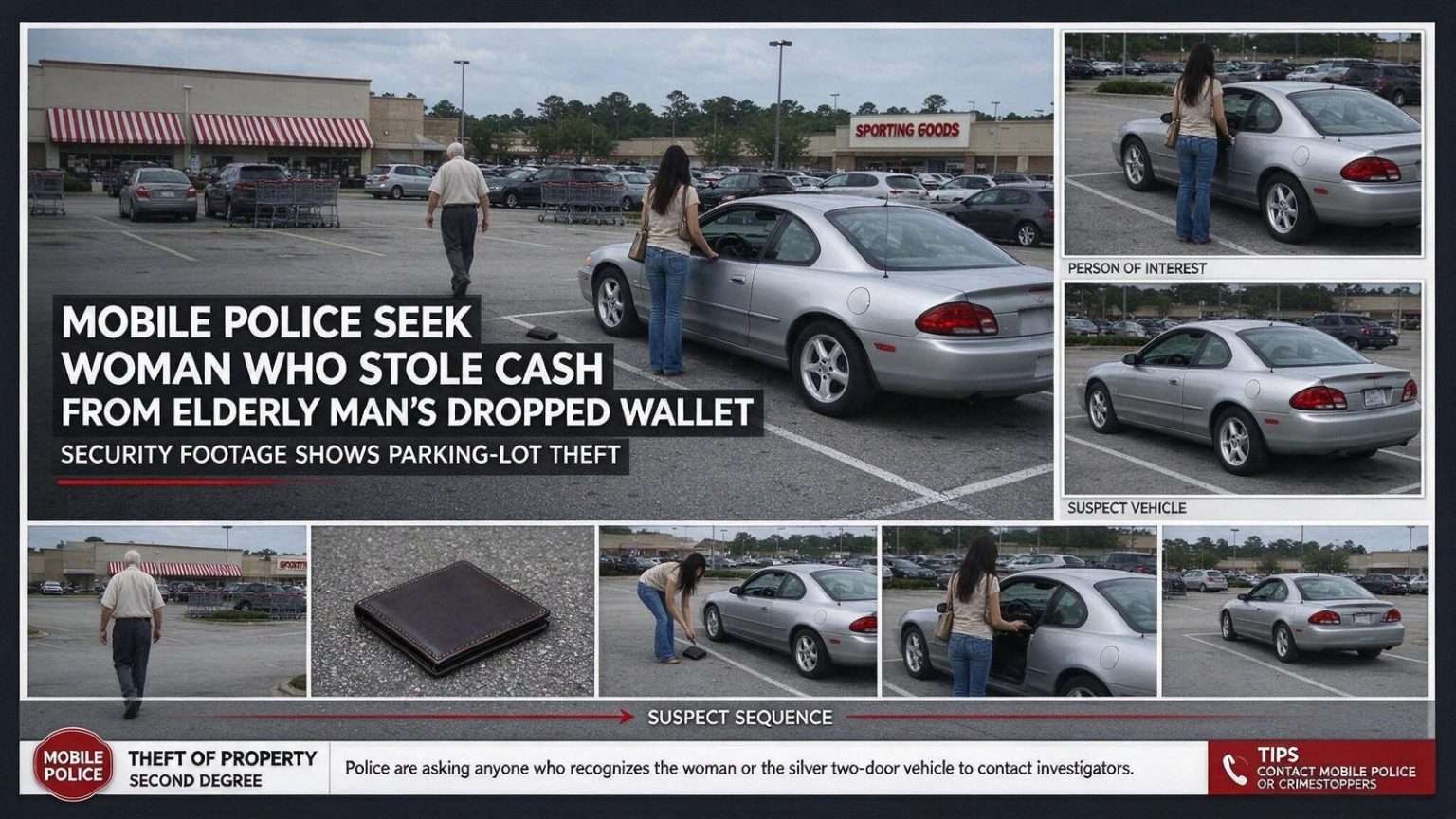
Mobile police are asking the public for help identifying a woman caught on security footage stealing hundreds of dollars from a wallet an elderly man accidentally dropped in a busy parking lot. The case, documented in crisp surveillance images, has circulated widely as investigators work to put a name to the suspect. It is the kind of offense that unfolds in seconds but can leave a victim, in this case an older resident, dealing with the loss of a significant sum of money and the unsettling knowledge that a stranger walked off with it.
According to police, the victim told officers he lost his wallet in the parking lot of a sporting goods store on Airport Boulevard around 4:20 p.m. on a Tuesday afternoon in mid-July. The wallet reportedly contained what a police spokesperson described only as a large sum of cash. The mid-afternoon timing placed the drop in one of the busiest stretches of the retail day, when parking lots along the corridor fill with shoppers and the comings and goings of dozens of vehicles make it easy for one more car to pass unnoticed.
Security camera footage reviewed by investigators showed a two-door silver car pulling into the parking space where the man had just dropped his wallet. A woman got out of the vehicle, picked up the wallet, removed the cash inside, and then placed the emptied wallet back on the ground before driving off, according to police. The sequence, captured start to finish on camera, is unusual in its clarity — and unusual, too, in the suspect’s decision to return the emptied wallet to the ground rather than take it, a detail that suggests the cash alone was the target.
Investigators released images from the surveillance footage showing both the suspect and the silver vehicle associated with her in hopes that someone in the community would recognize either the woman or the car. Photographs of the vehicle, including its body style and color, are often the more valuable of the two identifiers, since distinctive cars are far more likely to be spotted and remembered by neighbors, coworkers or family members than a stranger’s face is to be placed from a single still image.
The Corridor Where It Happened
Airport Boulevard serves as one of west Mobile’s principal commercial spines, a multi-lane artery lined for miles with shopping centers, restaurants, hotels and standalone retailers. Parking lots along the corridor belong to a different world from the stores they serve: vast expanses of asphalt where hundreds of cars move through daily and where the sight of a wallet on the ground registers with strangers as either an obligation or an opportunity. Retailers along the boulevard have invested heavily in camera systems over the past decade, which is precisely why so many offenses in the area end up on video.
For older residents especially, losing a wallet in a busy lot carries consequences beyond the cash. Beyond the replacement of a driver’s license and cards, the loss of a substantial sum can upend a monthly budget in a way that is far harder to absorb for someone on a fixed income than for a younger wage earner. Consumer-protection advocates who work with seniors routinely list lost and stolen cash among the most damaging everyday financial setbacks precisely because it is rarely recoverable and often unreported.
The Charge She Faces
Police said the suspect is wanted on a charge of second-degree theft of property, which under Alabama law applies to cases involving between $500 and $2,500 in stolen goods or cash. The threshold matters in how the case will move through the system: theft below the $500 line is a misdemeanor, while the second-degree felony range carries potentially significant prison time for a conviction, and the classification of the charge is determined largely by the value of what was taken.
That grading scheme continues up the ladder. Theft of property valued above $2,500 rises to first-degree theft, a felony with even stiffer penalties, and special categories — firearms, motor vehicles and controlled substances among them — are treated as first-degree offenses regardless of value. Where a parking-lot cash theft lands depends entirely on the count of bills involved, which is why police in cases like this one often describe the amount only in general terms while the charge is being finalized.
Alabama law also treats the keeping of lost property as a potential crime in its own right. A person who finds property that is evidently another’s and fails to take reasonable steps to return it can be exposed to theft charges for converting it to their own use. The woman in the footage, by contrast, is alleged to have affirmatively taken cash from the dropped wallet — conduct that investigators classified as a straightforward taking rather than a passive failure to return.
The distinction between theft and stronger charges shapes what prosecutors can prove. Taking an item from the ground in a parking lot rather than from a person’s hands keeps the offense in the category of theft of lost or mislaid property rather than a stronger charge such as robbery, which requires force or the threat of force against a victim. The legal distinction does nothing to soften the impact on the man who lost the money, but it defines the ceiling of what a conviction could bring.
Anyone with information about the woman’s identity was asked to contact the Mobile Police Department directly. In cases like this, investigators typically follow a familiar playbook: run the vehicle description against registrations and prior calls for service, canvass businesses in the area for additional camera angles, and wait for the released images to make their way through social media shares until someone recognizes the suspect. Tips from the public remain the single most common way such identifications are made.
How These Cases Get Solved
Cases like this one, in which surveillance footage captures clear images of a suspect but investigators still need the public’s help to make an identification, are a regular reminder of how much local law enforcement relies on tips from residents to close out property crime cases. The spread of security cameras across retail parking lots, storefronts and doorbell systems in recent years has transformed the evidence available to detectives, but a video file cannot testify; a human being still has to say, “I know who that is.”
Mobile Police Department investigators work a city of nearly 190,000 residents spread across dozens of neighborhoods and commercial corridors, and property crimes of every description generate a daily volume of reports that far exceeds what any detective unit can pursue with fieldwork alone. That arithmetic makes the department’s public appeals more than a formality — they are a functioning part of the investigative process, and historically the department has credited citizen tips with clearing cases that had sat idle.
Regional CrimeStoppers programs offer another channel for such tips, allowing people to pass along information anonymously and, in some cases, to qualify for cash rewards when a tip leads to an arrest. The anonymity matters: many of the most useful tips in surveillance-driven cases come from people who recognize a relative, an acquaintance or a neighbor’s car and would hesitate to get involved openly. Detectives then match the tip against the footage before moving to formally identify and locate the suspect.
The mechanics of an identification often move faster than people expect once the images are out. A single share from a well-followed local social media account can put the photographs in front of tens of thousands of residents within hours, and investigators have repeatedly seen cases break within days of a public appeal. The silver two-door in this case may prove to be the decisive detail — vehicles are seen by more people, in more places, than faces ever are.
A Pattern Along the Retail Corridors
The theft adds to a string of similar parking lot opportunistic crimes reported around the city’s retail corridors, where lost items, brief moments of inattention and a fast getaway can be enough for a would-be thief to strike before store employees or bystanders even notice anything happened. The pattern is not unique to Mobile — police departments everywhere note that parking lots produce a disproportionate share of theft-of-property reports — but the region’s spread-out, car-dependent retail geography gives offenders both the cover and the escape routes they look for.
Police routinely urge residents to stay aware of their surroundings in parking areas, keep wallets and purses secured rather than loose in pockets or shopping carts, and to double-check for dropped belongings before leaving a space — simple habits that remove most of these opportunities before they arise. Carrying large amounts of cash is the other standing piece of advice, though officers acknowledge that many residents, particularly older ones, continue to prefer cash for everyday spending.
For now, the investigation rests on the same foundation as so many before it: clear images, a distinctive car and an appeal to the community. Anyone who recognizes the woman or the silver two-door vehicle was asked to come forward, and investigators have emphasized that even partial information — a name, an address where the car is kept, a sighting — can be enough to move the case forward.