A Mobile man accused of fatally shooting his girlfriend has been released on bail while he awaits further court proceedings, in a case his family describes as a tragic accident rather than a deliberate act of violence.
Raphiel Pier Quinnie faces a manslaughter charge in connection with the death of 19-year-old Selena Edwards, who died from a single gunshot wound near Michigan Avenue in mid-July.
According to Quinnie’s mother, the couple, who share an infant child together, were handling a firearm together while on a trampoline at the time of the shooting. Jackie Quinnie described the incident as a misunderstanding rather than an intentional act, saying she believes her son did not realize a round remained in the gun’s chamber when it discharged.
She characterized the relationship between her son and Edwards as a loving one and said he has been devastated in the aftermath of her death. The account from the family — that two young parents were playing with a gun they believed to be unloaded — matches the pattern investigators and prosecutors across Mobile County see repeatedly: no intended victim, no argument, just a moment of carelessness around a weapon that was treated as safe when it was not.
The Court’s Early Decisions
A Mobile County district judge set Quinnie’s bail at $18,000 a few days after the shooting, allowing him to be released from custody while the case moves forward. Bail at that level, in a case where no one alleges the shooting was intentional, reflects the court’s balancing of two principles: the gravity of a young woman’s death, and the reality that the accused faces charges that do not assert a purposeful killing.
Beyond the manslaughter count, Quinnie also faces a second-degree charge of receiving stolen property, with prosecutors alleging that the firearm involved in the shooting had been reported stolen. The stolen-firearm allegation adds a second thread to the case, and it is a common companion charge in Alabama shootings — weapons move through informal markets, change hands without background checks and surface in court only after they are fired.
Earlier accounts of the incident had placed the shooting near a home on Cloverleaf Circle South, differing slightly from later reporting that identified the location closer to Michigan Avenue. Such discrepancies are typical in the hours after a fatal shooting, when initial radio traffic and witness accounts pin down a scene loosely before investigators fix the exact location.
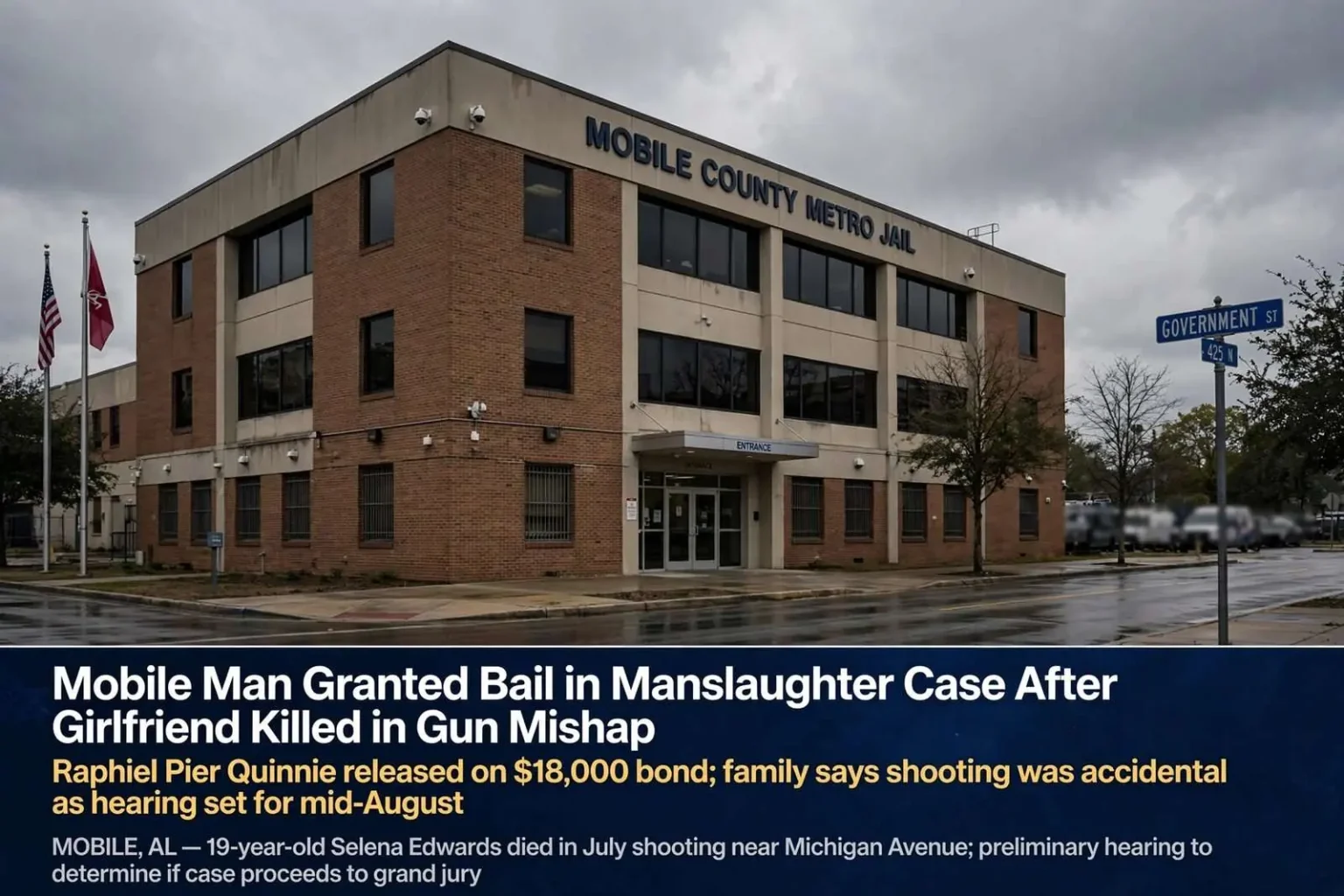
Quinnie was booked into the Mobile County Metro Jail in the early morning hours following the shooting. The booking process — photographs, fingerprinting and intake into the county’s main jail facility — is the first formal step in what will be a months-long legal process for a man who, until the shooting, had no stated history before the court in a violent case.
What Comes Next in the Case
A preliminary hearing in the case has been scheduled for mid-August, when a judge will consider whether there is sufficient evidence for the case to proceed toward a grand jury or further prosecution. The hearing is the first true test of the state’s evidence: prosecutors must show enough to establish that a crime occurred and that the defendant is probably connected to it, while defense attorneys use the same session to probe the weaknesses in the account before the case reaches a grand jury.
Until then, Quinnie remains free on the bond set by the court.
Alabama law treats unintentional killings on a spectrum, and where a case lands on it shapes everything that follows. Manslaughter, the charge Quinnie faces, generally covers deaths caused recklessly — conduct a person knows or should know creates a substantial risk. Criminally negligent homicide, a lesser charge, involves a gross deviation from reasonable care without that conscious awareness. Prosecutors and defense attorneys often spend considerable time during preliminary proceedings establishing whether a shooting meets the legal threshold for manslaughter, criminally negligent homicide, or a lesser charge, and the distinction can turn on what the shooter knew about the weapon’s condition.
A Recurring Pattern in County Courts
Cases involving unsecured or improperly handled firearms around children and partners are unfortunately not uncommon in Mobile County court dockets. Courtrooms along Government Street see a steady flow of them: weapons assumed to be unloaded, displayed to a friend, cleared carelessly, or left within reach of children, with a moment’s negligence ending a life. Safety instructors and law enforcement officers repeat the same rule in response — treat every firearm as loaded at all times — because the alternative assumption is precisely what turns ordinary evenings into criminal cases.
The presence of a young child in the household, as in this case, adds a layer that courts weigh carefully. Judges handling bail in such cases often attach conditions — no contact orders, firearm restrictions, supervision requirements — meant to address the safety concerns that remain while the accused awaits trial. The terms of Quinnie’s release, beyond the bond amount itself, will govern his conduct in the months before the case is resolved.
For the families on both sides, the proceedings carry a double weight. Edwards’s family mourns a 19-year-old mother whose death no court outcome can undo; the Quinnie family maintains that the shooting was an accident even as their son faces a felony that could send him to prison for years if convicted. Cases in which the victim and the accused shared a child leave a family fractured on both sides of the courtroom gallery, with the infant at the center of two grieving households.
The preliminary hearing set for mid-August will be the first public accounting of the evidence — witness statements, the weapon itself, and whatever the investigation established about how the gun came to be loaded. Preliminary hearings in Mobile County’s district courts are typically brief, but they often determine the trajectory of a case: defendants can be held to answer to a grand jury, charges can be negotiated before that step, or the state’s case can falter on its first showing.
The outcome of Quinnie’s hearing next month is expected to shed further light on how authorities view the circumstances surrounding Edwards’ death.
Guns, Storage and the Law
The case arrives amid continuing public discussion in Alabama about firearm storage and child access. Alabama’s legislature has debated measures in recent years requiring the safe storage of weapons around minors, and law enforcement agencies across the state run recurring campaigns urging owners to secure guns in homes with children. Whatever the eventual outcome in court, the circumstances described in this case — a loaded weapon handled as a toy on a family trampoline — are the scenario those campaigns are built to prevent.
Mobile County’s court system processes these cases through a well-established pipeline. After a fatal shooting, detectives from the Mobile Police Department’s investigations section assemble the file — scene evidence, autopsy findings from the Alabama Department of Forensic Sciences and witness interviews — and present it to the district attorney’s office, which decides the charging thresholds. District judges handle the early stages, from bond-setting sessions held within days of an arrest to the preliminary hearings that follow within a few weeks. From there, felony cases move to a grand jury and, on indictment, to circuit court for trial.
Bond decisions in such cases reflect that pipeline. An $18,000 bond with standard conditions is on the lower end for a fatal shooting, which signals how the court viewed the charges as filed — a recklessness case, not an intentional killing — and leaves the defendant working and parenting while the case advances, under the watch of the court.
For now, the case sits in the gap between arrest and hearing, the period when little happens publicly and much happens privately: defense counsel reviewing the file, prosecutors confirming the investigation, and two families waiting on the legal system’s slow machinery. The mid-August hearing will move the case into its next phase, whichever direction the evidence points.
The circumstances — a young couple, an infant, a trampoline and a gun believed empty — have made the case a talking point among local parents and firearms instructors, who point to it as the kind of tragedy that a trigger lock, a safe or a ten-second chamber check would have prevented. Edwards’s death, in that telling, is the cost of the assumption that a gun is unloaded — the single most dangerous assumption in firearms handling, and one that Mobile County’s courtrooms see proven fatal year after year.
The infant at the center of the case will grow up on both sides of it — the child of a victim buried and a defendant awaiting trial — a circumstance that family members on both sides say shapes every decision ahead. Under Alabama law, relatives in such cases can end up navigating custody questions, family court proceedings and criminal ones in parallel, and the resolution of the criminal case will not answer the questions the families face about the child’s care.
Local defense attorneys not connected to the case note that manslaughter prosecutions arising from accidental shootings carry difficult questions of proof on both sides. The state must establish recklessness beyond a reasonable doubt eventually, but first at the preliminary stage it needs only probable cause; the defense, meanwhile, typically argues that a moment of negligence in handling a weapon believed safe falls below even that threshold, or that the evidence about who handled the gun and when remains unsettled.
The mid-August hearing will offer the first public look at how investigators answered those questions — who was holding the firearm, where it came from, and how a round came to be in the chamber of a gun the family says was believed to be empty.