University of South Alabama Mobile
Mobile Man Held in Drug Case Charged With Murder in Next Street Shooting
Nearly a month after a man was found shot on Next Street, Mobile police charged Joshua Jamar Lamont Kennedy, already jailed on drug counts, with murder in the death of 23-year-old George Williams.
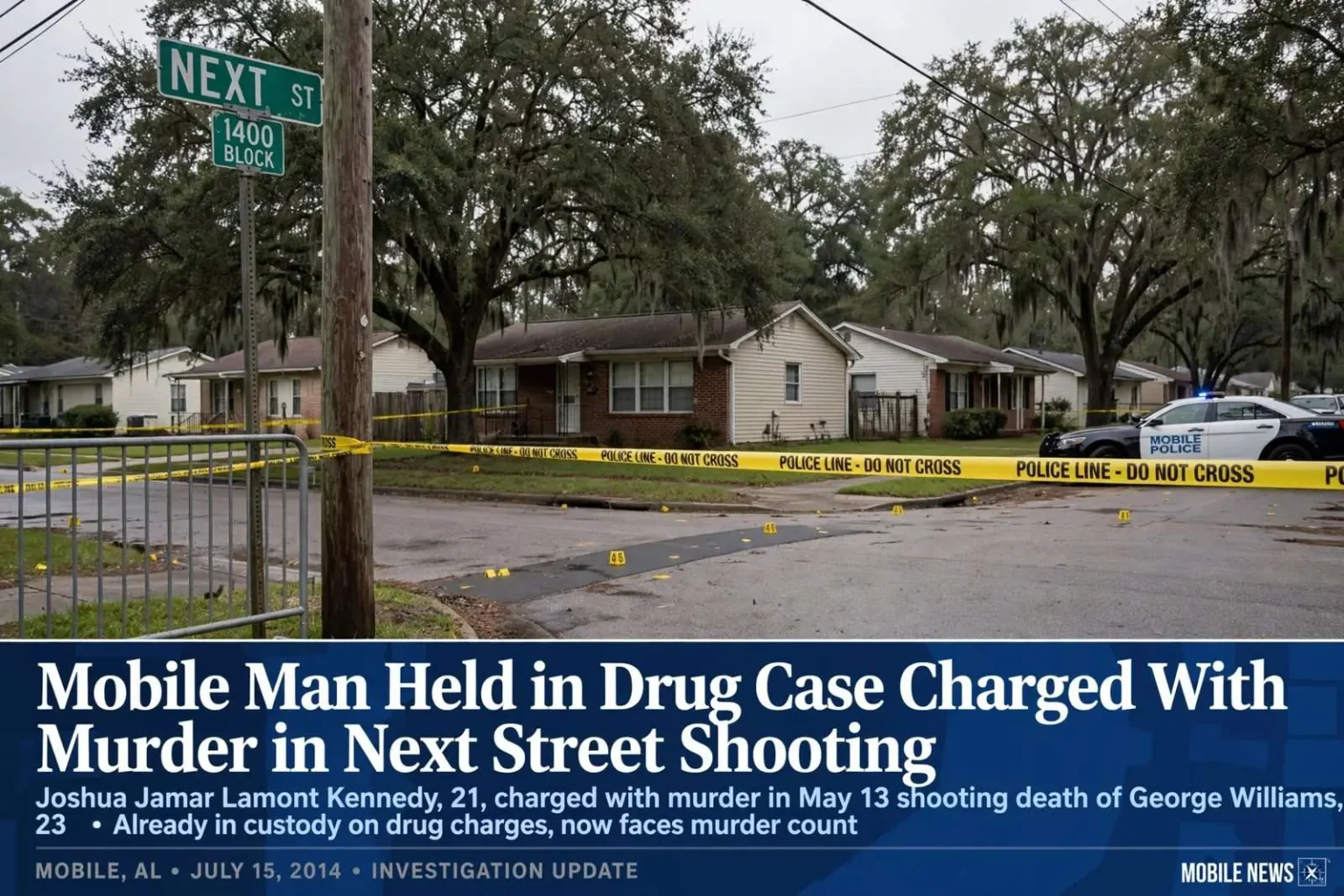
Nearly a month after officers found a man suffering from a gunshot wound on Next Street, Mobile police charged a man already facing unrelated counts with murder in the case. Joshua Jamar Lamont Kennedy, 21, was accused of one count of murder in the death of George Williams, 23. According to police, Kennedy fatally shot Williams following an argument on Tuesday, May 13, 2014. Williams died of his injuries two days after the attack.
The charge closed one gap in a case that had been developing since mid-May, when the afternoon gunfire on a residential street left a 23-year-old man fighting for his life at a local hospital. For detectives, the intervening weeks were spent locating witnesses, reconstructing the argument that preceded the shooting, and building enough evidence to support a murder count against a suspect who was already behind bars on other charges.
A Shooting on Next Street
The events traced back to the afternoon of May 13, when medical technicians transported Williams from the 1400 block of Next Street to the University of South Alabama Medical Center. He had been found in the roadway in front of a home, suffering from at least one gunshot wound to his abdomen. Two days later, he died of those injuries.
The University of South Alabama Medical Center, in central Mobile, has long served as one of the region’s major trauma centers, and shooting victims from across the city are routinely routed there. Trauma teams work to stabilize patients whose injuries would have been fatal in earlier decades, but wounds to the abdomen remain among the most dangerous, and Williams survived two days before the injuries claimed his life.
Police believed the shooting followed an argument between the two men on Next Street. Investigators developed Kennedy as a suspect over the weeks that followed, ultimately bringing the murder charge against a man who was already in custody on separate allegations. The identification process in such cases typically relies on witness interviews and physical evidence gathered from the scene, and the month-long gap between the shooting and the charge reflected the pace of that work rather than any dramatic breakthrough.
Next Street sits in one of the residential neighborhoods west of downtown Mobile where spring violence had drawn repeated police attention. Residents of blocks like the 1400 block of Next Street experience such shootings up close — a crime scene in the roadway in front of a home, Investigators working the neighborhood for days, and the long aftermath of a death that began with an argument most neighbors never heard.
Already in Custody
Officers had apprehended Kennedy on June 3 on charges of possession of a controlled substance and trafficking in marijuana. According to court records, Kennedy also went by the name “Chicken.” The records showed he had faced arrest in Mobile County three other times since 2012, on charges that included possession of a controlled substance, domestic violence and driving without a license.
The drug counts on which Kennedy was held were serious in their own right. Trafficking in marijuana under Alabama law is a felony carrying substantial mandatory prison exposure, and combined with a pending possession charge, the June arrest left Kennedy facing years behind bars even before the murder count arrived. That posture — a suspect already in custody when the more serious charge lands — is common in homicide investigations, where detectives often develop their case while the suspect is held on whatever charges first brought him to jail.
He remained jailed at the Mobile County Metro Jail on the Tuesday afternoon the murder charge was reported. The facility on Branch Avenue serves as the county’s main detention center, housing defendants awaiting trial as well as those held on newer charges. With the murder count added, Kennedy’s release on bond became far less likely, and his stay at the jail shifted from a holding pattern to the front end of a homicide prosecution.
What Happens Next in Court
Kennedy was scheduled to appear before District Court Judge Bob Sherling on July 17 for a preliminary hearing, at which prosecutors would be expected to outline the evidence supporting the case. The hearing is the first significant checkpoint in an Alabama felony prosecution, and both sides use it to measure the strength of the case the other will present.
Under Alabama criminal procedure, a preliminary hearing exists to determine whether probable cause exists to believe the defendant committed the charged offense. If the district court finds probable cause, the case is bound over to a grand jury, which decides whether to return an indictment that would move the case to Mobile County Circuit Court for trial. Defense attorneys frequently use the hearing to lock witnesses into early testimony, while prosecutors sometimes waive the hearing entirely when an indictment is imminent — a strategic choice that often signals confidence in the evidence.
As of the report, Kennedy had not entered a plea, and the case was set to proceed through the preliminary stages of Mobile County’s criminal court process. The murder count carried the possibility of a lengthy prison term if it resulted in a conviction, and it added to the drug counts already pending against him. A murder conviction in Alabama can carry sentences ranging from decades to life imprisonment, and prosecutors weigh that exposure alongside the drug charges when negotiating or taking a case to trial.
Investigators Sought the Public’s Help
The killing was one of several that drew the attention of Mobile investigators that spring and summer, a period in which the department repeatedly asked residents to come forward with information that might help resolve open cases. In the Williams shooting, detectives encouraged anyone with knowledge of the events on Next Street to contact the Mobile Police Department’s CrimeStoppers line at 251-208-7000 or to text the keyword CRIME411 to CRIMES, 274637.
CrimeStoppers programs operate across the Gulf Coast, allowing tipsters to pass information to investigators anonymously and, in many programs, to qualify for cash rewards when tips lead to arrests. The channels matter in neighborhoods where witnesses may hesitate to speak openly with detectives; a tip line offers a middle path for residents who know something but fear being publicly identified. Detectives working the Williams case made clear that information could still reach them even after a charge was filed, since witness accounts often continue to surface as a prosecution moves forward.
The broader pattern of that spring placed additional weight on community cooperation. Each unresolved shooting leaves a family without answers and a neighborhood without assurance that gunfire will carry consequences, and police officials argued throughout the period that the department’s clearance rate depended heavily on residents willing to talk. The Williams case, beginning with an argument on a residential street and ending in a hospital bed, was exactly the kind of case where a few calls could make the difference.
A Familiar Pattern on the Docket
The charge underscored a pattern that would become familiar to those following the city’s court dockets that year: a suspect already held on one set of allegations facing far more serious counts as an earlier investigation reached its conclusion. Homicide cases rarely come together in the first days after a shooting. Detectives gather physical evidence from the scene, wait on forensic results, and conduct interview after interview before they can present a case to a prosecutor — and meanwhile the suspect, if arrested on other charges in the interim, waits in jail as the larger case takes shape.
The sequence matters for the defendant as well. Time served on the initial charges counts toward any eventual sentence, and the overlapping cases give defense attorneys and prosecutors multiple points of negotiation. When a murder count is added to pending drug charges, the combined exposure changes the calculus entirely, often accelerating resolution discussions on the lesser charges.
For the family of George Williams, the filing marked a step toward answers about a death that had unfolded over two days in mid-May, beginning with a confrontation on a residential street and ending in a hospital bed. Families in such cases typically follow the docket for months or years afterward — preliminary hearings, grand jury action, motion hearings, and eventually trial or a plea — each step reopening the loss that began with the gunfire on Next Street.
Mobile’s Response to Spring Violence
Mobile police officials spent the spring and summer of 2014 pressing a message of community partnership alongside enforcement. The department urged residents with information on any open case to come forward, promoted the CrimeStoppers channels as an anonymous option, and pointed to charges like the one filed against Kennedy as evidence that investigations continued long after the initial headlines faded.
The approach reflected the realities of urban homicide investigation nationwide. Cases built on witness testimony require trust between neighborhoods and the officers who work them, and departments that maintain that trust tend to clear more cases. Mobile’s investigators balanced that outreach with the deliberate, evidence-first pace that homicide prosecutions demand — a pace that residents sometimes read as inaction, but that prosecutors require before taking a case to a grand jury.
The Williams case also illustrated how the criminal justice system handles defendants with prior records. Kennedy’s arrests since 2012 — on charges including possession of a controlled substance, domestic violence and driving without a license — formed part of the record that judges weigh at bond hearings and that prosecutors weigh at charging decisions. The law treats each case on its own facts, but the accumulated record shapes outcomes at every stage, from the magistrate’s initial bond to sentencing if a conviction follows.
The Road Ahead for the Case
With the July 17 preliminary hearing before Judge Sherling on the calendar, the case moved into the phase where Alabama’s criminal process sorts felony charges. The district court would hear the prosecution’s showing of evidence, the defense would have its first formal opportunity to test it, and the matter would proceed toward the grand jury unless the state chose another route. Kennedy remained at the Mobile County Metro Jail without resolution on any of the counts against him.
Whatever the outcome, the sequence of events — an argument on Next Street, a shooting in the roadway, two days at the trauma center, a death, and a month of investigation ending in a jailhouse murder charge — traced the full arc of a Mobile homicide case as it moves from the street to the courthouse. For the neighborhood where it began, the charge brought a measure of resolution; for Williams’s family, the longer process was only beginning.