West Mobile Man Sentenced to Federal Prison for Hancock Bank Robbery, Ordered to Repay $5,190
A west Mobile man was sentenced to 41 months in federal prison for robbing a Hancock Bank on Rangeline Road, fleeing the state before his arrest and later admitting to the crime.
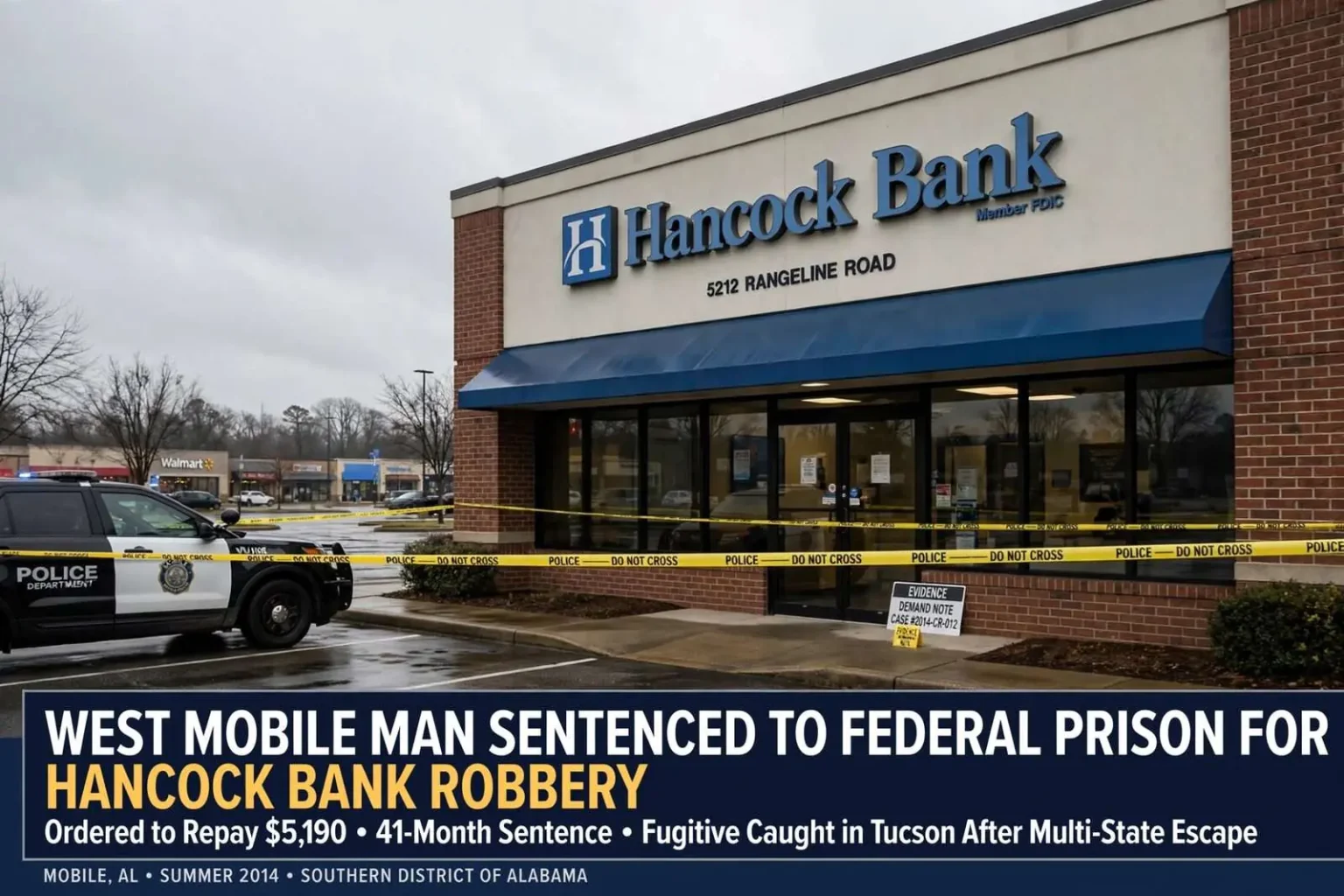
A west Mobile man was headed to federal prison in the summer of 2014 after being sentenced for a bank robbery that sent him fleeing across state lines before his eventual arrest hundreds of miles away.
According to court documents, James Henry Crow walked into the Hancock Bank at 5212 Rangeline Road and handed a teller a note. The note, prosecutors said, indicated in substance that he did not want to shoot anyone or hurt a woman in the parking lot, and that the teller should hand over the money.
The demand note is the defining artifact of most bank robberies, and its wording often becomes evidence in its own right. In this case, prosecutors said, the note’s reference to a woman in the parking lot and its assurance that the writer did not want to shoot anyone gave the holdup an odd restraint — a threat sufficient to commit the crime, couched in language that stopped short of an overt promise of violence.
A getaway across three states
An agent testifying in the case told U.S. Magistrate Judge Katherine “Kit” Nelson that after the January 10 robbery, Crow slipped away from police at a nearby Walmart, where he changed clothes in a restroom. From there, he boarded a bus to Biloxi, Mississippi, continuing on toward Tucson, Arizona. It was in Tucson that Crow was arrested.
The agent said he admitted to robbing the bank and acknowledged daily marijuana use. Investigators said he had been using the alias “Mark Wright.”
The geography of the escape traced a long diagonal across the South and the Southwest. A bus out of Mobile to the Mississippi Gulf Coast put the first state line behind him within hours; the continuation toward Tucson carried him more than a thousand miles farther. Federal investigators chasing a fleeing bank robber work through surveillance footage, witness descriptions, transportation records and the network of local police departments along likely routes — a slow weave that eventually caught up with the alias “Mark Wright” in the desert.
The arrest in Tucson closed the pursuit, but the case still had to be moved — returned to the district where the crime occurred, where the witnesses lived and where the bank stood. Prosecution in the home district is the standard practice in federal bank robbery cases, which means the file on a Mobile holdup traveled back across the country to be heard in the city where it began.
The sentence
On Thursday, Chief U.S. District Judge William Steele sentenced the 55-year-old to 41 months in prison, to be followed by three years of supervised release and drug treatment. The judge also ordered Crow to pay Hancock Bank $5,190 in restitution.
According to a news release from U.S. Attorney Kenyen Brown, Crow was a four-time felon. Booking records showed he had been arrested several times before in Mobile County, most often on traffic and marijuana-related charges. In 1994, he had pleaded guilty to trafficking marijuana.
The sentence’s components each carried their own purpose. The 41-month prison term reflected federal sentencing guidelines that weigh the offense conduct — a note-based robbery without a weapon displayed — against the defendant’s criminal history category. The three years of supervised release put Crow under federal supervision after prison, subject to conditions and drug testing. The ordered drug treatment acknowledged the substance use the defendant himself had admitted to, recognizing what sentencing courts long have: that a sentence which ignores addiction often produces nothing but a return trip.
The restitution order completed the sentence’s accounting. Under federal law, restitution to robbery victims is mandatory, and the $5,190 figure represented the amount taken from the Hancock branch — money the bank could expect to recover through the criminal case rather than absorb as a loss.
A familiar corridor
The Rangeline Road area, a busy commercial stretch on the west side of Mobile, was home to the bank branch at the center of the case. For customers and employees, the robbery was a jarring interruption to an ordinary day, even though the note contained no overt threat of violence.
Commercial corridors like Rangeline Road concentrate exactly what a bank robber needs and exactly what makes such crimes memorable: steady traffic, multiple lenders in close proximity, and a workforce of tellers trained above all to comply. Bank staff are instructed to hand over the money, note what they can and stay safe — the loss is insured and the customer is replaceable; a person is not. The woman referenced in the demand note was, by the note’s own terms, someone the robber claimed he had no intention of hurting.
The case moved through the federal system rather than state court because bank robbery is a federal offense, prosecuted by the U.S. Attorney’s office and heard in U.S. District Court. The rule is nearly as old as federal criminal law itself: banks hold federally insured deposits, and robbing one is treated as a crime against the national financial system, whatever the amounts involved. That framework brought the matter before Judge Steele, whose sentence combined incarceration with supervised release and court-ordered drug treatment — a nod to the substance use that the defendant himself had acknowledged.
It also explains the cast of officials in the case. A federal agent developed and testified to the investigation; a U.S. magistrate judge handled the initial proceedings, including the testimony that laid out the getaway; and the district’s chief judge imposed the final sentence. A holdup at a single teller window on Rangeline Road engaged every tier of the Southern District of Alabama’s federal bench.
The restitution order required Crow to repay the money taken in the robbery, a standard component of federal sentences intended to make victims whole. For Hancock Bank, the $5,190 figure represented the amount lost in the January holdup.
The arc of the case
The path from a Rangeline Road teller window to an Arizona arrest underscored how quickly a local crime could ripple outward. Within days, a bus ticket had carried the defendant from Mobile through Mississippi and on toward the Southwest, only for the investigation to catch up with him and return the matter to a courtroom in his home city.
Distance, in the end, changed nothing about the outcome. The federal warrant followed the alias across the map, and the trial court that would judge the case sat within sight of the corridor where the robbery took place. Fugitives who cross state lines in bank robbery cases rarely escape the jurisdiction so much as delay their arrival in it.
With the sentence handed down, the case drew to a close: a prison term, a period of supervision to follow, treatment for addiction and an order to repay what had been taken. For a defendant already carrying a lengthy record — the four prior felonies, the 1994 trafficking plea, the arrests scattered across two decades of Mobile County booking logs — it marked another chapter in a long history with the courts of Mobile County and, now, the federal system.
For the bank’s employees and customers, the sentence closed the file on a January morning that began as an ordinary banking day and ended with a demand note, an empty drawer and an empty chair where the robber had stood. The note had promised no shooting; the court’s judgment promised no early return; and the ledger between them, measured in months and restitution dollars, was balanced by the only institution with the reach to follow a bus from Mobile to Tucson — the federal system itself.
Why bank robbery lands in federal court
The federalism behind the case is worth understanding for anyone who wonders why a Mobile stickup was not tried in a Mobile County courtroom. The federal bank robbery statute reaches any theft by force or intimidation from a bank whose deposits are insured by a federal agency — which is to say, virtually every bank in America. The crime is complete the moment the demand is made with the implicit or explicit threat of force; whether a weapon ever appears affects the sentencing range, not the offense itself.
The practical consequences of the federal forum show throughout this case. Federal prosecutors brought the charges, federal agents ran the investigation, and the sentencing fell under the federal guidelines system — a grid of offense levels and criminal history categories that produces the kind of structured outcome seen here: 41 months, neither the lenient end a sympathetic account might have sought nor the harsher range that a weapon or injury would have triggered.
Supervised release, the component that follows the prison term, is the federal system’s substitute for parole. There is no parole in the federal system; instead, defendants serve the bulk of their imposed sentence and then spend a defined period under community supervision, where violations — new arrests, failed drug tests, missed appointments — can send them back to prison without a new trial. For a defendant with a acknowledged daily substance habit, that supervision period is where the sentence’s real test will occur.
The drug treatment condition attached to the supervised release is likewise standard where the record supports it. Courts impose treatment conditions on the theory that untreated addiction is the single best predictor of reoffending in cases of this type, and the defendant’s own admission of daily marijuana use put the condition squarely on the table.
The investigation’s long road
The January robbery and the summer sentencing bookend a case that moved through every stage the federal process offers: the crime itself, the flight, the investigation across multiple states, the arrest in Arizona, the return to Mobile, the proceedings before a magistrate judge, and finally the sentencing before the district’s chief judge. Each stage added to the record — the teller’s account, the surveillance evidence, the agent’s testimony about the Walmart escape and the bus route, the alias, and the admissions that followed the arrest.
The distance the defendant traveled turned out to be the case’s most memorable feature, but the investigation’s ability to reconstruct his path was its most telling. Transportation records, witness sightings and the loose network of an alias all fed a picture that ultimately converged on Tucson. The $5,190 he carried away from the Rangeline Road branch bought a bus ticket and a few months of movement; it did not buy distance from the warrant waiting at the end of the line.
In the end, the case returned to where it began — a federal courthouse in the Southern District of Alabama, a few miles from the branch office at 5212 Rangeline Road. The money goes back to the bank, the defendant goes to federal prison, and the corridor that saw the robbery keeps its ordinary traffic: deposits made, tellers working, and one January morning now a closed file in the court’s records.