Mobile Police Sought Two Men After Robbery, Assault at Water Street Gas Station
Mobile police searched for two young men after a robbery and assault at a North Water Street Exxon, where a victim's wallet and phone were snatched and he was attacked as he gave chase.
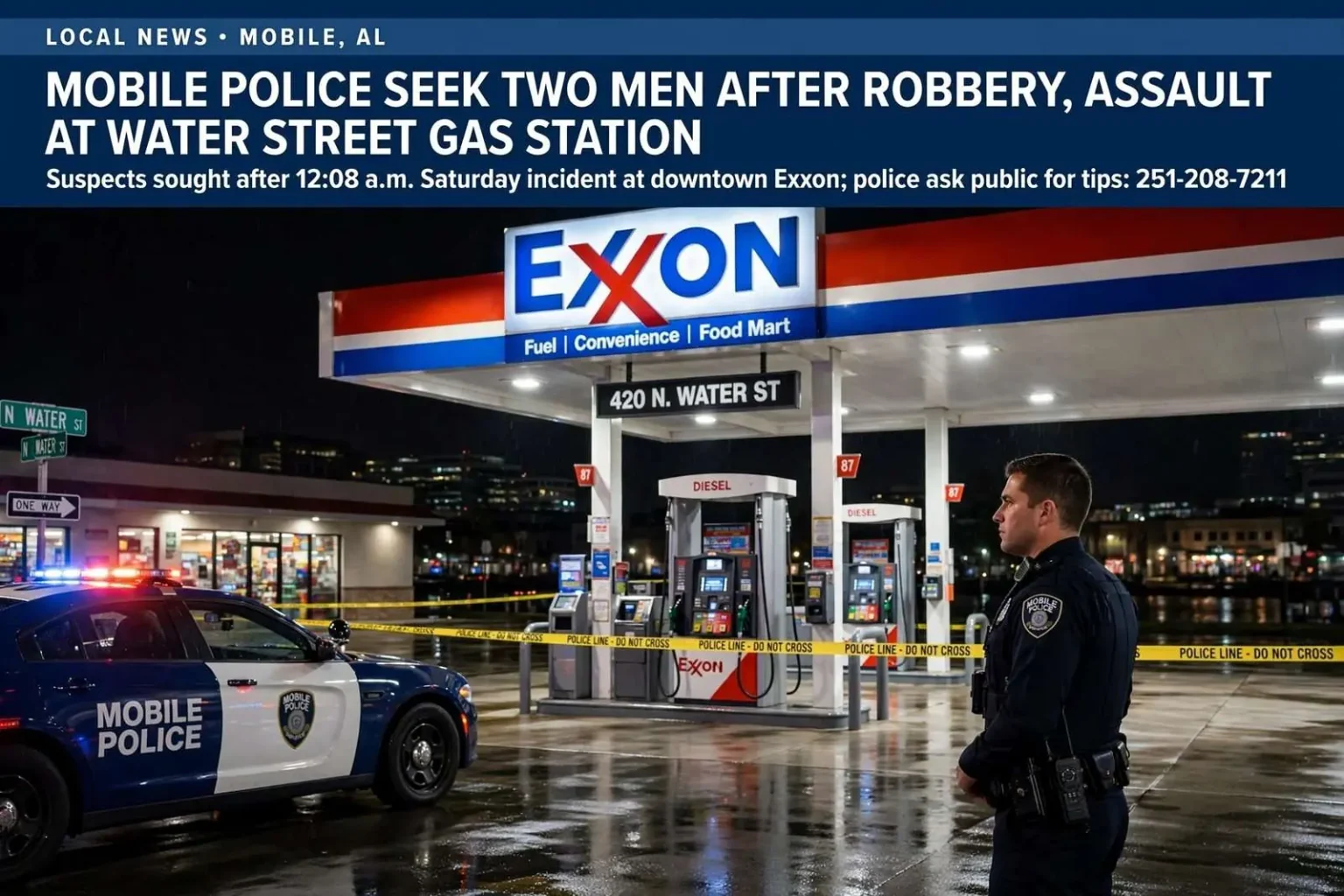
Mobile police searched for two young men after a robbery and assault at a downtown gas station over the weekend, an incident that unfolded in the early hours near the waterfront. According to the Mobile Police Department, officers received a report at 12:08 a.m. Saturday of a person robbed at the Exxon station at 420 N. Water Street. Investigators were looking for two suspects in the case, and within hours of the report detectives were canvassing the area for witnesses and surveillance footage that might identify them.
The timing and the location put the case at the intersection of two of the department’s standing priorities: protecting the after-hours economy that keeps downtown Mobile busy past midnight, and maintaining safety along the corridors where that economy operates. The North Water Street area sits steps from the riverfront, where visitors, late-shift workers and residents cross paths at all hours, and incidents there tend to draw immediate attention from both investigators and downtown stakeholders.
A confrontation in the parking lot
The victim told police that a group of young men had been in the parking lot of the station and asked him for money. When he pulled out his wallet, one of the group grabbed the wallet and his cell phone and ran, according to a department news release. As the victim attempted to chase the men, police said, some of them turned and attacked him. He was taken to a local hospital for treatment of minor injuries.
The sequence — a demand for money, a snatch when the wallet appeared, and an assault when the victim gave chase — followed a pattern that street robbery investigators know well. The victim’s decision to pursue the fleeing suspects, though instinctive, is the point in such encounters where property crimes most often become physical ones, and in this case it ended with a trip to the hospital for injuries that were minor but real.
The suspects faced charges of first-degree theft of property and third-degree assault. Under Alabama law, first-degree theft typically involves property taken from the person or above a statutory value threshold, and theft from the person — the wallet pulled from a victim’s hand — fits that classification. Third-degree assault covers the physical attack that followed, and together the two charges reflected the full arc of the encounter from demand to getaway.
Once identified, the suspects would face those charges through the Mobile County court system, with prosecutors deciding whether additional counts were warranted as the investigation developed. Charging decisions in robbery cases of this kind often wait until suspects are in custody, since the facts tend to sharpen considerably once witnesses and evidence are matched to identified defendants.
An early correction
Initial accounts of the case indicated that officers were searching for three suspects. Police later refined that figure and clarified that they were seeking two men in the robbery. The correction, issued after officers gathered additional information, reflected the fluid nature of an investigation in its opening hours, when witness accounts and surveillance are still being sorted.
Corrections of this kind are routine in the first hours of a street robbery case, and experienced investigators treat early suspect counts as provisional. A group seen together in a parking lot may include bystanders as well as participants; adrenaline distorts what a victim counts and remembers; and surveillance frames that catch a group approaching may not capture who actually took part in the taking. The department’s willingness to issue a corrected count publicly was a small signal that the investigation was moving — that detectives were reconciling accounts against evidence rather than repeating an early guess.
The North Water Street corridor sits near the heart of downtown Mobile, a stretch that draws both residents and visitors and that police patrol regularly. A late-night robbery at a well-traveled gas station there was the kind of case that tended to generate quick attention from investigators, who relied heavily on tips from the public to identify suspects who fled on foot.
Gas stations occupy a particular place in urban crime patterns. They are open around the clock, staffed by one or two employees, lit against the night, and visited by strangers carrying cash at every hour. Their lots concentrate foot traffic away from the sight lines of the street, and the combination of cash transactions, isolated corners and late-night lulls makes them — and the parking areas around them — recurring settings for street robberies in cities across the country.
The 420 N. Water Street station sits in a corridor where those dynamics meet downtown’s particular rhythm. The blocks near the riverfront empty late on weekend nights as bars and restaurants close, and the hours just after midnight — the hour when this report reached police — are the ones when the after-hours crowd disperses, often on foot, past businesses that are still open and lots that are still occupied.
Investigators asked for tips
The department encouraged anyone with information about the men to contact the Mobile Police Department at 251-208-7211. As with many street robberies, the ability to identify and locate the suspects hinged in part on whether witnesses or nearby businesses could offer descriptions or footage that matched the victim’s account.
Tips do more than name suspects. In the hours after a robbery, they establish the direction of travel, the clothing worn, the vehicle if one was involved, and whether the same group is connected to other calls in the area. Detectives working a case like this one pull the department’s calls for service around the time and place, looking for any other report that might involve the same group of young men, and each tip helps confirm or eliminate the possibilities.
Surveillance is the other half of that work. Businesses along a corridor like North Water Street typically maintain camera systems of varying quality and coverage, and one of the first tasks for robbery detectives is to collect the footage before it is overwritten — a window that can be measured in days depending on the system. A camera that catches the parking lot, the sidewalk or the escape route can convert a description into an identification.
The episode served as a reminder of the risks that can accompany a routine request for money in a parking lot after midnight. What began as a demand for cash escalated quickly into a snatch-and-run theft and then a physical assault when the victim tried to recover his belongings. Police urged anyone approached in similar circumstances to prioritize personal safety over property and to report incidents promptly.
That guidance reflects a consistent strand of crime-prevention advice: property is replaceable, and the moments when a robbery turns into an assault are overwhelmingly the moments when the victim resists after the taking is complete. Wallets and phones can be canceled, replaced and, in the case of modern phones, remotely wiped and tracked. The injuries that come from a chase are harder to undo, and the police department’s message to potential victims was to let investigators do the pursuing.
The case remained open
At the time of the report, the two men remained at large, and the case was among the active robbery investigations on the department’s docket. Officers continued to ask that tips be directed to the non-emergency line so that detectives could follow up on any leads that might help bring charges against those responsible.
The routing of tips to the non-emergency line matters to how quickly a case moves. Robbery detectives work their cases through the investigations bureau, and tips that arrive on the line assigned to investigators reach the case file directly, rather than moving through patrol dispatch. For witnesses deciding whether to call, the department’s message was that the case remained active and that even partial information — a partial description, a direction of flight, a name overheard — could advance it.
For a downtown that depends on foot traffic after dark, the case also touched on a broader concern about safety at late-night stops. Gas stations, open around the clock and often lightly staffed, can become targets precisely because they draw travelers carrying cash and moving alone. Police in Mobile had long encouraged businesses along heavily traveled corridors to maintain working cameras and adequate lighting, both to deter would-be robbers and to give investigators evidence to work with when a crime did occur.
The camera-and-lighting message is aimed as much at deterrence as at evidence. Street robberies are crimes of opportunity, and the visible presence of a working camera — or the simple fact of a well-lit lot where a group of strangers can be seen from the street — shifts the calculation of where such an encounter is worth attempting. Corridors where businesses invest in both tend to see less of the opportunistic late-night crime that thrives in the gaps between streetlights and unmonitored lots.
For the businesses themselves, the incentive is direct. A robbery in a station’s lot costs more than the stolen cash: it costs the sense of safety that brings late-night customers to the pumps and the counter, and in a district whose reputation depends on visitors feeling comfortable moving around after dark, each incident reverberates beyond the address where it happens.
In this case, the speed with which the department refined its account suggested detectives were actively reconciling the victim’s statement with other evidence gathered in the hours after the report. A corrected suspect count is usually the product of exactly that process — surveillance reviewed, witnesses re-interviewed, accounts compared — and its release within a day of the robbery indicated a case moving rather than sitting.
The victim’s injuries, described as minor, were the difference between a terrifying encounter and a tragic one, and they are not guaranteed in similar circumstances. A group that is willing to assault a man who chases his own wallet has already crossed the line where robbery becomes battery, and police noted that the outcome could easily have been worse had the chase gone differently. That arithmetic — a phone and a wallet against a hospital visit — is the department’s core safety message to anyone confronted in a parking lot after midnight.
The case also illustrated the ordinary machinery of street-crime investigation in a mid-sized city: a 12:08 a.m. call, a victim’s statement taken in the parking lot where it happened, a news release with a suspect count, a correction when that count changed, and a phone number published for anyone who might have seen something. None of it is dramatic, and all of it is how suspects in cases like this one are most often found — through the accumulation of small pieces of information that residents and businesses supply, and that detectives assemble into a case that can be charged and proven.
Anyone with information about the robbery at the Exxon station at 420 N. Water Street was asked to contact the Mobile Police Department at 251-208-7211. Callers could remain anonymous, and investigators said every lead would be followed up as the search for the two men continued.