Bay Minette Attorney Bob Wills Signed On to Run Tim James’ Baldwin County Campaign
Tim James named Bay Minette attorney and longtime school board president Bob Wills as his Baldwin County regional director, tapping one of North Baldwin's most durable civic figures for his run for governor.
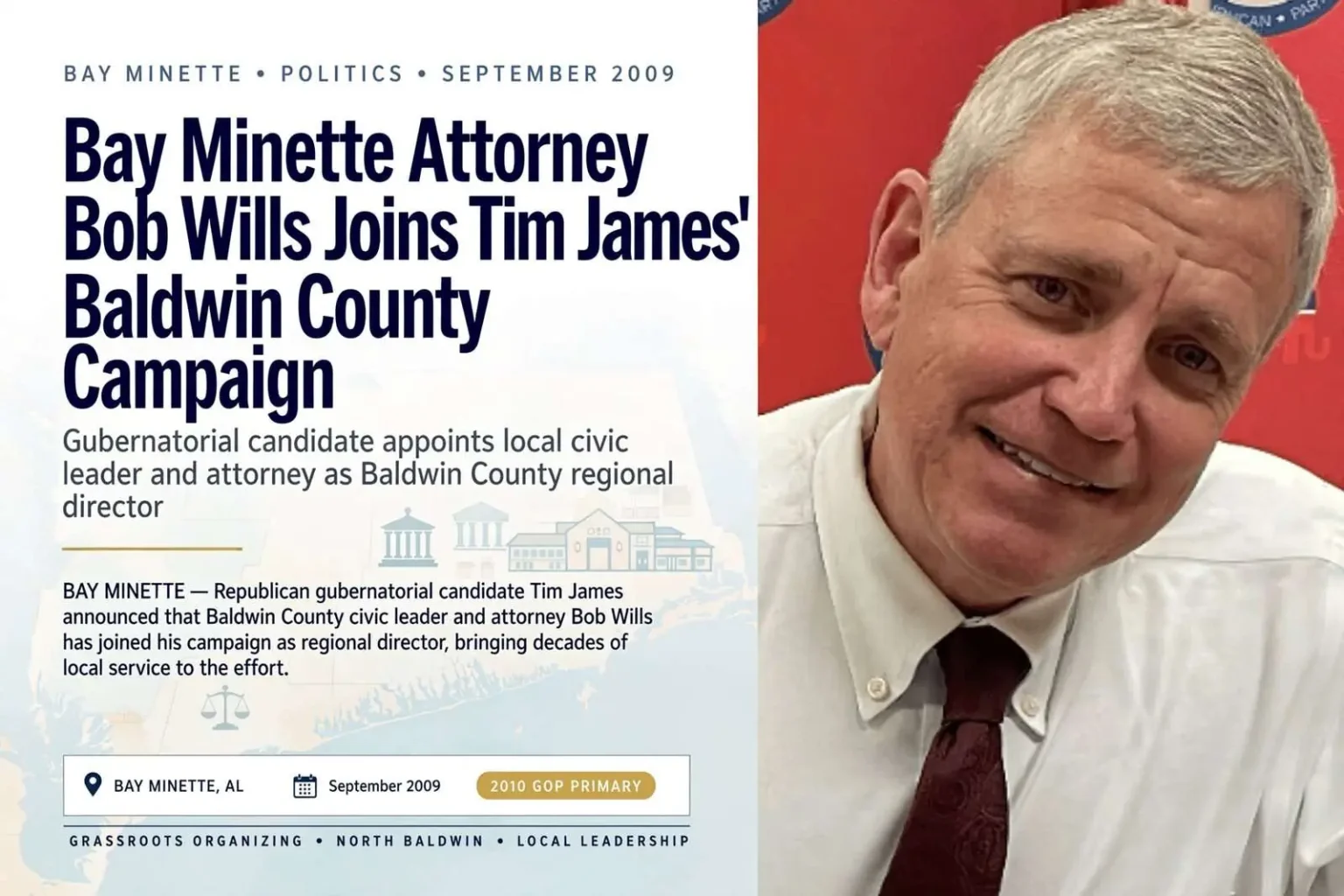
BAY MINETTE — Republican gubernatorial candidate Tim James announced that Baldwin County civic leader and attorney Bob Wills had joined his campaign as a regional director, giving the campaign a familiar name in a county whose Republican voters would be central to any statewide bid. “Bob Wills has a long and distinguished record of serving the people of Baldwin County and Alabama,” James said. “He’s a leader who will build a strong campaign team.”
Wills said the work had already begun. “As Baldwin County Regional Director of Tim’s team, I have already begun working on building our grassroots organization,” he said. “Tim James has a strong base of goodwill and support in Baldwin County, and he should mount a formidable campaign here and throughout Alabama.”
A Résumé Built in One County
Wills, a 1973 graduate of the Emory University School of Law, practiced in Bay Minette with the firm of Wills & Simon. His record of civic service in North Baldwin was unusually deep even by the standards of a county that prizes such things:
Member of the Baldwin County Board of Education for 14 years, serving three times as its president. Legal counsel to the Baldwin County Commission for nine years. Legal counsel to the City of Bay Minette for 20 years. President of the Baldwin County Mental Health Association for more than 20 years. Active with the Bay Minette Rotary Club for some 30 years. Board member of the North Baldwin Health Care Foundation.
Each of those posts put him inside a different institution that organizes the county’s life — the schools, the commission, the county seat’s city hall, the mental health network, the Rotary, the hospital foundation. Very few people in any Alabama county have sat at that many of the tables where decisions get made and, more to the point, where voters get known.
A man who has advised the county commission, the county seat and the school board has, in practical terms, met nearly everyone in Baldwin County who votes in a Republican primary — which is precisely why a statewide campaign wanted him. Campaign staff can be hired and mailers can be printed, but a regional director whom half the county already addresses by his first name cannot be manufactured.
Family and Church
Wills and his wife, Betty Lou, had been married 37 years. Their children — Elizabeth Wills Strom, Robert Jr. and Mary Louise — all graduated from Baldwin County High School and all lived in Bay Minette, along with the couple’s five grandchildren. The rootedness was the point: three generations in one town, through the schools and the church and the civic boards, is the deepest credential Baldwin County knows.
Wills was an active member of First United Methodist Church in Bay Minette, where he taught Sunday school and sang in the choir. The detail is not incidental. In Alabama county politics, the Sunday school class and the Rotary lunch have historically been as reliable a route to a voter as any mailer. A candidate’s county chairman who sees his voters every Sunday and every Tuesday works a network no paid operation can replicate.
Why Baldwin County Mattered
Baldwin County had become one of the fastest-growing counties in Alabama and one of its most reliably Republican. Decades of growth along the Eastern Shore and down to the beach communities had transformed a rural county of farms and timber into a sprawling suburban-and-coastal electorate, and its voters had moved solidly into the Republican column well ahead of much of the rest of the state.
For a candidate seeking the GOP nomination for governor, running up a margin along the Eastern Shore, in the beach communities and in the county’s north end was close to a requirement. A regional director whose name was known from Bay Minette to Fairhope offered the campaign both organization and reassurance — organization in the precincts, reassurance for donors and endorsers deciding whether the campaign was building something real.
James had announced his campaign for governor the previous year. Since then he had campaigned in 40 of Alabama’s 67 counties and had been building campaign leadership across the state — the grassroots network that Wills was now charged with extending in Baldwin. The approach reflected the geography of Alabama politics: a candidate cannot appear everywhere at once, so he appears where it counts and installs people he trusts in the counties he cannot work personally.
The candidate, a Republican and the son of former Gov. Fob James, lived in Greenville with his wife, Angela, and their three children, and operated his business interests from there. The family name carried weight and baggage in equal measure — two term-limited spans of his father’s governorship had made “James” a household label statewide, recognized fondly by some voters and warily by others. The son’s task was to introduce himself beyond the name, and county-by-county organization was the mechanism.
The regional director structure also told donors something. Early endorsements from respected local figures are currency in the year before a primary, when campaign treasuries are thin and every commitment signals viability. A Baldwin County civic leader signing on suggested the campaign was assembling the establishment next door to Mobile, a county any Republican would need.
The Long Road to the Primary
The 2010 primary was still more than a year away, and the Republican field would grow considerably before it arrived. Alabama’s governor’s races draw crowded fields — sitting legislators, statewide officeholders, business figures — and 2010 promised to be no exception, with the party ascendant and the incumbent limited to two terms. Every campaign in that field would spend the interim building exactly what James was building: named leadership in the counties that vote.
Campaigns for governor in Alabama are won county by county, in living rooms and Rotary halls, long before any advertisement airs. The ads matter in the final months, when the whole electorate tunes in at once, but the pre-primary year decides who has the precinct captains, the county chairs and the local credibility to convert a good ad into actual votes. Signing Bob Wills was a piece of that year’s work — the kind of announcement that draws a paragraph in the local paper and quietly matters for the following fourteen months.
Signing a man who had spent three decades in those rooms was, for James, an early piece of business worth announcing. Wills brought the school board network, the commission memory, the Rotary table and the Sunday school class — the full civic ledger of North Baldwin — to a campaign that would need every name on it. In the arithmetic of an Alabama primary, that is what a regional director is for, and why the announcement ran under the candidate’s own name from the county seat itself.
North Baldwin’s Civic Economy
The kind of résumé Wills carried works because Baldwin County’s civic institutions are genuinely separate centers of influence. The school board in a fast-growing county controls construction, attendance lines and employment at a scale that rivals city government; the commission controls roads, sewer extensions and zoning in the unincorporated stretches where most of the growth was happening; the city attorney’s desk in the county seat sees every ordinance, franchise and lawsuit. Serving all three, across decades, means having been present at nearly every consequential public decision of an era.
The mental health association presidency and the hospital foundation board filled out the picture on the human-services side — the institutions that counties rely on for exactly the work government does awkwardly. In North Baldwin, where Bay Minette anchors the county’s northern end and its identity differs from the shoreline communities in accent, economy and politics, those posts made Wills a bridge figure between the county’s halves.
That geography is the subtler part of why the appointment made sense. Baldwin County is not one electorate but several — the Eastern Shore’s commuter suburbs, the beach communities’ resort economy, and the agricultural north — and campaigns that treat it as a single bloc habitually underperform in one of them. A Bay Minette man with countywide boards on his résumé gave the James campaign a foothold in the north end to match the name recognition any Republican carries on the shore.
What a Regional Director Actually Does
The title covers work that is unglamorous and decisive. A regional director recruits the precinct-level volunteers who will staff the polls on primary day, arranges the candidate’s appearances in front of the county’s civic clubs and churches, fields the calls from local officials deciding whom to back, and feeds intelligence back to headquarters about which neighborhoods are organizing and which are not. Done well, it is a year of small meetings; done poorly, it is a name on a letterhead.
For Wills, the job drew on everything the résumé suggested he had already done for free. Organizing a school bond campaign, shepherding a commission agenda, chairing a Rotary fundraiser — these are the same skills as organizing a primary, minus the candidate. The campaign’s bet was that a man who had spent thirty years doing civic work without a paying office attached would treat a gubernatorial campaign the same way: show up, do the work, and call on the people who already know him.
James, for his part, was assembling a leadership slate with an eye to exactly that multiplication. Forty counties visited meant forty networks still to be converted into organizations, and the conversions happen through people like Wills — the civic veteran who can guarantee a crowd, a headline, and a list of volunteers the moment the campaign needs one. In Baldwin County, the campaign now had one of the county’s most reliable names doing the guaranteeing, more than a year before the ballots were printed.