Friends of Baldwin County Cemeteries: Fairhope Funeral Director Jesse Payne Is Bringing Forgotten Headstones Back to Life
Fairhope native and licensed funeral director Jesse Payne founded Friends of Baldwin County Cemeteries in 2025 and has cleaned and restored an estimated 50 to 75 historic graves.
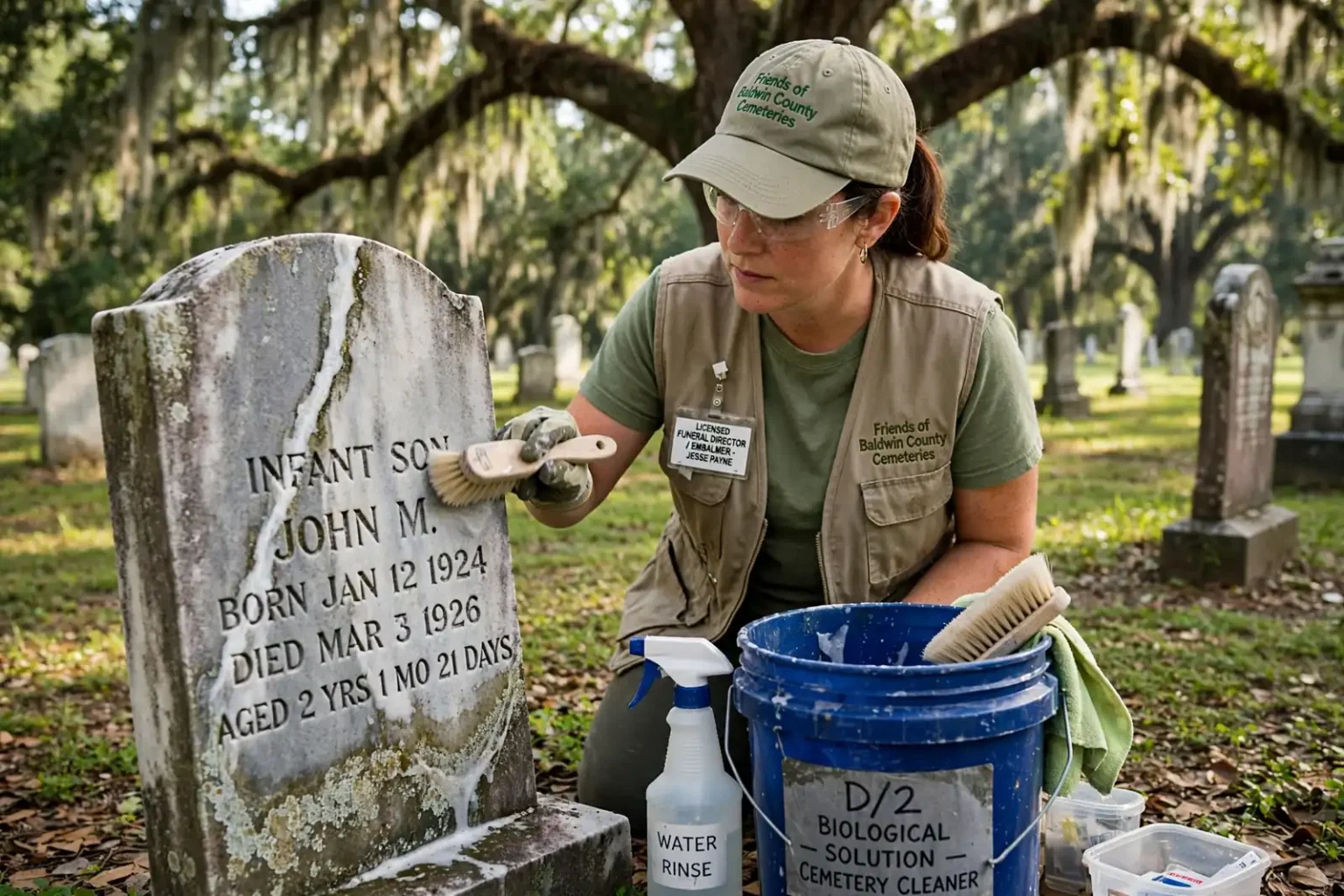
Jesse Payne still remembers the first headstone she brought back to life. It marked the grave of a 2-year-old boy at Brook Cedron Cemetery in Barnwell, and it was so caked with dirt and grime that no one could tell it was marble. Today the Fairhope native leads Friends of Baldwin County Cemeteries, a volunteer effort she started in 2025 to clean and restore gravestones across the county, and she estimates she has worked on 50 to 75 graves so far.
Payne described that first stone as “the cutest little grave.” Once it was cleaned, its true colors came through: mostly gray, she said, with a vein of white running through it.
“A lot of marble specifically, if you do marble headstones, they’ll have the veinage in them and you wouldn’t be able to see that unless you clean it,” Payne said. “The first grave that I did, it was mostly gray and it had like a veinage of white in it. It was gorgeous.”
A family cemetery that sparked a mission
Payne was born and raised in Fairhope, and Brook Cedron Cemetery is personal for her. Several generations of her family are buried there, including her grandparents, Gordon and Barbara Childress. She has long tended their graves, replacing flowers, pulling weeds and keeping the stones clean.
Over time, she started noticing the condition of the rest of the cemetery. Faded artificial flowers were scattered across the grounds, and so was trash.
“I kind of noticed there was like fake flowers everywhere. There’s trash everywhere,” Payne said. “I kept telling myself, ‘My God, I can’t believe the council or whoever, the board, is not taking care of this.’ That happened several times and I was like ‘Well, why don’t I just do something about it?'”
That question became Friends of Baldwin County Cemeteries, a volunteer group made up of Payne’s friends and family. She runs the work as a side project alongside her full-time career.
A funeral director’s eye for the cemetery
Payne is unusually well prepared for the job. She is a licensed funeral director, embalmer and cremationist, which means cemeteries are already a regular part of her working life.
“Being a (funeral director), you have to go to the cemetery, you have to look at people who’ve passed away and you have to help them with the grieving process and everything like that, so I think it’s absolutely helped me,” Payne said.
That background also shapes how she approaches restoration. Payne works with the permission of the cemeteries and, when they can be found, the families of the people buried there. Most of the graves she has restored are historical, dating to before the 1970s, when many family members who once cared for them have died or moved away.
How a headstone gets restored
Payne’s workdays in the cemetery start early, usually between 7:30 and 8 a.m., before the heat of the day. She picks weeds, collects trash and then turns to the headstones themselves.
To clean the stones, she uses D/2 Biological Solution, a cleaner she said is also used to clean and maintain veterans’ graves at national cemeteries. Products like it are designed to remove the biological growth that darkens old stones, such as black mold, algae and lichen, without the damage that harsher methods can cause.
“I recently did a couple of graves for a gentleman,” Payne said. “Of course, you’ve got that black mold and lichen there, and people don’t realize that you can get that off no problem with the correct steps and everything like that. He was just amazed. He was flabbergasted, really. It makes them look refreshed.”
A cleaning can take a couple of hours or stretch over several days, depending on the stone’s condition. Broken markers take the longest. One double gravestone for E.L. and Robert Jackson, who died in the early 1900s, had broken into multiple pieces. Payne spent a week restoring it, rejoining the pieces with a stone-safe epoxy that needs 24 hours to cure.
Why gentle methods matter
Old headstones are more fragile than they look. Marble, which was widely used for grave markers in the 19th and early 20th centuries, is a soft stone that can be etched by acidic cleaners and scratched by abrasive tools. Over decades of rain, its carved lettering can wear down, and sugary-looking surfaces can crumble when scrubbed too hard.
Cemetery preservation guidance generally warns against using household bleach, wire brushes, power tools or high-pressure washers on historic stones, all of which can cause damage that cannot be undone. Instead, preservationists favor plain water, soft natural-bristle brushes and cleaners made specifically for masonry and monuments, along with a lot of patience. Repairs to broken stones call for adhesives and materials that are compatible with the stone rather than ordinary hardware-store cement.
That is why Payne stresses “the correct steps.” Done right, cleaning lets the stone’s original color and carving show again. Done wrong, it can shorten the life of a marker that has already stood for a century.
Cemeteries from Fairhope to Bay Minette
Brook Cedron Cemetery is where Payne got started, but her work has spread across Baldwin County. Her list of cemeteries includes:
- Brook Cedron Cemetery in Barnwell
- Twin Beech Cemetery in the Fairhope area
- Overton Davis Cemetery in the Fairhope area
- The abandoned Mount Sinai Cemetery in the Fairhope area
- High Pine Cemetery in Bay Minette
Many of Baldwin County’s older burial grounds are small church, family or community cemeteries that predate the county’s rapid growth of recent decades. Some no longer have an active congregation or association to maintain them, which leaves upkeep to volunteers, descendants or no one at all. Efforts like Payne’s help keep those places and the local history they hold from disappearing under weeds and grime.
Interest in that history runs deep in the county. Recent efforts have ranged from a federal grant to add more than 2,000 gravesites at the Alabama State Veterans Memorial Cemetery at Spanish Fort to community historical society programs on the county’s oldest churches.
How to get involved
Payne encourages residents to follow the Friends of Baldwin County Cemeteries Facebook page. She uses it to share her restoration work and to organize community cleanup days, when volunteers can help clean up local cemeteries.
Anyone who wants to care for a family grave or a neglected cemetery on their own should start by getting permission from the cemetery’s owner or caretaker and, when possible, the family of the deceased. It also helps to learn about proper cleaning methods before touching an old stone, or to work alongside someone experienced.
“The importance of talking about death is huge”
Spending her days among the dead does not bother Payne. If anything, she said, it has made her more willing to talk about death openly.
“It does the opposite in fact,” Payne said. “I ask people this all the time. I’m like, ‘Do you know whether or not what you want to do? Is there a plan? Have you talked about it?’ My family gets annoyed by me now because I’m like ‘So what do you want after you die? What do you want to do? You want to do cremation? You want to do burial? You want to have a green burial?’ I think the importance of talking about death is huge because you just never know when it’s going to happen. You really don’t.”
Funeral professionals often echo that advice. Talking about end-of-life wishes ahead of time, from burial or cremation to the kind of service a person wants, can spare families from making hard decisions in the middle of grief. For Payne, that conversation and the work of restoring forgotten graves come from the same place: a belief that the people who came before us, and the people who will remember us, both deserve care.