
Mobile Police Sought Man Wanted in Rape and Kidnapping of a Woman
Mobile police searched for Jeffrey Sewell, 30, wanted on four felonies including first-degree rape and kidnapping after a woman said she was held and assaulted for several hours.
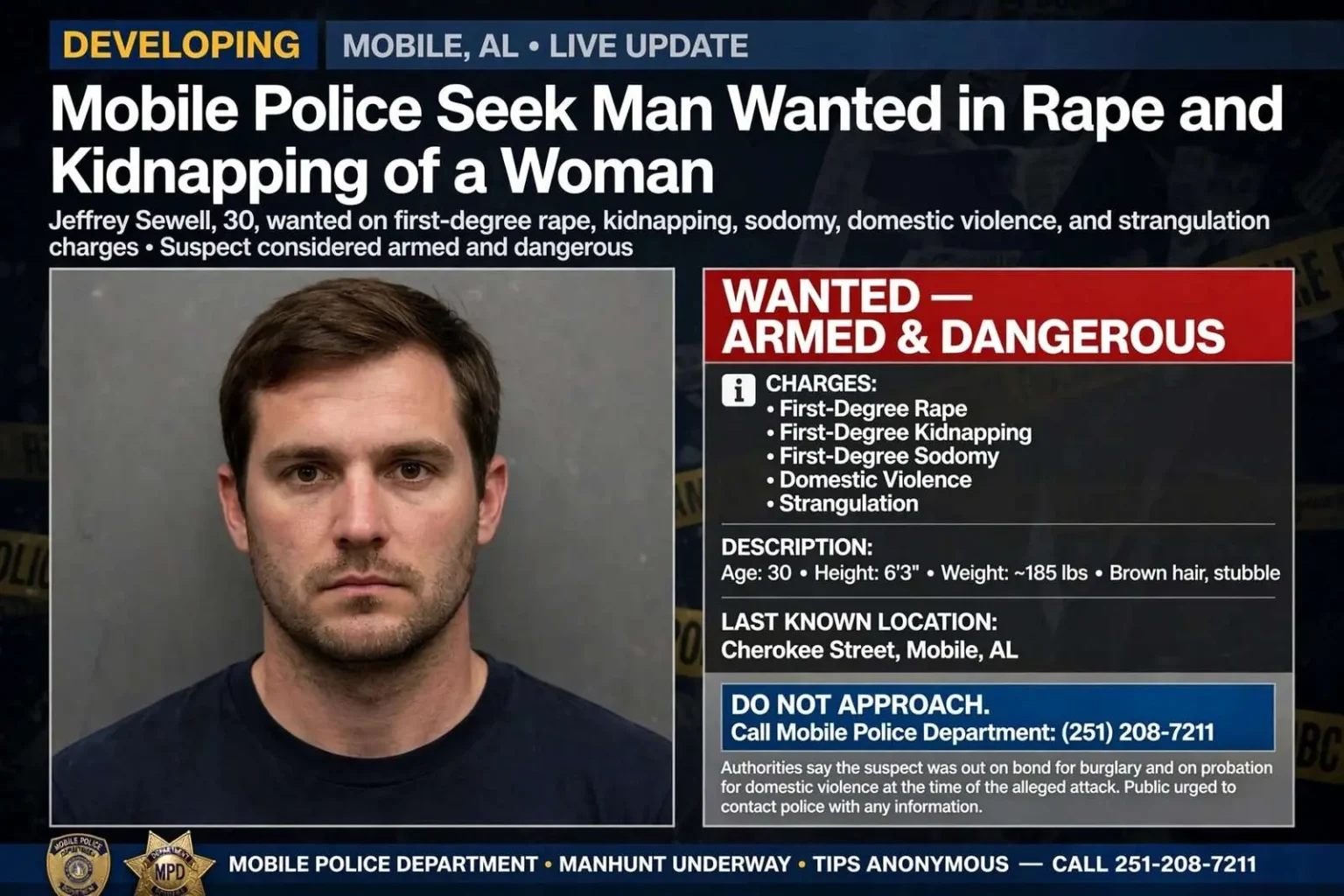
Mobile police searched for a man accused of kidnapping and raping a woman, an assault that authorities said unfolded over the course of several hours. Jeffrey Sewell, 30, was wanted on charges of first-degree rape, first-degree kidnapping, first-degree sodomy, domestic violence and strangulation.
Police said the woman in the case reported that Sewell had held her and physically and sexually assaulted her before she was able to report the attack. Detectives took the report and moved quickly to obtain warrants, and the department publicly identified Sewell as the suspect within hours of the allegations reaching investigators.
A suspect already known to the courts
According to police, Sewell was out on bond for a burglary charge and on probation for a domestic violence offense involving another woman at the time of the reported attack. His arrest record, officials said, stretched back roughly 12 years.
The combination of pending charges, probation and a lengthy history lent urgency to the search, as investigators worked to locate a man they considered dangerous.
His history, as described by police, followed a pattern that domestic violence specialists recognize: allegations involving one partner, followed by allegations involving another, with the courts releasing the defendant between cases. Bond and probation are designed to balance a defendant’s presumption of innocence against community safety, and cases like this one are the reason judges ask detailed questions about prior violence before setting those conditions.
Police described Sewell as 6 feet 3 inches tall and about 185 pounds. His last known address was on Cherokee Street in Mobile. Authorities circulated a photograph in hopes that residents might recognize him and help pinpoint his whereabouts.
The manhunt began after the woman’s report reached investigators, who spent the first hours confirming the account, coordinating with supervisors and preparing the warrant paperwork that allowed the department to name Sewell publicly. Under department practice and Alabama law, naming a suspect before an arrest is reserved for serious cases, when public safety may depend on residents knowing who police are looking for.
The bundle of charges — rape, kidnapping, sodomy, domestic violence and strangulation — is among the most serious a Mobile County defendant can face, and the fact that the suspect was allegedly already under court supervision when the new offenses occurred placed the case squarely in the category that prosecutors treat with the greatest care.
Cherokee Street runs through a working-class section of the city, and police activity tied to the search was visible in the neighborhood as officers followed up on addresses associated with the suspect and canvassed residents who might have seen him.
The allegations
The charges Sewell faced were among the most serious in the state’s criminal code. First-degree rape and first-degree kidnapping are Class A felonies in Alabama, carrying the potential for lengthy prison terms upon conviction.
The additional counts of sodomy, domestic violence and strangulation reflected the account the victim gave to investigators, who said she had been confined and assaulted for hours before the case came to light.
Strangulation, in particular, has drawn increasing attention from prosecutors and lawmakers in Alabama and across the country. Research on domestic violence has shown that victims who are strangled face dramatically elevated risks of later homicide, and several states have made the offense a felony in its own right precisely because it often marks an escalation in a violent relationship.
Prosecutors in Mobile County treat strangulation allegations as a key signal in charging decisions. Evidence of strangulation — including medical documentation of injuries that may not be visible — can elevate both the charges a defendant faces and the risk assessment used in bail arguments, and investigators are trained to ask about it specifically when interviewing survivors.
First-degree kidnapping, under Alabama law, generally involves the forcible detention of a person with intent to inflict physical harm or to terrorize, and the charge combined with the other counts described the ordeal investigators said the woman endured from the time she was taken until she was able to reach help.
Because the charges are Class A felonies, bond would be set at a level reflecting the gravity of the offenses and the defendant’s history, and a conviction on a single count would carry a potential sentence measured in decades rather than years.
Domestic violence probation in Alabama typically carries conditions that include no-contact orders, counseling requirements and regular reporting to a probation officer. A new arrest on charges of this severity would constitute a violation of those conditions almost by definition, giving the court an independent basis to hold the defendant regardless of how the new charges resolve.
Cases in which a suspect is already on bond or probation when new allegations arise often draw heightened scrutiny, both from prosecutors weighing how to proceed and from the public asking how such situations occur.
A defendant arrested on new felony charges while on bond for another offense can expect prosecutors to seek revocation of the earlier release, and a probation violation is handled separately from the new charges, often resulting in immediate custody. In practice, that means the court system has multiple avenues for holding a defendant like Sewell once he is located, even before the new charges go to trial.
For Mobile investigators, the immediate priority was locating Sewell before he could flee the area or harm anyone else.
A call for the public’s help
Police asked anyone with information about Sewell’s whereabouts to contact the Mobile Police Department. As in many cases involving a wanted suspect, detectives depended on tips from residents, family members and acquaintances to narrow the search.
A single credible lead about a location or a vehicle could prove decisive in bringing a suspect into custody.
Tip lines in manhunts of this kind are staffed around the clock, and investigators triage each report by specificity — a location, a vehicle, a time of day — before dispatching officers to follow up. Anonymous tips are accepted, but those that come with names and details can be verified and acted on faster, which is why departments emphasize the value of even partial information.
The department’s appeal underscored a broader reality of local law enforcement: even with an active investigation and a known identity, apprehending a suspect who does not want to be found often requires community cooperation.
U.S. Marshals and other agencies frequently assist local departments in locating violent felony suspects, and Mobile investigators had access to those partnerships if the search extended beyond the city. Fugitive teams combine local knowledge with databases that track addresses, vehicles and associates, and their involvement often accelerates an arrest once the initial canvass runs out of leads.
Officers urged anyone who spotted Sewell not to approach him but to alert police immediately. That guidance is standard in cases involving violent felony suspects, both for the safety of residents and to preserve the opportunity for officers to make an arrest without a confrontation.
At the time of the report, Sewell remained at large, and the case stood as an open and serious matter on the department’s docket. The outcome would depend in part on how quickly investigators could act on any information the public provided, and on whether the woman’s account would be tested in court against a defendant once he was located and charged.
The search also reflected the difficult work of protecting victims of domestic and sexual violence, cases that often involve a suspect known to the person harmed and a history of prior contact with the courts.
Neighbor notifications in cases like this often extend beyond the police blotter: schools in the area may be alerted when a violent suspect is being sought nearby, and patrol officers on the affected beats receive the photograph and description so that a sighting reported to any officer reaches investigators immediately.
Advocates have long noted that survivors face steep hurdles in coming forward, and that swift, coordinated police action can be critical both to their safety and to the strength of a prosecution. Advocacy organizations in the Mobile area provide crisis counseling, safety planning and courtroom support for survivors, and police departments increasingly work with those groups from the earliest stages of an investigation.
Investigators in cases of this kind typically move on parallel tracks: securing medical evidence, interviewing witnesses, documenting the scene and the timeline, and monitoring locations where the suspect might go. The first hours matter, because evidence that can be collected quickly — from phones, vehicles and addresses the suspect is known to frequent — grows harder to obtain as time passes.
Survivors of sexual violence in Alabama can also reach out to the statewide crisis line and to hospital-based sexual assault nurse examiner programs, which collect forensic evidence in a way that preserves the survivor’s options whether or not she chooses to participate in prosecution immediately. Those programs exist precisely because cases like this one depend on evidence gathered in the first hours and days.
In circulating Sewell’s photograph and description, Mobile police signaled that they regarded the threat as immediate and urged residents who believed they had seen him to call rather than confront him.
The department’s notice, distributed with the suspect’s photograph, physical description and last known address, was the standard instrument of such searches — a direct appeal to the thousands of people who see a face before any officer does, and a reminder that in a manhunt, the public’s eyes are the widest net the police can cast.