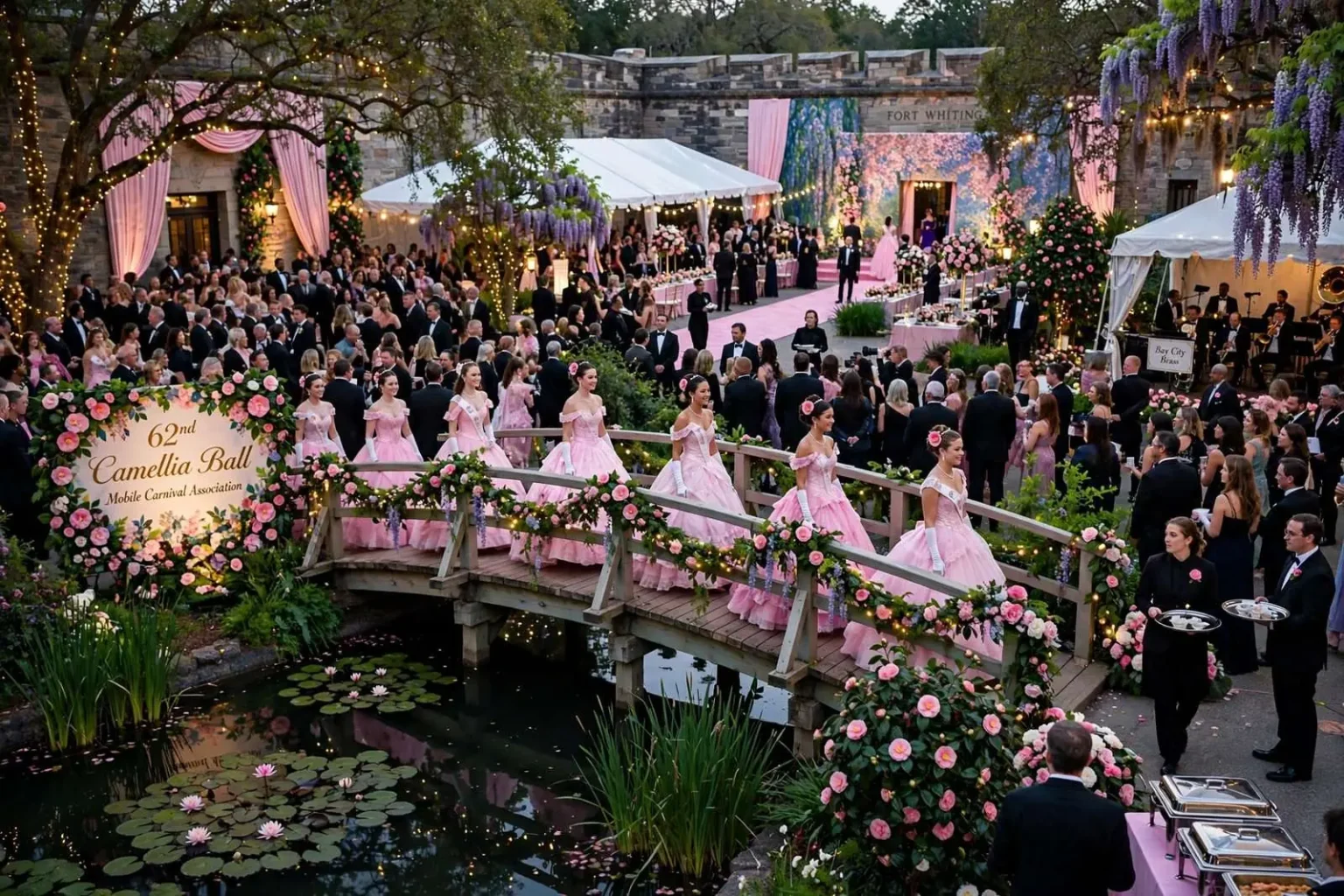
An elegantly decorated ballroom with garden-themed floral displays for a formal debutante ballMobile's Camellia Ball opened the 2015 Mardi Gras season with a Monet-inspired garden theme.

MOBILE, Ala. — Mardi Gras season officially got underway in Mobile with the 62nd Camellia Ball, the traditional kickoff event hosted by the Mobile Carnival Association at Fort Whiting.

Roughly 1,500 guests filled the venue as the reception committee welcomed 30 young women making their formal Mobile debut, each dressed in the traditional pink ball gowns that have become a signature of the citywide celebration. The evening marked the first major formal event of the season, a role the Camellia Ball has played for the Mobile Carnival Association for more than six decades.

This year’s decorations drew inspiration from Claude Monet’s gardens at Giverny, transforming the venue into a water garden complete with a replica of the artist’s famous Japanese footbridge. Debutantes crossed the bridge as they were formally presented to guests, while florals and design details throughout the ballroom echoed Monet’s Impressionist palette. The celebration spilled into the courtyard as well, where tents and a pink carpet extended the garden theme beyond the main ballroom.

The elaborate décor was designed by Mobile Carnival Association design chairman Robison C. McClure and brought to life by Ron Barrett and Julia Greer of the design firm Barrett and Greer. Music came from two ensembles: Jubilation, a band from Mandeville, Louisiana, performed in the ballroom, while Bay City Brass of Mobile entertained guests in the courtyard. Fifty-four young serving girls circulated among attendees offering hors d’oeuvres throughout the evening.

Catering for the event was handled by Clifton Morrissette of Delta Fish House, while Showbiz Theatrical Services provided lighting and sound. The evening was documented by photographer Jeff Tesney and videographer Ron White of Wedding Media Group.

The Camellia Ball’s role as the traditional opener for Mobile’s Mardi Gras season underscores the city’s status as home to the oldest organized Carnival celebration in the United States, predating the more widely known New Orleans festivities. For the debutantes and their families, the ball represents a milestone moment, while for the broader Mobile community it signals the start of weeks of parades, balls and celebrations that define the winter social calendar across the region.

Each year’s Camellia Ball brings a new design theme, with past years drawing inspiration from a range of artistic and cultural touchstones. This year’s Monet-inspired garden setting continued a tradition of elaborate, carefully choreographed presentations that have made the ball a fixture of Mobile high society for generations.

Mobile is the county seat of Mobile County in southwest Alabama and the state’s only saltwater port. Situated where the Mobile River meets Mobile Bay near the northern Gulf of Mexico, the city has long served as a commercial and cultural gateway between Alabama and the wider Gulf Coast. Founded in 1702 as Fort Louis de la Louisiane and ruled in turn by France, Britain, and Spain before joining the United States in 1813, Mobile carries a layered heritage distinct from the rest of the state.

See also  Mobile County's 2015 Budget Includes Raises but Leaves Little Room to Spare

Today Mobile anchors a metropolitan area spanning Mobile County and neighboring Baldwin County, and it remains a center for shipping, aerospace, healthcare, and higher education in the region. Its downtown and waterfront have seen sustained revitalization, while historic neighborhoods preserve architecture from its colonial and antebellum past. The city’s identity is shaped as much by its working port and industrial base as by its festivals and food culture, making it a frequent focal point for news about growth and change in southern Alabama.

Mobile lays claim to a long tradition of outdoor festivals and public celebration, most famously its Carnival or Mardi Gras season, which predates the better-known celebrations of New Orleans. Throughout the year the region hosts music festivals, food and arts events, and waterfront gatherings that draw visitors from across the Gulf Coast.

Such events are economic and cultural anchors for the area, supporting hospitality, tourism, and local artists while fostering a sense of community identity. Organizing them involves coordination among city government, business sponsors, public-safety agencies, and volunteers, and they frequently appear in local news coverage of the region’s cultural life.

For many residents, these gatherings are also a point of civic pride and a way to mark the seasons. The mix of nationally known and local performers common to regional festivals reflects the area’s dual character as both a close-knit community and a stop on broader touring circuits.

Probate courts in Alabama handle matters distinct from the trial courts that hear criminal and civil cases, including wills, estates, guardianships, and involuntary commitments for mental-health treatment. In Mobile County the probate judge is an elected official with broad administrative and judicial duties.

Cases involving involuntary psychiatric commitment require the court to balance an individual’s liberty interests against concerns for their safety and the safety of others, a sensitive legal threshold that has drawn scrutiny in many jurisdictions. The procedures governing such hearings, including who must appear and testify, are set by state law and local rule.

See also  Historic Mobile Orphanage to Become 'Cotton Hall' Mardi Gras Lodge

Disputes over those procedures often surface tensions between healthcare providers, the court, and advocates for patients. Because the stakes involve both liberty and wellbeing, courts and clinicians alike face pressure to honor the law while ensuring that people in crisis receive timely and appropriate care.

The natural environment is central to life on the Gulf Coast, where barrier islands, bays, rivers, and wetlands support fisheries, recreation, and storm protection. Coastal Alabama faces challenges common to low-lying regions, including hurricane exposure, erosion, and the management of fragile ecosystems.

The Mobile-Tensaw Delta, one of the largest river deltas in the country, is a particularly significant natural asset. Conservation efforts, fisheries regulation, and shoreline restoration are frequent points of collaboration among state agencies, federal bodies like the Army Corps of Engineers, and environmental groups.

How the region plans for growth while protecting its natural assets is a recurring theme in local reporting. The tension between development pressure and ecological stewardship plays out in zoning fights, infrastructure projects, and disaster-recovery decisions that shape the coast for generations.

Local journalism serves as the connective tissue of communities like those across South Alabama, informing residents about government, schools, public safety, and the events that shape daily life. Outlets covering Mobile and Baldwin County help hold institutions accountable and give voice to neighborhood concerns larger media may overlook.

In an era of shifting advertising revenue and the rise of digital platforms, community news organizations have had to adapt how they gather and deliver information. The persistence of regional reporting remains important for civic engagement, particularly on issues such as coastal development, education, and local governance that directly affect residents.

The relationship between a local newsroom and its community is reciprocal: readers supply tips, context, and a sense of what matters, while the reporting provides a shared record of decisions and events. That loop is essential to a well-informed public.

Baldwin County sits directly east of Mobile County across Mobile Bay and is the largest county in Alabama by land area. It encompasses the Eastern Shore communities of Daphne, Fairhope, Spanish Fort, and Foley and stretches south to the beaches of Gulf Shores and Orange Beach along the Gulf of Mexico.

Long among the fastest-growing counties in the state, Baldwin blends suburban development near the bay with tourism-driven coastal economies. Its proximity to Mobile and its position on the Eastern Shore make it a recurring subject of regional news covering growth, infrastructure, schools, and the balance between development and coastal preservation.

See also  Mobile Business Owner Hosts Shopping Spree to Support Alzheimer's Caregivers

Mobile Bay is a shallow estuary in southern Alabama where freshwater from the Mobile, Tensaw, and other rivers mixes with saltwater from the Gulf of Mexico. It is among the largest estuarine systems in the United States and supports commercial and recreational fishing, shipping through the Port of Mobile, and wetlands that buffer the coastline from storms.

The bay’s Eastern Shore, in Baldwin County, includes Daphne, Fairhope, and Spanish Fort, while the Western Shore lies in Mobile County. Its ecology and economy have guided settlement for centuries, and the bay figures in regional debates over development, navigation, and conservation. Events on either shore are routinely covered as part of the interconnected life of the Mobile metro area.

The Gulf of Mexico borders Alabama’s southern edge and defines much of the state’s coastal identity. Alabama’s Gulf coastline, centered on Dauphin Island, Gulf Shores, and Orange Beach, supports a tourism industry built around beaches, charter fishing, and marine recreation, while offshore waters host shipping lanes and energy interests.

The Gulf’s warm, shallow shelf and exposure to hurricanes make weather and disaster preparedness recurring concerns for communities from Mobile to Baldwin County. The marine environment also underpins commercial seafood harvests that have sustained Gulf Coast families for generations, tying the region’s economy and culture closely to the water.

Alabama is a state in the southeastern United States bordered by Tennessee, Georgia, Florida, the Gulf of Mexico, and Mississippi. Often called the Heart of Dixie, it spans Appalachian foothills in the north and flat coastal plains in the south. Its largest cities include Birmingham, Montgomery, Huntsville, and Mobile.

Alabama’s history encompasses Indigenous roots, Spanish and French colonial settlement, a cotton-plantation economy, the Civil War and Reconstruction, and the Civil Rights Movement of the 1950s and 1960s, followed by a shift toward manufacturing, aerospace, and technology. Local news across the state frequently reflects this mix of tradition and change.