Downtown Mobile Cyclists Test-Ride Fresh Bike Lanes on St. Louis Street
About 150 cyclists turned out in downtown Mobile to try freshly painted bike lanes along St. Louis Street during a Sunday afternoon flash ride event.
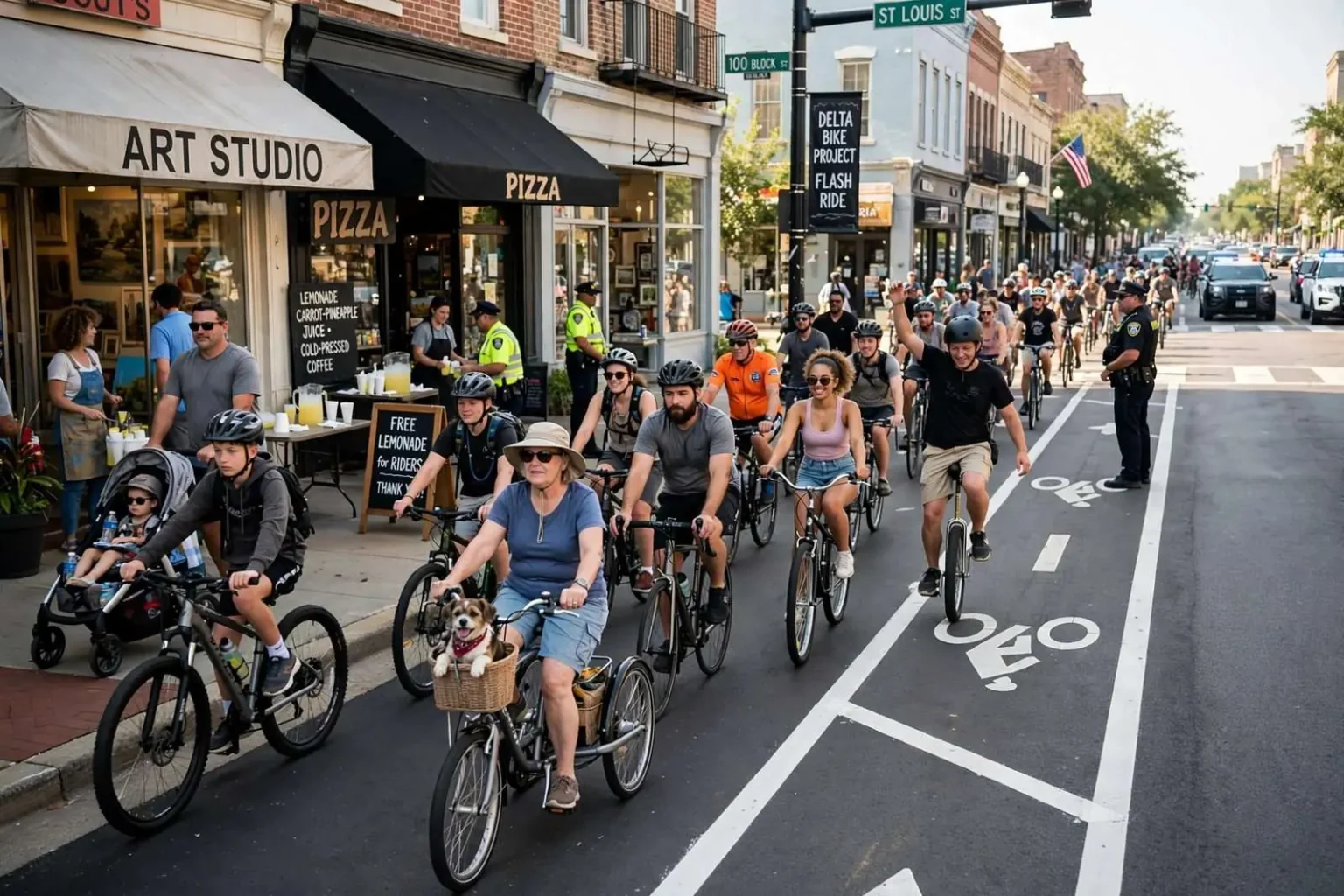
MOBILE, Alabama — Roughly 150 cyclists rolled through downtown Mobile on a hot Sunday afternoon to try out freshly painted bike lanes along a newly repaved stretch of St. Louis Street, part of a grassroots push to make the city’s core more welcoming to riders. The ride was equal parts demonstration and celebration, giving riders a first taste of marked lanes in the heart of downtown while showing city leaders and passersby that demand for bicycle infrastructure is real, visible and growing.
The event transformed a block of the city’s grid into something Mobile’s streets rarely show: a corridor where bicycles had a designated place and drivers had clear instructions about where to find them. For two hours on a summer Sunday, the painted white lines did the talking, and the crowd did the pedaling.
A Flash Ride With a Purpose
The event, organized by the executive director of the Delta Bike Project, brought together roughly 100 riders who met at the group’s St. Francis Street location before pedaling over to St. Louis Street, where 50 or 60 more cyclists joined them. Volunteers had marked both sides of the four-block stretch with white paint, creating two 8-foot bike lanes and leaving two 12-foot travel lanes for cars. Police officers stationed at each end of the corridor did not close the street but slowed traffic as riders passed through.
The Delta Bike Project operates as a community bike shop in downtown Mobile, combining used-bike sales with repair education and advocacy for better riding conditions. Its St. Francis Street space has become a natural gathering point for the city’s riding community, and the flash ride format — organize quickly, show up visibly, make a point — suited both the group’s grassroots character and the temporary nature of the painted lanes.
The lane design itself followed a straightforward logic. Eight feet is wide enough for a comfortable riding lane on each side of the street, while the remaining 12-foot travel lanes keep two-way car traffic flowing. The four-block stretch was chosen because the city had just repaved it, providing a smooth surface and a blank slate for the volunteer-painted markings. Police presence at each end kept vehicle speeds down without closing the street, preserving the ordinary traffic that riders would share with in everyday use.
Getting Drivers Used to Sharing the Road
Organizers said the police presence reflected a broader cultural shift already underway in the city, where drivers are still adjusting to sharing downtown streets with cyclists. The goal of clearly marked, easy-to-navigate bike lanes, they said, is a healthier, happier and more economically vibrant downtown. The idea traces back to when the city first repaved the corridor and included a single experimental block of bike lane to gauge interest. After a month of encouraging local riding groups to use that block, organizers said the response was strong enough to justify expanding the concept along the full stretch for the flash ride.
The incremental approach — one block, then four — is how bike infrastructure often takes root in Southern cities where dedicated lanes are still novel. The experimental block gave both riders and drivers a low-stakes trial period. Riding groups publicized the lane among their members, drivers grew accustomed to the markings, and the city could observe how the configuration performed before any decision about permanence. A month of strong response turned the experiment into a demonstration with a proven audience.
Advocates frame the case for lanes in practical terms. Marked lanes make riding predictable — cyclists know where to be, drivers know where to look — and predictability reduces the friction that generates conflict on shared streets. Cities that have invested in connected bike networks report benefits ranging from public health to retail activity, as riders on slow-moving bicycles notice and stop at storefronts that drivers blow past. Mobile’s downtown, with its historic grid, relatively flat terrain and growing residential population, checks the boxes that lane advocates look for.
Riders of Every Stripe
One longtime Mobile rider who has given up driving entirely, getting around instead by bus, on foot or by bike, rode up and down the new lanes several times on her three-wheeled cycle, with her small dog riding along in a basket. She said the marked lanes made her feel noticeably safer navigating downtown streets. The crowd also included roller skaters, families with strollers, and at least one local artist performing tricks on a unicycle, a skill he picked up decades earlier as a member of a local unicycle club that once performed in downtown parades.
The mix of users said as much about the corridor’s potential as the ride’s headcount. Bike lanes designed for commuters also serve the carless residents who depend on bicycles and buses for daily errands, and a street that feels safe enough for a three-wheeled rider and a dog in a basket is a street that works for nearly everyone. The unicyclist’s parade pedigree added a fitting note of local color — Mobile’s downtown streets have long hosted celebratory processions, and the flash ride joined that tradition in its own way.
Sunday timing made the event accessible to riders who avoid weekday traffic, and the hot afternoon did little to dampen participation. Attendance at the level the ride drew — roughly 150 riders across the two meeting points — gave organizers a concrete number to carry into conversations with city officials about extending the lanes.
Small Businesses Join In
Nearby shop owners used the turnout as a chance to introduce themselves to the crowd. A recently opened art studio on St. Louis Street, run by two artists who relocated from a more expensive space a few blocks away on Dauphin Street, saw a wave of new visitors curious about the space. Down the block, a local pizzeria’s general manager handed out samples of homemade lemonade, carrot-pineapple juice and cold-pressed coffee to help riders cool off, calling it both a chance to promote his menu and a vote of support for a more bike-friendly downtown.
The business response reflects a dynamic playing out in downtowns across the country: retailers have learned that cyclists arrive as customers, not just as traffic. A rider on a bicycle moves slowly enough to notice a new studio, and a refreshment stop on a hot ride converts passing interest into a purchase. The studio’s move from Dauphin Street — trading a pricier address for St. Louis Street — tracks a familiar pattern of businesses seeking space one block off the main commercial strip as downtown districts evolve.
For organizers, the participation of shop owners reinforced the economic argument embedded in their pitch. The flash ride was framed not as a special event but as a preview of a street that works better: more people arriving under their own power, more eyes on storefronts, more reasons to linger downtown.
Bikeable, but Not Yet Bike-Friendly
Several longtime downtown business owners said the area has long been physically bikeable but has lacked the infrastructure to make it truly welcoming to cyclists. Organizers hope events like the flash ride will build enough public support to expand marked bike lanes to more of downtown Mobile’s streets in the future.
The gap between bikeable and bike-friendly is measured in everyday decisions. Visitors and residents decide whether to bring a bicycle downtown based on whether the trip feels predictable, and predictable comes from paint, signage and connection — not from courage. The Sunday demonstration gave the city a working example of what the missing infrastructure looks like in practice, on a street whose fresh pavement made the case that the cost of adding lanes is highest at repaving time and lowest when the work is already underway.
The distinction they draw is a common one in American city planning. Almost any grid of narrow, low-speed downtown streets is technically rideable, and Mobile’s flat terrain makes pedaling easy. But without marked lanes, buffered space, or connected routes, riding downtown requires each cyclist to negotiate every block with every driver, and the result is a community of confident riders rather than a broad base of everyday ones. Infrastructure is what converts the former into the latter.
The four-block stretch of St. Louis Street, freshly repaved and painted, offers a template. Whether the city extends the concept depends on the same elements the flash ride supplied: visible demand, business support, and a demonstration that the configuration works. Organizers left the event with a larger argument than any single street could carry — that a healthier, happier, more economically vibrant downtown is something Mobile can paint, one lane at a time, starting with the four blocks where 150 riders spent a hot Sunday afternoon proving it can be done.