Push 4 Peace Rally Draws Crowd to Cathedral Square in Downtown Mobile
Families gathered at Cathedral Square in downtown Mobile for the second annual Push 4 Peace rally, a night of music, spoken word and prayer.
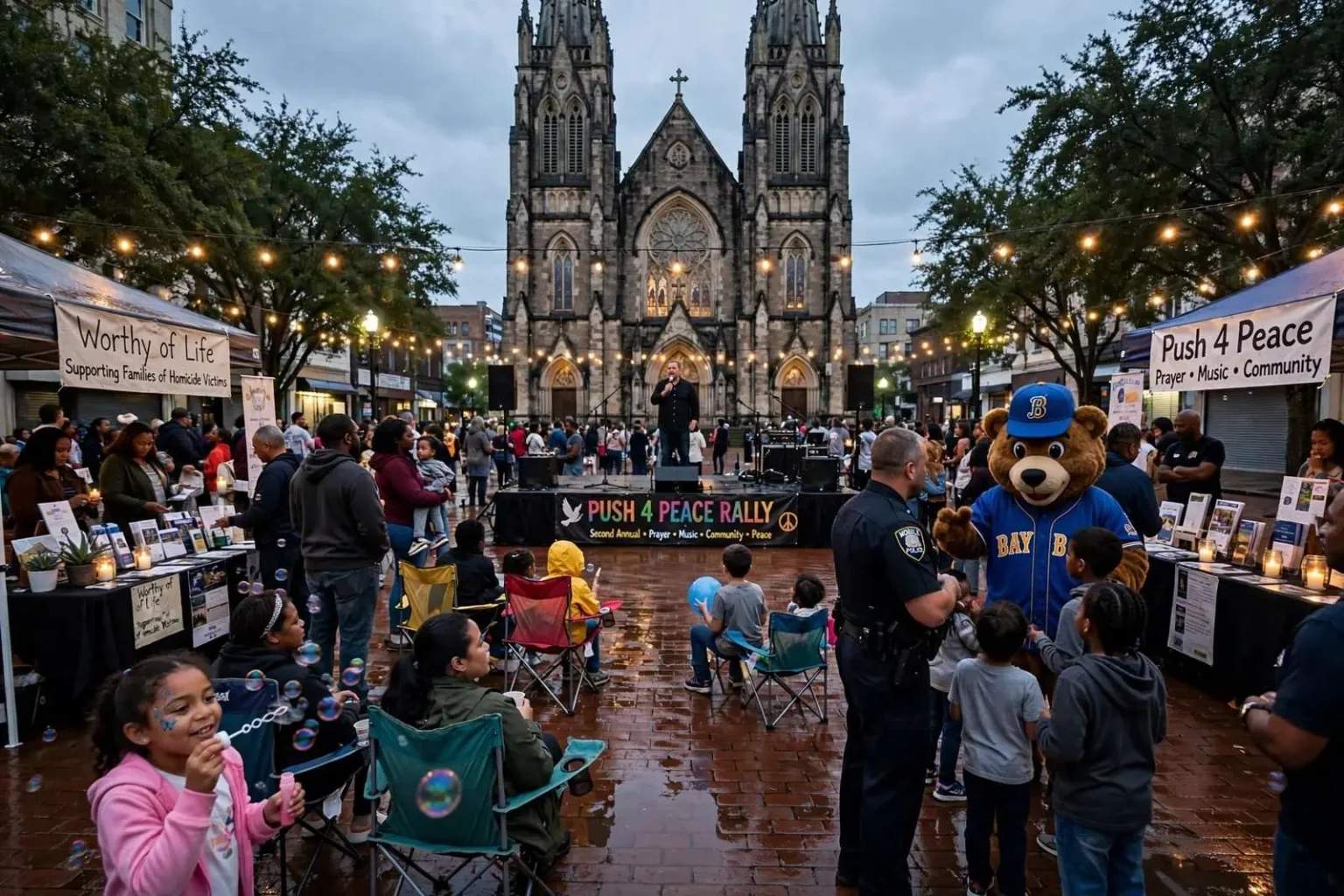
A steady stream of rain earlier in the day did not keep families away from Cathedral Square in downtown Mobile on a recent Friday evening, as residents set up colorful lawn chairs for the second annual Push 4 Peace rally and prayer vigil. By the time the event kicked off before 6 p.m., bubbles floated over the square while children got their faces painted and adults browsed booths set up around the park.
Cathedral Square, the brick-paved park in the shadow of the Cathedral-Basilica of the Immaculate Conception in the heart of downtown, has long served as a gathering place for festivals, markets and public ceremonies. On this evening it belonged to families from across the city, many of them from neighborhoods far from downtown, who came together around a shared concern over violence in their communities.
A Response to Violence, Born From Tragedy
The gathering was started by husband and wife Danny and Danielle Pledger in the wake of the 2012 mass shooting in Aurora, Colorado, as a way to bring the community together proactively rather than only after tragedy strikes. “We noticed that all the time, after bad things happen, people come together for vigils,” Danielle Pledger said. “We wanted to see God before something bad happened to our city.”
The Aurora shooting, in which a gunman opened fire inside a crowded movie theater during a midnight premiere, stunned the nation and prompted soul-searching in communities far from Colorado. For the Pledgers, it raised the question of what their own city could do before the next tragedy rather than after. The answer became Push 4 Peace — an annual rally built around prayer, music and open conversation about violence, aimed especially at young people growing up in Mobile’s most affected neighborhoods.
Organizers describe the annual event as a “spoken word and musical rally,” featuring a rotating lineup of speakers, rappers and dancers who used the stage to talk openly about their own experiences with violence while encouraging peace and prayer among those in attendance. The format is deliberately youthful: rather than a traditional prayer service, the evening runs on performances and testimony, with local artists using spoken word and hip hop to speak to the crowd about loss, forgiveness and responsibility.
A Message From the Rally’s Host
Minister Roderick Odom, who hosted the event, spoke to the urgency he sees in the community. “We’re in desperate times,” Odom told the crowd. “So many young brothers and sisters are dying… Everybody is somebody’s baby.”
His words carried the weight of a city that has watched young lives lost to gunfire year after year. Mobile’s violence, like that of many mid-sized Southern cities, is concentrated among young men in a handful of neighborhoods, and community leaders have increasingly turned to grassroots events — rallies, marches, mentoring programs and vigils — to reach young people where institutional programs have struggled.
City Leaders and a Grieving Mother Take Part
The rally drew a number of notable faces from around Mobile, including Police Chief James Barber, a representative from Mayor Sandy Stimpson’s office, and even the Mobile BayBears’ mascot, Bay B. Bear. The presence of the minor league baseball team’s mascot signaled the family-friendly intent of the evening, which paired its serious message with face painting, bubbles and activities for the youngest attendees.
Barber, who has led the Mobile Police Department since 2012, has made community engagement a centerpiece of his tenure, appearing at neighborhood meetings, church gatherings and events like Push 4 Peace across the city. For departments facing the trust gap that often separates officers from the communities they patrol, the visibility of leadership at grassroots events has become an expected part of the job.
Among the speakers was Cassandra Rodgers, whose 25-year-old son was killed in a still-unsolved shooting years earlier. Rodgers, who now leads an organization called Worthy of Life, spoke on behalf of her family about the toll violence takes on children left behind. “Little kids are suffering without their parents,” she said ahead of the event. “I know what it is to have your family torn apart.”
Rodgers’ organization is part of a network of mothers and family members of homicide victims who have turned private grief into public advocacy across Mobile. These groups hold their own vigils, push for tips in unsolved cases, and mentor children who have lost parents to violence — work that happens largely out of the spotlight but fills a gap that neither police nor city government can address directly. Her message at Cathedral Square was aimed at the children in the crowd as much as the adults: the cost of a single shooting ripples through classrooms, churches and dinner tables for years afterward.
Prayer, Performance and Community
As darkness settled over the square, the program moved through its lineup of speakers and performers while families lingered over the booths ringing the park. The tone balanced celebration with solemnity — children chased bubbles across the bricks while adults listened to testimonies about sons and daughters, brothers and sisters lost to gunfire.
The second annual gathering showed the kind of growth organizers hope for: more families, more community partners and a broader base of support than the first year. Grassroots anti-violence events often live or die on exactly that kind of momentum, and Push 4 Peace’s organizers have staked their effort on the idea that a yearly, visible gathering — in the middle of downtown, in front of the police chief and the mayor’s office — keeps the issue in front of the whole city rather than letting it fade back into the neighborhoods where it does the most damage.
Mobile’s Broader Fight Against Violence
The timing of the rally, coming at the end of a workweek as summer activities wind down, made it accessible to families who might not attend a weekday event. Free admission, a downtown location near major parking areas, and an early 6 p.m. start all lowered the barriers that keep many residents from participating in civic gatherings, and organizers have made a point of keeping those details consistent year to year.
Push 4 Peace joins a wider set of community responses to violence that have taken root in Mobile over the past decade. Faith leaders hold monthly prayers for peace in various neighborhoods, antiviolence marches draw hundreds through the streets of communities like Maysville and Trinity Gardens, and organizations focused on mentoring, job training and conflict mediation have grown alongside them. What distinguishes Push 4 Peace is its setting: rather than gathering in the neighborhoods most affected by shootings, the event deliberately stages its message downtown, where city leaders, police brass and passersby cannot avoid it.
Cathedral Square itself is a meaningful choice. The square sits at the center of Mobile’s historic district, bordered by the cathedral, the Mobile Museum of Art’s downtown outpost and some of the city’s oldest commercial blocks. Holding a rally about neighborhood violence in the city’s postcard setting makes a statement — that the issue belongs to the entire city, not just to the communities where the shootings happen.
The involvement of the BayBears, the Double-A minor league affiliate that played at Hank Aaron Stadium on the city’s west side, reflects the way local institutions have been pulled into the antiviolence effort. Sports franchises, churches, schools and nonprofits have all lent their platforms to the cause, part of a broader community mobilization that officials credit with keeping attention on the issue between crises.
What Comes Next for the Movement
For the Pledgers and the other organizers, the long-term hope is that the rally becomes a fixture of the city’s calendar, as familiar as the festivals that fill Cathedral Square each spring and fall. Their founding premise — that a community should gather to seek peace before tragedy, not only after — remains the event’s guiding idea, and each year’s program builds on the last.
The families who spread their lawn chairs across the square on Friday evening came from across Mobile, and their reasons for attending were as varied as the neighborhoods they call home. Some came to support the speakers, some came for the children’s activities, and some came because they too have buried someone. All of them, organizers say, are part of the answer the event is trying to build: a community that knows each other’s names, prays together in public, and refuses to accept young deaths as routine.
As the evening closed, the bubbles and the music gave way to a final prayer for the city — for the young men and women Odom described as dying in desperate times, for mothers like Cassandra Rodgers carrying unsolved losses, and for a Mobile that its organizers hope will learn to push for peace before it needs to mourn. The second annual Push 4 Peace rally ended as it began: a community, gathered in the rain-washed heart of its city, insisting that every life lost is somebody’s baby.