Mobile Police Board Up Juniper Street Home After 58 Arrests in 2014
Mobile police shut down a Juniper Street home tied to 58 arrests in 2014, using Alabama's drug-nuisance law to board it up.
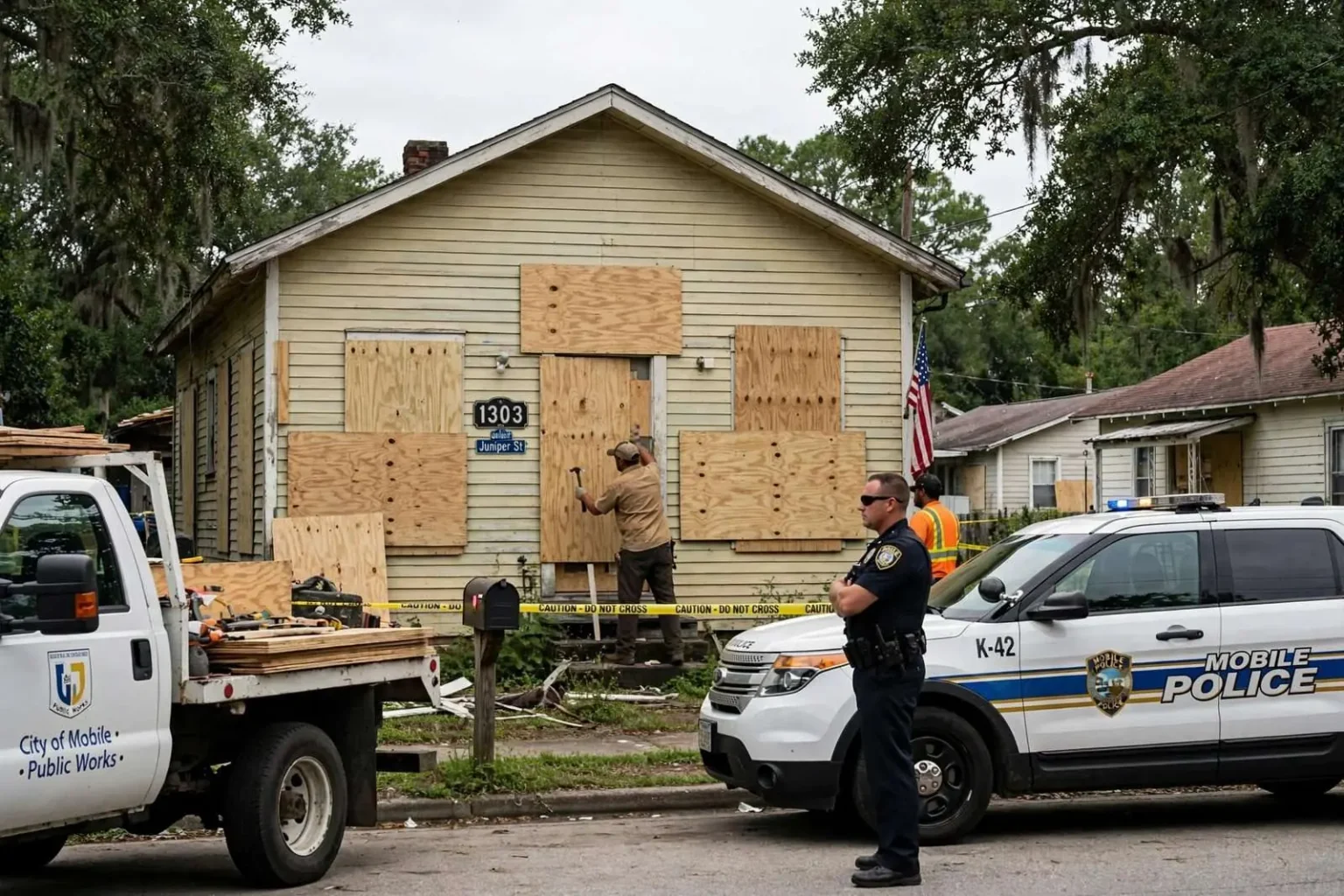
City workers boarded up a house on Juniper Street in Mobile on a Tuesday afternoon in June 2014, closing out a property that police say had racked up 58 arrests since the start of that year alone. The plywood over the doors and windows marked the end of a property that officers described as one of the busiest trouble spots in the neighborhood — and a test case for how aggressively Mobile would use state law to shut such places down.
Mobile Police Chief James Barber said the home’s owner had been sent a warning letter the week before, notifying them that the residence at 1303 Juniper St. was in danger of being declared a drug-related nuisance under Alabama law, a designation that can ultimately cost an owner the property. Police said the house had been on their radar as a known gambling and drug den for years.
The nuisance declaration process is built to give owners a chance to act before the city does. Under the state’s drug-related nuisance statute, a property where illegal drug activity repeatedly occurs can be hauled into court, and a judge can order it closed, padlocked or even forfeited. The warning letter Barber referenced is the procedural first step — formal notice that the next incident may not bring a letter but a lawsuit. When the owner did not clean up the property, the city moved to the next stage.
Two raids since January
Officers conducted two separate raids at the address since January, according to police. The most recent came on June 6, when officers arrested 24 people on charges including possession of a controlled substance and simple gambling. An earlier raid in January resulted in 34 arrests at the same address, bringing the year’s total to 58.
The scale of the activity at a single residential address stood out even to veteran officers. Fifty-eight arrests in roughly five months means the house was drawing people from across the area on a near-daily basis, and each raid — with its planning, staffing and booking paperwork — consumed resources the department would otherwise have spread across the district. Officials said the pattern was exactly the kind of drain on neighborhoods and police resources that the nuisance law was written to interrupt.
Capt. John Barber, who heads the Mobile Police Department’s Special Investigations Section, said the property had been known to police as a trouble spot for years before officers moved to shut it down for good. The Special Investigations Section handles the long-game work that regular patrol shifts cannot: surveillance, informant development, drug purchases and the case-building that turns complaints into search warrants. In the Juniper Street case, that work produced two successful raids — and, eventually, the paperwork for a nuisance action.
Court date set, homeowner named
With a temporary restraining order in place, no one was permitted to enter or leave the boarded-up house. Police were scheduled to appear before a Mobile County circuit judge later that month to formally make their case against the home’s owner, identified in court records as the property owner of record.
The temporary restraining order is the mechanism that keeps a closed property closed. Once a judge signs it, the house becomes legally off-limits pending the nuisance hearing, and anyone who enters faces separate consequences. The circuit court hearing that followed would determine whether the closure became permanent, whether the property could be forfeited outright, and what conditions the owner would have to meet before any reopening.
Second home closed under nuisance law
The Juniper Street closure marked the second time that year Mobile police used the state’s drug-related nuisance law to shut down a residence. Weeks earlier, in late May, city officials had boarded up a home on Partridge Street after officers served a third drug-related search warrant there in just two months. In that case, the homeowner agreed to bring the property up to code and prohibit further drug activity as a condition of reopening.
The two cases illustrated the two ways nuisance actions typically end. On Partridge Street, the owner negotiated — accepting conditions, repairs and oversight in exchange for getting the house back. On Juniper Street, the city was headed to a contested hearing, arguing that the volume of criminal activity — two raids, 58 arrests and years of complaints — left no workable agreement. The contrast offered a preview of how the department planned to handle similar properties: give owners notice and a path back to lawful use, then take the property through court if they refuse it.
For residents of the streets where these houses sit, the closures were relief measured in years of frustration. Nuisance properties generate a cycle that extends well beyond the drug trade — traffic at all hours, disputes among visitors, property damage, and a chilling effect that pushes ordinary neighbors indoors. Community groups in Mobile neighborhoods have repeatedly told city officials that one bad house can degrade an entire block, and the city’s expanding use of the nuisance statute was a direct response to those complaints.
The strategy also reflects a shift in policing philosophy that took hold in Mobile during those years. Rather than treating each raid as an isolated win, the department began pairing enforcement with civil action aimed at the property itself — the idea being that arresting visitors does little good if the house reopens the next night. Alabama’s nuisance law, like similar statutes in other states, gives cities that second tool, and Mobile’s police leadership made clear it intended to use it.
What happens after the plywood goes up
Following the Juniper Street closure, Chief Barber said police had not received any further complaints of drug activity at the property. He added that officers planned to meet with neighborhood leaders to discuss ways to prevent similar nuisance properties from taking root in the surrounding community, acknowledging that police alone could not solve the underlying problem.
That acknowledgment matters. Researchers who study chronic problem properties consistently find that enforcement clears a location temporarily, but without follow-up — attention to the vacant building, work with landlords, code enforcement, and community presence — the activity often relocates a few blocks away and begins again. Barber’s plan to sit down with neighborhood leaders recognized that the department’s tools end at the property line, while the conditions that create nuisance houses start much earlier.
He described a broader effort to work with residents on long-term solutions rather than relying solely on repeated raids. In practice, that means the department treating neighborhood feedback as intelligence — identifying the properties that generate the most calls, tracking owners who decline to act, and escalating from warning letters to lawsuits in a predictable, documented sequence. The two 2014 closures gave officers a track record to point to when they asked other property owners to clean up voluntarily before the city came for the building.
How Alabama’s nuisance law works
The statute at the center of the Juniper Street case allows a city to sue in circuit court when a building is used for drug dealing or related criminal activity. After notice to the owner, a judge can issue a temporary restraining order closing the property, then hold a hearing on a permanent order. Penalties escalate from required cleanup and conditions to padlocking for a year or more, and in serious cases the property can be declared a nuisance and sold. The law also reaches owners who claim ignorance: repeated warrants and arrests at an address establish that the activity was open and notorious, putting the owner on notice along with the city.
Civil rights advocates have long cautioned that nuisance actions must be aimed at activity, not at neighbors or family members of the people arrested — a concern that played out nationally as other cities overused similar ordinances. In Mobile’s case, officials emphasized that the law was being used sparingly, against a handful of addresses generating extraordinary complaint volumes, rather than as a blanket threat against whole neighborhoods. The 2014 numbers — two closures in a city of nearly 200,000 — matched that argument.
What residents of the Juniper Street area saw that June afternoon was the rare visible conclusion of a long enforcement effort. Boarded windows are an ugly sign, but in the calculus of community policing they are also a message: the open-air activity that made the street difficult is over, the courts have been engaged, and the property will stay closed until an owner takes responsibility. For the officers of the Special Investigations Section, the case joined a growing file of addresses where the department proved it would spend the months and paperwork required to make a closure stick.
The June hearing before the Mobile County circuit judge was set to decide the property’s ultimate fate, and the neighborhood was watching. Whatever the ruling, the sequence that produced it — warning letter, raid, raid again, restraining order, hearing — became the template Mobile police said they intended to apply wherever a house became a business for drugs and gambling. For the people who live on those streets, the measure of success will not be the plywood on 1303 Juniper St., but whether the next corner stays quiet.