A Mobile Law Student Finished a Summer on Capitol Hill in Shelby’s Office
Meg Demeranville, daughter of Dr. Charles and Kathy Demeranville of Mobile, completed an internship in Sen. Richard Shelby's Washington office, sitting in on Banking Committee hearings and guiding Capitol tours.
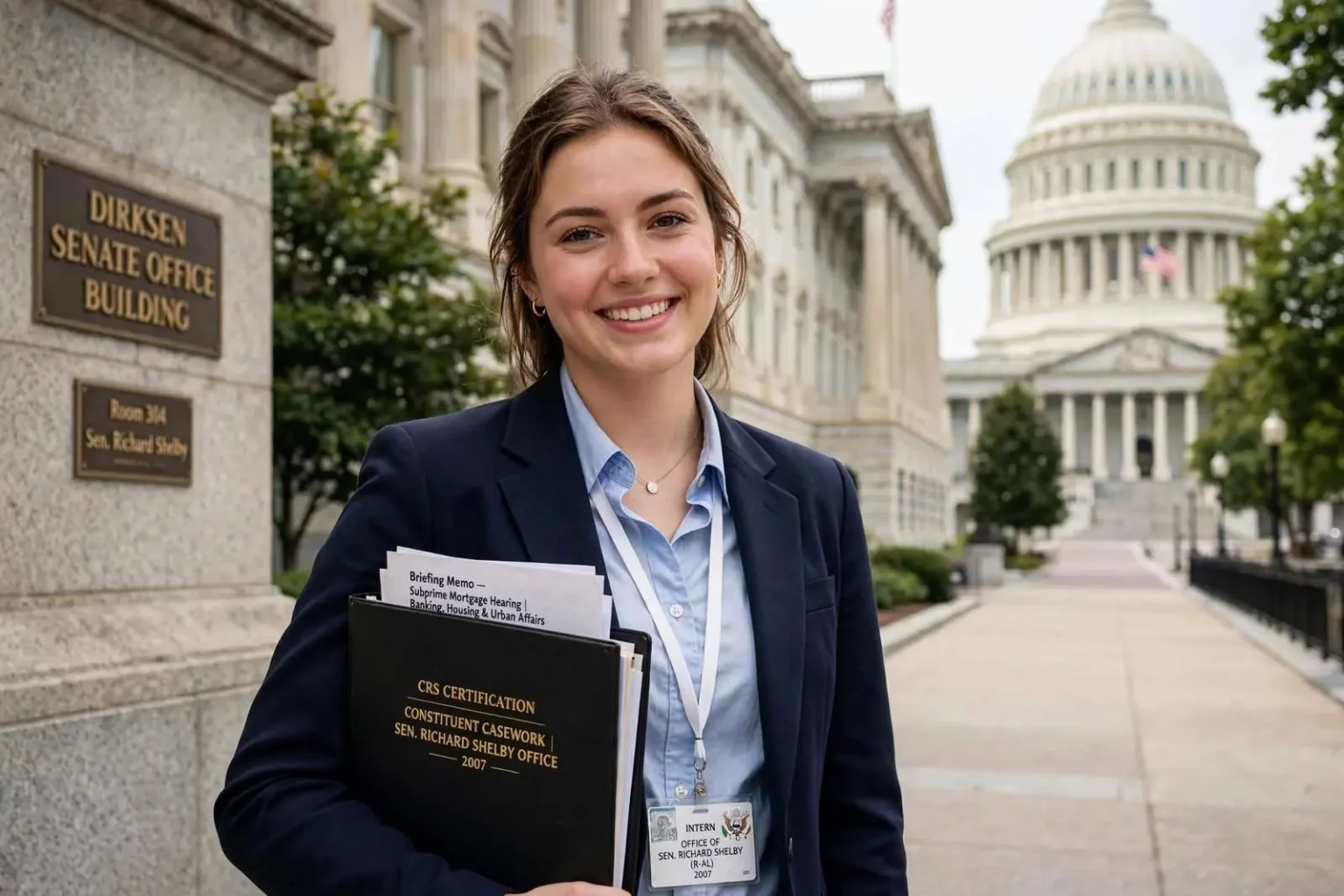
A Mobile law student completed an internship in the Washington office of U.S. Sen. Richard Shelby, a stint that carried her from constituent correspondence to the hearing rooms of one of the Senate’s most consequential committees. Meg Demeranville, the daughter of Dr. Charles and Kathy Demeranville of Mobile, joined Shelby’s office in May and recently finished her term there — one of the Alabama students selected each year for congressional internships that put young people inside the day-to-day work of a Senate office.
What the work involved
The job was a genuine one rather than a decorative one. Demeranville corresponded with constituents, assisted with government research, conducted tours of the U.S. Capitol building, earned Congressional Research Service certification, and attended several hearings of the Senate Committee on Banking, Housing, and Urban Affairs.
Constituent mail is the unglamorous backbone of every Senate office. Each day, Alabamians write about Social Security checks, veterans’ benefits, immigration cases, Medicare disputes and passport backlogs, and interns help track, research and route the casework that keeps an office accountable to the people it serves. Research assignments run alongside the mail: briefing memos, vote summaries and issue backgrounders that support the senator’s work on the floor and in committee. Capitol tours, meanwhile, put the intern at the intersection of history and hospitality, walking Alabama families through the Rotunda and the corridors their state’s politicians have walked for two centuries.
The Congressional Research Service certification is a credential in the mechanics of federal information — training in how to locate, evaluate and cite the documents and data of the federal government, issued by the research arm that serves Congress itself. For a law student, the skill translates directly: federal practice, legislative work and judicial clerkships all run on exactly that kind of document fluency.
That last item was not a small thing. Shelby was the ranking Republican on the Banking Committee, the panel with jurisdiction over the nation’s banks, securities markets, housing policy and the Federal Reserve. In the summer of 2007, that committee’s subject matter was becoming the most urgent in American economic life, as the market for subprime mortgages began to come apart. An intern sitting in those hearings was watching the opening chapters of a story that would consume the country — the spreading failures in adjustable-rate lending, the strains building in mortgage-backed securities, and the regulatory questions that would dominate Washington for the next decade.
Shelby’s position on the committee made the assignment unusually valuable for an Alabama intern. As ranking member, he helped shape the Republican side of the panel’s agenda, and his office’s staff followed the mortgage turmoil in detail. A law student with an interest in banking, real estate or financial regulation could hardly have sat closer to the fire.
In her words
“Working as an intern for Senator Shelby has been an invaluable experience,” Demeranville said. “I’ve been able to witness policy development in action, learn about the Capitol and the legislative process, and meet a wonderful group of people. I will truly treasure my time interning on the Hill.”
She was pursuing a juris doctorate at the Cumberland School of Law in Birmingham. Cumberland, founded in 1847 and one of the oldest law schools west of the Appalachians, has long supplied Alabama’s courts, firms and government offices with lawyers, and a Washington internship fits squarely into the school’s tradition of blending classroom training with practical exposure. Students who spend a summer in a Senate office return with a working map of how federal law is actually made — knowledge that shows up later in administrative practice, in regulatory work and in the handful of Alabama careers that lead to Washington itself.
Why senators run these programs
Shelby framed the internship as an extension of the classroom, and as a recruiting tool for public service. “The Congressional Internship Program is an important complement to these students’ academic studies,” the senator said. “Their experiences help bring to life what they have studied in the classroom. The internship fosters a fuller, richer understanding of our government’s legislative process, while providing a first-hand view of public service.”
He added the hope that lies behind most such programs: “Many times, interning in our nation’s capital inspires and motivates young people to one day seek elected office or work as public servants. I know the bright, energetic students who assisted me during June will go on to achieve great things, whether in Washington, D.C. or elsewhere.”
Shelby’s program was open to college students who showed an interest in government and public service. Every Senate office runs some version of it, and the economics are simple: interns cost the office little, do real work, and form the pipeline from which future staffers, legislative assistants and chiefs of staff are drawn. For the students, the exchange is access — to hearings, to the building, to the staff professionals who run a Senate operation — that no classroom can replicate.
The pipeline from the coast to the Capitol
Congressional internships are among the least visible and most durable pieces of political machinery in America. They are how a congressional office identifies the young people who will later staff it, and how a state’s professional class is quietly seeded with people who understand how Washington actually works. The path is well worn: intern one summer, return as a staff assistant, rise to legislative correspondent, legislative assistant and beyond — or take the Washington literacy back home into law, banking, business or state government.
For south Alabama, that pipeline matters. A region whose economy depends on federal decisions about ports, shipbuilding contracts, aerospace, hurricane recovery money and coastal regulation benefits from having its own sons and daughters in the rooms where those decisions get made, or at least in the offices of the people who make them. Mobile’s economy in particular runs on federal programs: the port’s channel deepening, the shipyard’s Navy contracts, the FAA and Coast Guard facilities, the Gulf Coast recovery dollars that follow every hurricane. Navigating that landscape requires fluency in Washington’s procedures, and the internship system is where that fluency starts.
Shelby’s own career underlined the point. By 2007 he was one of the most powerful Alabamians ever to serve in the Senate — chairman or ranking member of Banking, a position from which he shaped the response to the financial crisis that unfolded in the very hearings his interns attended. An Alabama student in that office was not merely observing government; she was connected, one degree away, to the center of the country’s economic policy debates.
What a summer on the Hill is worth
The Banking Committee’s summer of 2007 deserves its place in the story. The hearings Demeranville attended covered territory — subprime lending, mortgage market regulation, housing finance — that would define the next decade of American politics and law. Law students spend their careers on cases that began in such rooms, and few of them get to watch the questions form before the answers become history. For an aspiring lawyer, hearing a banking regulator or a housing advocate testify in person, and then reading the same hearing in transcript later, teaches a lesson about how policy documents come to exist that no textbook conveys.
Demeranville went back to law school in Birmingham. What she took with her, beyond the certification and the letter of reference, was an accurate picture of how the Senate spends its days: reading mail from home, researching, walking visitors through the Capitol, and sitting quietly in the back of a hearing room while the country’s problems are argued out in front of a panel. That unglamorous reality is the ground floor of American self-government, and every year a handful of Alabama students — including, that summer, a law student from Mobile — learn it by working it.
The Banking Committee in the summer of 2007
The timing of Demeranville’s internship placed her inside a committee at a hinge moment. Through the spring and summer of 2007, the subprime mortgage troubles that had begun among subprime lenders the year before were spreading to the secondary market: mortgage-backed securities that had been rated as safe investments were being downgraded, hedge funds with mortgage exposure were failing, and the first waves of adjustable-rate resets were pushing foreclosure rates upward in states across the country. The Senate Banking Committee, with jurisdiction over housing and the regulators overseeing the mortgage industry, was one of the central stages on which Washington began confronting the problem.
For the Alabama members of that committee’s audience, the stakes were concrete. Community banks across the state held mortgage assets, housing markets in Huntsville and along the Gulf Coast were sensitive to credit conditions, and the coming crisis would eventually touch every corner of the financial system — including the local banks that had avoided subprime lending but relied on the same funding markets. An Alabama intern watching the hearings was, in effect, previewing the regulatory debates that would shape her profession’s future work.
The committee’s jurisdiction also explains why the assignment carried such weight in Shelby’s office. Banking covered not just banks but securities markets, housing policy, urban development, transportation in some forms, and the Federal Reserve’s oversight. Legislative assistants on the committee staff tracked a wider range of economic policy than almost any other panel in the Senate, and the intern’s research and correspondence work fed directly into that operation.
A Mobile family’s Washington connection
The internship also represented the kind of civic connection Alabama families have maintained with Washington for generations. Senators’ offices process internship applications from students across the state, and selections often reflect academic record, community involvement and a demonstrated interest in public service. For a Mobile student studying law in Birmingham, the assignment to the state’s senior senator — and to his seat on the committee most relevant to the nation’s economy — was a natural fit.
The practical value compounds over a career. Law students who have worked in a Senate office enter the job market with references from Capitol Hill, familiarity with the federal research apparatus, and a network of staff contacts that pays dividends whether they practice regulatory law in Birmingham, join a firm’s government relations group, or return to Washington as counsel to a committee. Alabama’s congressional offices have long drawn their professional staffs from just such a pool of former interns, and each summer’s class refreshes the pipeline.
What the experience offered Demeranville, in sum, was three things at once: a credential, in the CRS certification; a vantage point, in the Banking Committee hearings; and an education in the texture of congressional work, from constituent mail to Capitol tours. The first two are portable; the third is the part interns tend to remember — the weeks spent inside the building where the federal government’s daily work actually gets done, writing to the people back home and watching the country’s arguments unfold a few rows back from the dais.