Mobile Man Sentenced in Rare Corpse Abuse Case After Body Burned Off Schillinger Road
A Mobile County judge handed down a split sentence in a rare corpse abuse case tied to a 2010 overdose death.
MOBILE, Alabama — A Mobile County circuit judge handed down a split three-year prison sentence to a man convicted of abusing the corpse of a woman whose family says died of a methamphetamine overdose around Christmas 2010, in a case attorneys and the court described as exceedingly rare in state history. The sentencing hearing closed out a prosecution that had stretched more than two years from the discovery of the remains, and it put one of Alabama’s least-used criminal statutes at the center of a Mobile County courtroom. The unusual charge and the unusual facts left even the judge describing the case as unlike anything in his experience.
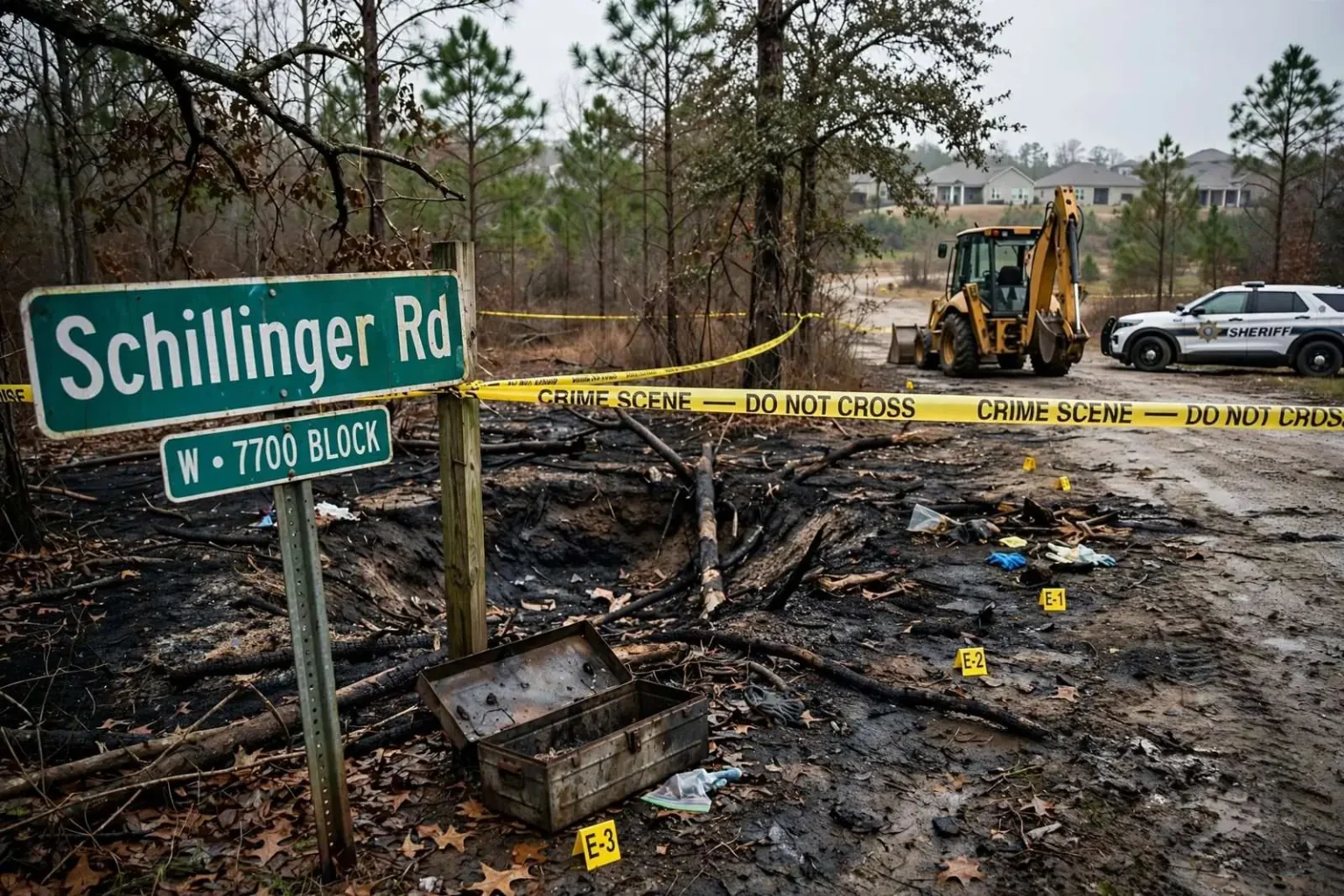
Sean Barnett was convicted in May of corpse abuse after trial testimony established that he and another man placed the body of Tracy Dearmon inside a tool box, crushed it using a backhoe, and buried and burned the remains in a pit on Barnett’s property off Schillinger Road in west Mobile. The details, laid out over the course of the trial, described an effort to conceal a death rather than to cause one, which is why the case arrived as corpse abuse rather than murder. Jurors weighed the evidence against Barnett for the role prosecutors attributed to him in that concealment.
Dearmon’s family has said the true date of her death remains uncertain, noting that even her tombstone lists an incorrect date, months removed from when they believe she actually died. The uncertainty has compounded the family’s grief, denying them a fixed day to mark and leaving questions about her final weeks unanswered. Prosecutors built the timeline as carefully as the evidence allowed, but some details about when and how Dearmon died were never definitively established.
Schillinger Road runs through the fast-growing western edge of Mobile County, an area where subdivisions now press against tracts that were rural land a generation ago. It was on property in that area that the remains were buried and burned, a pit on private land that might have kept its secret indefinitely if investigators had not been led back to it. The case broke open only after authorities pursued the account of the man who admitted handling the body.
A body hidden and burned
The concealment described at trial was elaborate enough to keep the case hidden for months. A tool box, a backhoe and a burned pit are not the tools of a moment’s panic but of a deliberate plan to make a body disappear, and testimony about the sequence formed the core of the state’s case. Jurors had to sort the two men’s roles from each other, since the state’s key witness admitted his own hands-on part in the concealment while pointing at Barnett as the driving force behind it.
Corpse abuse cases almost never reach Alabama courtrooms, which is part of what made the trial and the sentencing notable among local legal observers. The statute exists to criminalize the mistreatment of human remains, a wrong that sits apart from killing itself, and prosecutors rarely have occasion to charge it. In this case, with Dearmon’s death not proven to be a homicide, the charge became the state’s principal instrument for holding someone accountable.
A judge who struggled with the punishment
Presiding Circuit Judge Charles Graddick acknowledged from the bench that he had wrestled with determining a fair sentence, having previously delayed the proceeding to think and pray on his decision. Sentencing in a case without modern precedent leaves a judge without a reliable yardstick, and Graddick told the courtroom he had searched for one. The delay itself was unusual, a signal of how seriously he took the absence of guiding comparisons.
He ultimately rejected both the defense’s request for straight probation and the prosecution’s push for the full ten-year term, instead ordering three years in prison followed by three years of probation. The split sentence is a middle path Alabama judges use when the facts pull in both directions, blending incarceration with supervised release. Here, the judge explained, it also served a practical purpose beyond the numbers.
Because of overcrowding-driven early release policies in the state prison system, Graddick noted the split sentence would likely keep Barnett incarcerated longer in practice than a straight sentence would have. Alabama’s prisons have operated under chronic overcrowding for years, and correction officials routinely release inmates well before their full terms expire to manage the population. A judge who wants a specific amount of prison time served can get closer to it by pairing a shorter term with probation than by imposing a long term the system will not fully enforce.
Remorse, or the lack of it
Graddick said what troubled him most was that Barnett continued to maintain his innocence, telling the courtroom that denying involvement left little room to see genuine remorse. Judges weighing sentences routinely look for acknowledgment of responsibility, and its absence can color how they read everything else a defendant says. Barnett’s protestations of innocence, in the judge’s view, foreclosed the kind of accounting that often shapes a punishment toward mercy.
Barnett offered condolences to Dearmon’s family before the sentence was read but did not admit responsibility. The statement drew no visible reaction from the family section, where relatives had waited through years of investigation, trial and delay. Condolences without accountability are a familiar gesture in sentencing hearings, and the judge made clear which portion of it he found credible.
His attorneys have said they intend to appeal, arguing that the state’s key witness against Barnett, who admitted to handling the body himself, could just as easily have been the one responsible for Dearmon’s death and its concealment. The appeal will center on whether a conviction built substantially on a cooperating witness’s testimony was sufficiently supported, a question appellate courts in Alabama have handled in varying ways across different cases. Until the appeal runs its course, the sentence stands and Barnett remains in the custody of the state.
A family’s message about addiction
Dearmon’s brother said the family was grateful for the judge’s evident compassion throughout the case and hoped the tragedy would serve as a warning to others about the dangers of drug addiction. The family’s account of her death, from a methamphetamine overdose around Christmas 2010, has framed the entire case as a story about addiction’s collateral damage rather than a simple crime narrative. What could not be undone was the concealment that followed, and the years of uncertainty it imposed on people who loved her.
Graddick, who said he has dealt with addiction within his own family, told the courtroom the case was a sobering reminder of how far substance abuse can spiral, even after death. The admission gave the judge’s words a personal weight that sentencing remarks rarely carry, and it connected the case to the thousands of Alabama families contending with methamphetamine and opioid addiction in their own homes. Mobile County, like the rest of the state, has spent years absorbing the consequences of that epidemic through its courtrooms.
What the case leaves behind
For prosecutors, the case demonstrated that Alabama’s corpse abuse statute can carry real consequences when the facts fit, even without a homicide conviction attached. For defense attorneys, it offered a study in the risks of a trial that hinges on a cooperating witness, and of the appellate arguments that follow. And for the court, it supplied the rare precedent that the next judge facing a similar charge will at least have somewhere to start.
For Dearmon’s family, none of the legal architecture changes the essential wound: a daughter and sister lost to addiction, a death date no one can fix, and a grave marker that tells the wrong story. They said their hope now is that the case keeps even one family from standing where they have stood. The sentence will run its course, the appeal will take its own time, and a corrected date on a tombstone in Mobile County will remain the family’s quiet work of putting the record straight.
The rarity of the charge also shaped how the trial itself unfolded. With no local template for presenting corpse abuse evidence, attorneys on both sides spent considerable time educating the jury on what the statute requires and what it does not. Witnesses described the physical work of the concealment in methodical detail, and the backhoe and pit became the case’s grim landmarks. Observers in the courtroom described the testimony as among the most difficult local jurors have been asked to absorb in recent memory.
The sentence also closes one thread while leaving others open. Barnett’s appeal will take months at minimum, and the man who testified against him has already resolved his own exposure to prosecution through his cooperation. Dearmon’s family, meanwhile, continues to live with the uncertainty that first brought the case to light: a death that happened, by their account, around Christmas 2010, and a correct date that may never be officially recorded anywhere but in their own memory of her.