University of South Alabama Mobile
Probation Revoked for Man Accused in String of Attacks Near USA Campus
A man accused of attacking two women near the University of South Alabama had his probation revoked and awaits trial in jail.
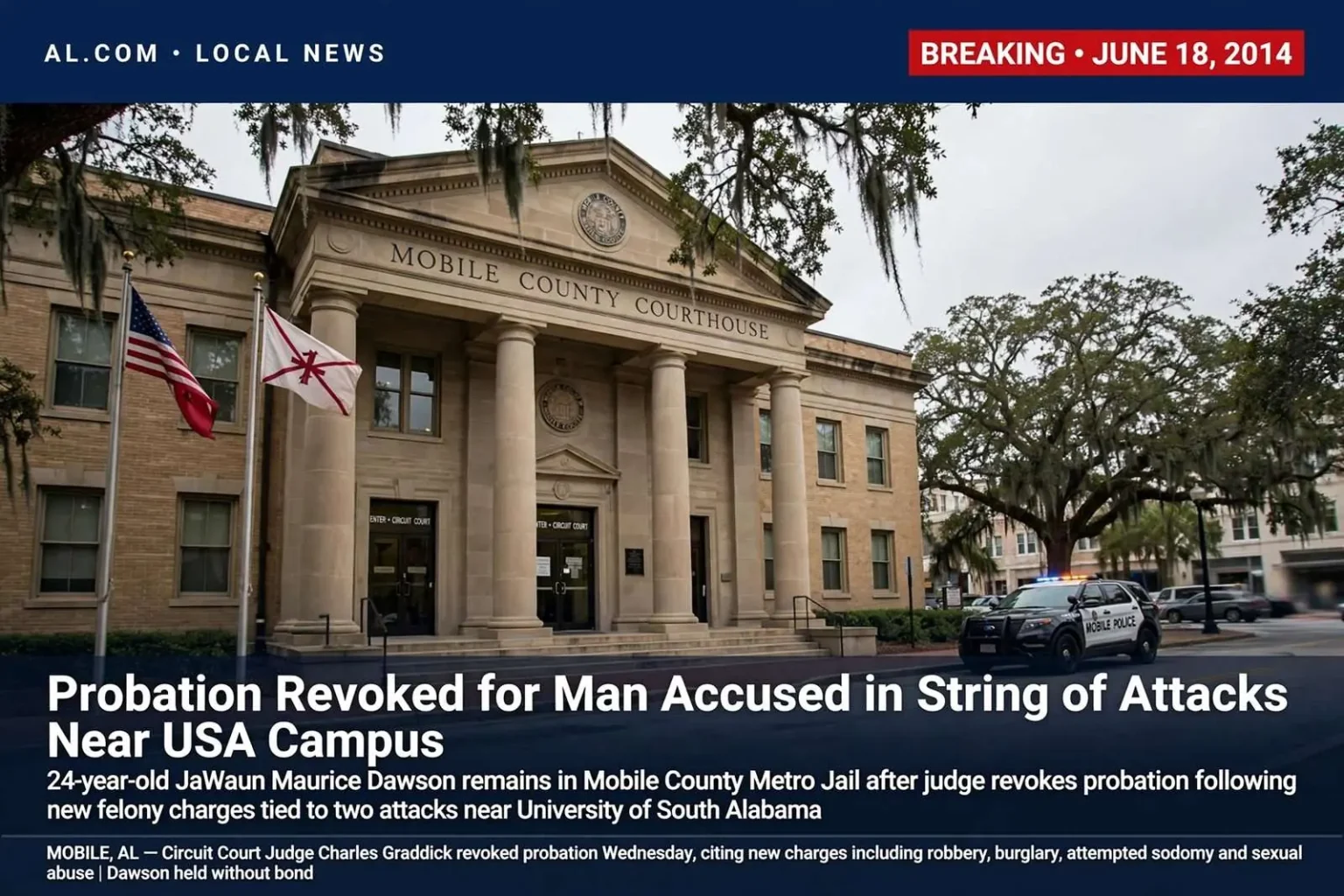
A 24-year-old man accused of attacking two women in and around the University of South Alabama campus in April 2014 will remain behind bars while his criminal case moves forward, after a Mobile County judge revoked his probation from an earlier conviction.
Presiding Circuit Court Judge Charles Graddick ordered the revocation for JaWaun Maurice Dawson, who had been serving two years of probation stemming from a 2012 guilty plea to theft and receiving stolen property. That earlier case involved a laptop and a purse taken from the university library.
On June 18, Graddick revoked the probation after new charges were filed against Dawson connected to two separate incidents in west Mobile.
New Charges Filed
Dawson pleaded not guilty this week to four first-degree felony counts: robbery, burglary, attempted sodomy, and sexual abuse.
According to police accounts, one incident occurred on April 24 when a woman was abducted at gunpoint in a parking area near the university’s north chemistry building. Investigators said she was robbed of cash and a cell phone and sexually assaulted in two separate campus-area locations.
Surveillance footage allegedly captured a man matching Dawson’s description attempting to use the victim’s stolen credit card afterward.
A grand jury indictment described a second incident the day before, on April 23, in which a man forced his way into a woman’s apartment in the 100 block of East Drive, directly across from the university’s campus. The indictment said the victim was struck in the head with a firearm, and a Mobile police spokesman said an iPhone and an Xbox gaming console were taken from the apartment.
Held Without Bond Reduction
Investigators described Dawson as a brazen repeat offender given the proximity and timing of the two attacks. A university spokesperson confirmed Dawson had previously been a student at the school before his 2012 theft case.
In revoking Dawson’s probation, Judge Graddick credited him with three months already served, meaning the time he had spent in custody since his arrest in the spring will count toward whatever sentence ultimately results from the revocation.
The revocation keeps Dawson in the Mobile County Metro Jail while the felony case proceeds, and it means he will not be released on the supervision that had governed his life since the 2012 plea. For residents of the neighborhoods surrounding the campus, the decision effectively removes the possibility of an early release while the most serious charges are still pending.
Graddick, who serves as presiding judge of Mobile County’s circuit court, has overseen a docket that includes many of the area’s most serious felony cases. The presiding judge role carries administrative responsibility for the county’s circuit judges in addition to a full caseload, and revocation hearings are a routine but consequential part of that work. When a defendant on probation is charged with new crimes, prosecutors typically ask the sentencing judge to revoke the original probation, arguing that the new charges demonstrate the defendant cannot safely remain in the community.
How Probation Revocation Works in Alabama
Under Alabama law, a judge may revoke probation after a hearing at which the state must show the defendant violated the conditions of supervision. New felony charges are among the most common grounds. The standard of proof at a revocation hearing is lower than at a criminal trial, so a revocation can occur well before the new charges are resolved. A revocation does not determine guilt on the new charges; it simply sends the defendant back to custody to serve some or all of the original sentence.
In Dawson’s case, the two-year probation term arose from a 2012 plea agreement in which he admitted to theft and receiving stolen property in connection with items taken from the University of South Alabama library. Because the underlying offenses occurred on university property, the case drew attention from campus officials as well as city police when the new allegations surfaced.
The Campus and Its Surrounding Streets
The University of South Alabama sits in west Mobile, its main campus bordered by residential streets and student apartment complexes that fall under Mobile police jurisdiction rather than campus patrol. East Drive, where the April 23 home invasion occurred, runs directly across from campus and is lined with housing popular with students. That mix of university property and city streets is a familiar challenge for campus police departments nationwide, and it is why serious incidents near the university typically involve both agencies.
The university’s north chemistry building and the parking areas around it sit along the northern edge of the main campus, an area students cross daily between classrooms and outlying parking lots. Police accounts of the April 24 abduction describe an attack that began in one of those parking areas before the victim was moved to two separate locations near the campus, where investigators said the sexual assaults occurred.
Campus crime alerts issued after the April incidents urged students to travel in groups, stay in well-lit areas, and use the university’s escort services after dark. Such alerts are standard practice under federal reporting requirements that obligate colleges to notify the campus community promptly about serious crimes in and around campus property.
What the Charges Carry
The four counts Dawson now faces are all felonies classified in the first degree under Alabama law. First-degree robbery and first-degree burglary each involve the use or threat of a dangerous instrument — in these cases, authorities described a firearm — and carry sentences that can extend to life in prison upon conviction. Attempted sodomy in the first degree and first-degree sexual abuse are similarly grave, and prosecutors in Mobile County have historically pursued the most serious available charges when an attack involves abduction and a weapon.
A Mobile County grand jury returned the indictment that formally charged Dawson in the East Drive case. Grand juries in Alabama meet regularly to hear evidence presented by district attorneys and decide whether probable cause exists to send a case to trial. An indictment is an accusation, not a finding of guilt, and Dawson’s not guilty plea preserves his right to a trial by jury where the state must prove every element of each count beyond a reasonable doubt.
The surveillance footage described by investigators — a man matching Dawson’s description attempting to use a stolen credit card — is the kind of evidence that often becomes central in robbery prosecutions, because it ties a suspect to the immediate aftermath of a crime. Credit card use and cell phone records are frequently used to establish both identity and location in cases built around street-level attacks.
A Case That Spanned Two Years
The arc of the case, from a 2012 library theft to a 2014 indictment on violent felonies, illustrates the stakes judges weigh at revocation hearings. Dawson was a university student before the 2012 case, according to a school spokesperson, and his plea to theft and receiving stolen property resulted in probation rather than prison time. Had he completed the two-year term without incident, the convictions would have ended with his supervision.
Instead, prosecutors pointed to the April attacks — separated by a single day, both within walking distance of campus, both involving robbery — as grounds to conclude that probation was no longer appropriate. Judge Graddick’s June 18 order took Dawson out of the community for the duration of the proceedings, and the three months of credit for time served provides only a modest offset against the potential exposure he faces.
What Comes Next in Court
With the indictment in hand and the plea entered, the case moves into the pretrial phase of Mobile County Circuit Court. That stage typically includes discovery, defense motions, and hearings on any suppression questions — including whether the surveillance footage and identification evidence will be admitted. Cases involving multiple first-degree felony counts often take many months to reach trial, and defendants held without bond in the county jail remain in custody throughout.
If convicted on any count, Dawson would be sentenced under Alabama’s sentencing framework for Class A and related violent felonies, where judges have discretion within statutory ranges and, in the most serious categories, may impose terms measured in decades. The revoked probation sentence remains a separate matter: revocation can add time from the original 2012 case on top of any new sentence.
The Mobile County District Attorney’s Office, which presents felony cases to the grand jury and tries them in circuit court, has not indicated whether it will seek to consolidate the two April incidents into a single trial. Prosecutors sometimes try related charges together when the evidence overlaps, and sometimes sever them when a joint trial could confuse the jury.
Impact on the University Community
For students and neighbors around the Spring Hill Avenue and University Boulevard corridors, the case has kept attention on safety in the transition zone between campus and city streets. The university’s police department patrols campus property, but the apartment complexes and residential blocks across the street depend on Mobile police, and both agencies took part in the investigation of the April attacks.
Community members who followed the case have noted that both incidents occurred within a roughly 24-hour span, a pattern investigators cited in describing the offender as brazen. The quick identification of a suspect and the grand jury’s decision to indict on all four counts within weeks of the attacks reflected the priority investigators placed on the case.
Advocates for victims of sexual assault in Mobile County point to cases like this one when explaining the importance of the county’s specialized prosecution and victim services units, which guide victims through interviews, medical examinations, and testimony. The two women attacked in April were central to the state’s case, and their accounts to investigators formed the basis of the police narrative that accompanied the charges.
As the criminal case proceeds, Dawson remains in the Mobile County Metro Jail under the revocation order. The next significant milestones will be pretrial hearings in circuit court, where his defense is expected to challenge the state’s evidence. Until the case is resolved, the probation revocation stands, the indictment remains pending, and the two April incidents — one on the edge of campus, one across the street from it — remain the subject of one of west Mobile’s most closely watched prosecutions.