Mobile City Council Approves $18,500 for Fourth of July Fireworks in 6-1 Vote
The Mobile City Council voted 6-1 on Wednesday to spend $18,500 on the city's Independence Day fireworks, even as officials signaled they may seek private help to fund future displays.
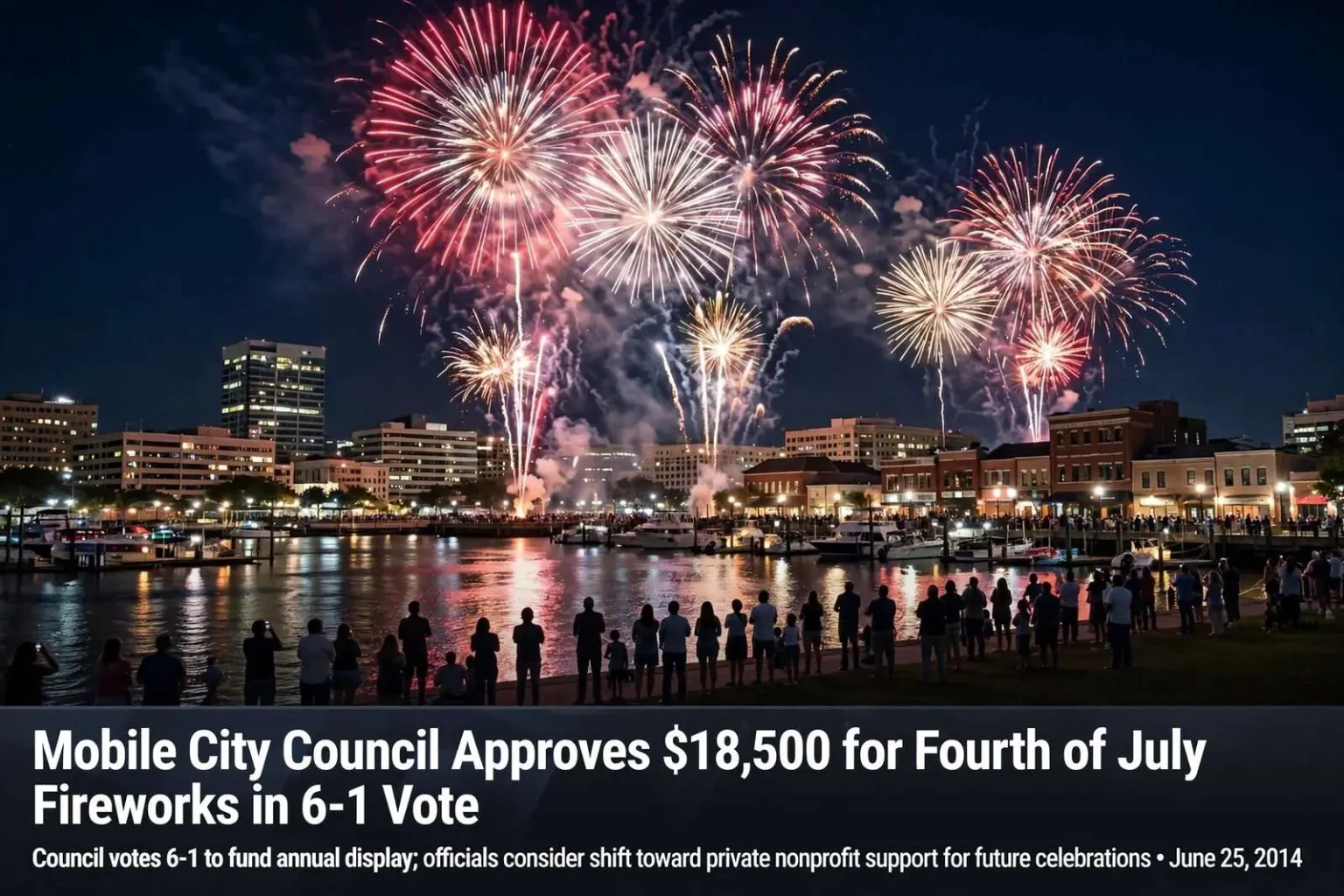
Mobile’s Fourth of July fireworks will light up the sky again this year with the backing of city taxpayers, though the arrangement may look different in years to come.
At its meeting on Wednesday, June 25, 2014, the Mobile City Council voted 6-1 to approve an $18,500 contract for the annual display. The agreement, with S. Vitale Pyrotechnic Industries Inc., matched the amount the city spent on the previous year’s show. As in years past, the money came from the City Hall Overhead account, a general pool used to support the display and other citywide functions.
A push toward private support
City officials made clear that the current funding model may not last. Chief of Staff Colby Cooper told the council that Events Mobile, the nonprofit that raises money for several citywide celebrations including the MoonPie Over Mobile drop on New Year’s Eve, would be approached about helping to underwrite future fireworks shows. Cooper noted that the city itself cannot solicit private donations, but a nonprofit could.
“The mayor would like to approach Events Mobile going forward,” he said, suggesting the organization could eventually own both the MoonPie drop and the July fireworks and package them together as a cost-saving measure. “It’s a city-run event. The mayor’s intent is to ask Events Mobile to run it in the future so it’s not a city event.”
The proposal reflected a broader strain on municipal budgets in the years after the recession, when cities across the country began looking for partners to keep signature events alive. Mobile’s July display was a beloved tradition, but it competed every summer with core services for the same limited dollars, and the administration’s argument was essentially structural: an event that residents and businesses enjoy citywide is a natural fit for the kind of private fundraising that already sustains the city’s New Year’s Eve celebration.
Events Mobile’s role in the MoonPie Over Mobile drop had already demonstrated the model. The organization raises contributions from sponsors to stage the downtown celebration, freeing the city from covering the full cost of a marquee event that draws visitors to downtown restaurants, hotels and businesses. Folding the July fireworks into that portfolio, Cooper suggested, could produce savings through combined production, sponsorship sales and shared logistics.
A lone dissenting voice
Councilwoman Bess Rich cast the only vote against the expenditure. She argued that private donors should be tapped to pay for the celebration and suggested that individual council members might use their discretionary funds to cover the cost. Rich said her position was consistent with how she had voted on similar requests in prior years.
“I’m all about being patriotic, and I know we need to have police and paramedic there,” Rich said. “Fireworks are wonderful. I just have to weigh the priorities.” She added that with limited resources, she preferred to see public money directed toward policing, firefighting and sanitation.
Rich’s dissent was less a rejection of the holiday than a statement about budget philosophy. Discretionary funds — the modest allocations each council member can direct toward district needs — were, in her view, a more appropriate source for a celebration than a general account that also backs essential citywide operations. Her stance had been consistent across years and administrations, which gave it a certain predictability at the budget table: celebrations yes, but paid for as far downstream as possible.
Council members defend the tradition
Other members defended the city’s role in marking Independence Day. Councilman Joel Daves said it was responsible for Mobile to fund a celebration of the nation’s founding and that exceptions should be made for such an occasion.
“It’s the anniversary of the independence of our country,” Daves said. “Men and women have fought and died since 1776. I’d be totally opposed to taking this out of the budget.” He said he would support having a third party pay for the show, but that if no sponsor could be found, the responsibility should fall to the city. “If we can’t find a way to honor our nation, then we should be out of business.”
Councilman Fred Richardson pointed out that neighboring communities, including Prichard, Saraland, Citronelle and cities across Baldwin County, would all mark the holiday with fireworks. “And we are not going to light a firecracker?” he asked. His argument was one of civic standing: a city of Mobile’s size and history letting smaller neighbors out-celebrate it would, in his view, be a telling concession.
Councilman C.J. Small added that many children in his district cannot afford other entertainment or travel to watch shows elsewhere. “To provide entertainment for our citizens is something we should provide,” he said, noting that some children in his district had never crossed Mobile Bay. For Small, the free public display was not an amenity but a rare form of accessible recreation — one of the few large celebrations that costs a family nothing to attend.
Together, the majority framed the expenditure as a matter of both patriotism and equity. The cost to the city amounted to a fraction of a percent of municipal spending, the show drew crowds to the riverfront and surrounding vantage points, and for families without the means to buy tickets to ticketed events, it was the city’s single most visible gift of the summer. Weighed against an $18,500 contract, the six council members in the majority found the trade straightforward.
How other cities pay for the show
The debate in Mobile echoed questions being asked in cities across the Gulf Coast, where communities lean more heavily on private and nonprofit support for their biggest celebrations. In Pensacola, a group of service clubs pays for the display while the city covers police and public works overtime. In Biloxi, business owners form a committee to raise money for the show, and the previous year the city contributed $8,000 toward advertising and promotion.
Those arrangements show the range of possible models. Pensacola’s is almost entirely private on the production side, with government limited to the public-safety and infrastructure costs that no private organizer can legally or practically avoid. Biloxi’s splits the difference further: merchants whose businesses benefit from holiday crowds do the fundraising, and city government plays a supporting rather than leading financial role.
Mobile’s fireworks cost, meanwhile, has fallen considerably over time. At one point the contract cost taxpayers close to $50,000, far above the $18,500 the council approved for this year’s celebration. The reduction reflects both competitive bidding for pyrotechnic services and a national market in which displays have become more efficient, and it strengthens the argument of officials who believe the city can eventually hand off even a modest remaining cost to private partners.
The 2014 vote also captured a moment of transition in how Mobile thinks about its signature events. The MoonPie Over Mobile drop had shown that a privately underwritten celebration could become the city’s most talked-about annual tradition, and the administration’s pitch to Events Mobile was an attempt to replicate that success on the Fourth of July. If the nonprofit took ownership of both events, city hall would step out of the celebration business — not by canceling anything, but by converting public obligations into community-supported traditions.
For the pyrotechnics contractor, the annual contract represents a small but reliable piece of the summer event economy. S. Vitale Pyrotechnic Industries Inc. has handled displays for municipalities across the region, and a consistent, renewed contract gives a city predictability in both price and quality — a consideration that matters when a public safety-sensitive event is staged over a waterfront each year.
The City Hall Overhead account, the funding source for the show, functions as one of the flexible pots in the city’s budget, supporting citywide functions that do not fit neatly inside a single department. That flexibility is useful, but it also makes the account a recurring subject of council scrutiny, since every dollar drawn for a celebration is a dollar unavailable for the operations Rich and others prefer to prioritize.
Whatever form future shows take, the 2014 decision preserved the tradition for another year at a cost the council found acceptable, while putting the city’s partners on notice that a change was coming. The vote stands as a snapshot of a city working through a question that every Gulf Coast municipality faces: how much of its civic celebration should rest on taxpayers, and how much on the businesses and residents who fill the crowd.
The council’s action also locked in the show’s footprint for the summer: the contract covers the pyrotechnic display itself, while the visible costs of crowd control, medical standby and cleanup remain with the city departments that handle them every year. Those supporting services rarely appear on a contract line, but they are part of the real price of a public celebration, and members weigh them alongside the headline figure whenever the item comes up for a vote.
In the meantime, residents planning their holiday could count on the same essentials as in every prior year — a display over the water, police and paramedic coverage on site, and a city willing to argue, at length and in public, about what its money is for.