Broker Chip Brown Prepares Another Run for the Public Service Commission
Mobile commercial real estate broker Chip Brown signaled plans to run again for the Alabama Public Service Commission, this time for the presidency, after a narrow loss in the 2010 Republican primary.
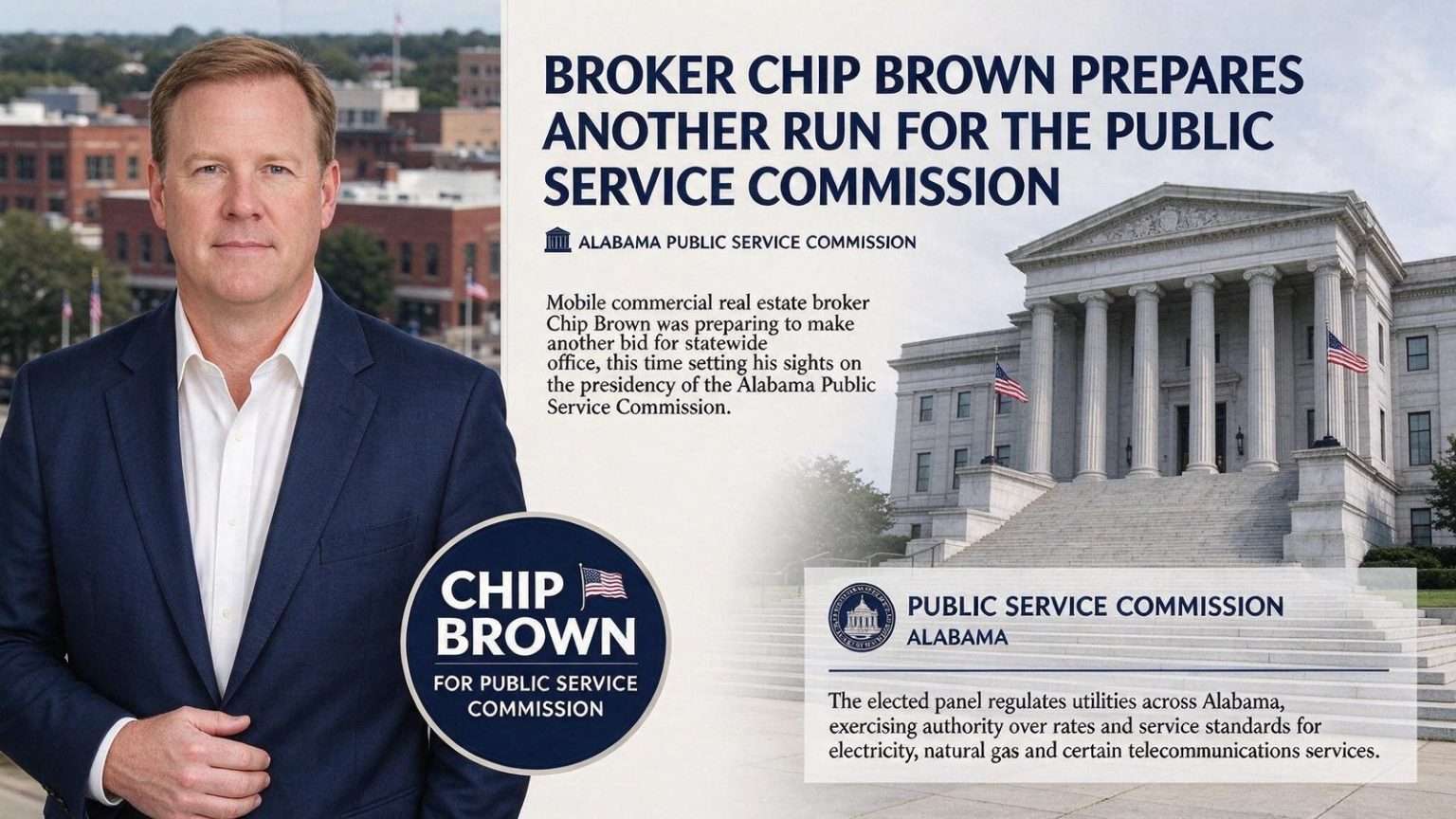
Mobile commercial real estate broker Chip Brown was preparing to make another bid for statewide office, this time setting his sights on the presidency of the Alabama Public Service Commission. Brown, who came up short in a 2010 campaign for the commission, was expected to announce in the coming weeks that he would seek the panel’s top seat in the next year’s elections. The prospective candidacy would return the south Alabama Republican to the ballot less than a decade after his first statewide run, and it would place him in a contest for the office that oversees utility regulation for the entire state.
Should he prevail in the March Republican primary, Brown would advance to the November general election to face the Democratic nominee for a seat then held by Lucy Baxley, the Democratic Party’s last remaining statewide officeholder at the time. The matchup would carry obvious stakes for both parties. For Alabama Republicans, capturing the presidency would complete a sweep of statewide offices, while for Democrats, holding the seat would preserve a foothold in an executive branch that had otherwise shifted firmly to the GOP.
The Public Service Commission occupies a distinctive place in Alabama government. The elected panel regulates utilities across the state, exercising authority over the rates and service standards of the companies that supply electricity, natural gas and certain telecommunications services to Alabama homes and businesses. Its orders reach virtually every household in the state, and its decisions can shape monthly utility bills for years after they are issued.
Despite that reach, commission races rarely draw the same attention as marquee statewide contests for governor or the Legislature. Many voters encounter the commission only when a rate case or a service dispute makes news, and down-ballot races on a crowded general election ballot can pass largely unnoticed. Yet the commission’s decisions carry real weight for ratepayers, and the direction of its policy can influence everything from industrial recruitment to the cost of cooling a home through a Gulf Coast summer.
Brown’s renewed interest reflected a belief that the office was within reach for a south Alabama Republican in a political climate increasingly favorable to the party. Republicans had consolidated their hold on statewide offices across Alabama, and candidates from the Mobile Bay area had repeatedly demonstrated that they could raise money, organize volunteers and compete in primaries from a coastal base. Brown’s calculation was that the presidency seat, held by a Democrat, was the most vulnerable statewide office on the board.
A close call in 2010
Brown was no newcomer to Public Service Commission campaigns. He had lost a tight race to fellow Republican Terry Dunn in the 2010 primary, a contest decided by a narrow margin after a hard-fought campaign. Dunn went on to defeat Democrat Susan Parker in the general election to claim the Place 2 seat, giving the GOP another hold on the commission and leaving Brown on the outside of a race he had invested heavily in winning.
Even in defeat, Brown had shown genuine regional strength. He notched 62 percent of the Republican vote in Mobile County and 67 percent in Baldwin County, running far ahead of his statewide showing in the two counties that anchor the Alabama Gulf Coast. Those numbers indicated that his profile as a business-oriented candidate from the coast resonated with primary voters in his home region, even where he remained less familiar elsewhere in the state.
The disparity between Brown’s home-region totals and his statewide performance illustrated the central challenge of any Gulf Coast candidacy for statewide office. Alabama’s political geography stretches from the Tennessee Valley in the north through the Black Belt and the river counties to the coastal plain, and a candidate who is a household name in one region may be an unknown in another. Building name recognition across that distance requires time, money and a campaign presence in communities far from Mobile Bay.
A family footprint on the Eastern Shore
That Baldwin County showing carried a personal note for Brown. His father, Harry Brown, had for many years served as mayor of Daphne, the Eastern Shore city on the eastern lip of Mobile Bay, giving the family a durable political footprint in one of Alabama’s fastest-growing counties. The elder Brown’s long tenure in Daphne city government made the family name familiar to voters across the Eastern Shore communities of Daphne, Fairhope and Spanish Fort, a corridor that has supplied a growing share of Baldwin County’s electorate.
Baldwin County’s growth has made it a coveted prize in Republican primaries. The county’s population has expanded steadily for decades as retirees and families have moved to the coast, and its voters participate at high rates in primary elections. A candidate with family ties and a history of strong showings there starts with an organizational advantage that rivals must work to offset.
For a candidate seeking statewide office, a solid base of support across the two-county Mobile Bay region offered a meaningful head start. Mobile and Baldwin counties together form a distinct media market and a cohesive political community, and a candidate who runs up large margins there can bank votes that competitors must spend resources elsewhere to replace. Brown’s 2010 numbers suggested he could do exactly that.
Looking to March
With the primary approaching, Brown’s prospective candidacy added another south Alabama name to a crowded field of Republicans seeking statewide posts. The coming cycle already promised competitive primaries for several constitutional offices, and candidates across the ticket would be competing for many of the same donors, endorsers and county-level activists. In that environment, an early announcement and a clear argument for why a commission seat matters can make the difference in a crowded field.
Brown’s challenge would be to translate strong home-region numbers into support across the rest of the state, where his name recognition was less established. That would mean building an organization capable of competing in the Tennessee Valley, the Montgomery River Region and the Black Belt, courting county party figures and local business leaders, and communicating a message about utility regulation that resonates with voters who may never have considered the office before.
The presidency itself is more than a ceremonial post. The commission’s president presides over its proceedings, helps set the panel’s agenda and, along with the associate commissioners, votes on rate matters and regulatory policy that determine what utility customers pay. Whoever holds the seat influences how Alabama balances the financial needs of regulated utilities against the interests of the ratepayers who fund them, a question that surfaces with every filing requesting higher rates.
A general election campaign against the Democratic nominee would follow any primary victory, and statewide races in Alabama have trended heavily toward Republicans in recent cycles. Still, a candidate cannot take any November contest for granted, and the Democratic nominee would have an incumbent’s record to defend or an outsider’s argument to make depending on how the field shaped up.
What it means for the coast
For voters along the coast, the prospect of one of their own competing for the presidency of a statewide regulatory body was a reminder that Mobile and Baldwin counties intended to remain part of the conversation in Montgomery. South Alabama’s interests in utility matters are substantial, from the power demands of the Port of Mobile and the industrial corridor along the Mobile River to the seasonal energy bills of coastal households facing long, humid summers.
Coastal residents also have a distinct stake in how the commission weighs reliability and storm response. Hurricanes and tropical systems regularly test the electric grid along the Gulf, and regulatory decisions about infrastructure investment and cost recovery determine how quickly and how affordably service is restored after a major storm. A commissioner from the region would bring direct familiarity with those concerns to the panel’s deliberations.
Brown’s formal announcement was expected soon, and the campaign that follows would unfold through county party meetings, civic forums and the daily work of introducing himself to voters who live far from the neighborhoods where the Brown name has long been known. Whether his second bid for the commission ends differently than his first would depend on how far that introduction could carry him beyond the Mobile Bay.
Baxley’s presence on the commission underscored how unusual the seat was in the Alabama political landscape. A former state officeholder with decades of name recognition, she had proven that a Democrat could still win statewide in Alabama, and any challenger who pursued the presidency had to account for that history. For Republicans, recruiting a candidate with an established political identity of his own was part of the calculation, and Brown’s family history and prior statewide run fit that description.
Brown’s professional background in commercial real estate also shaped the profile he brought to the race. The brokerage business requires detailed familiarity with land use, infrastructure and the utility service that underpins commercial development, and candidates with business credentials have historically argued that such experience translates naturally to utility regulation. A campaign built around that record would emphasize the connection between predictable utility costs and the state’s ability to attract and keep employers.
Primary campaigns for the commission also tend to be decided by a relatively small universe of highly engaged voters. Party activists, local officials and civic organizations play an outsized role in low-profile down-ballot races, and endorsements from sheriffs, probate judges and business groups across Alabama’s sixty-seven counties can matter more than advertising volume. A candidate must therefore travel the state in person, meeting local party committees and community groups one county at a time.
Geography plays a further role in how commission campaigns unfold. Alabama’s population centers of Huntsville, Birmingham, Montgomery and Mobile each represent distinct media markets, and a candidate from the coast must budget for television and radio time in markets that never see his advertising during local races. That reality raises the cost of building statewide name recognition and helps explain why candidates with established family names or prior campaigns often hold an early advantage.
Utility policy itself was likely to feature in the campaign’s argument. Questions about how the commission reviews rate requests, how it weighs investment in new generation and grid improvements, and how it treats the interests of residential customers versus large industrial users are the substance of the job. A candidate who can explain those issues in plain terms gives himself a chance to elevate a race that most voters otherwise encounter only as a name on the bottom of the ballot.