Mislabeled Mobile Mug Shot Spreads Online, but Jail Records Tell a Different Story
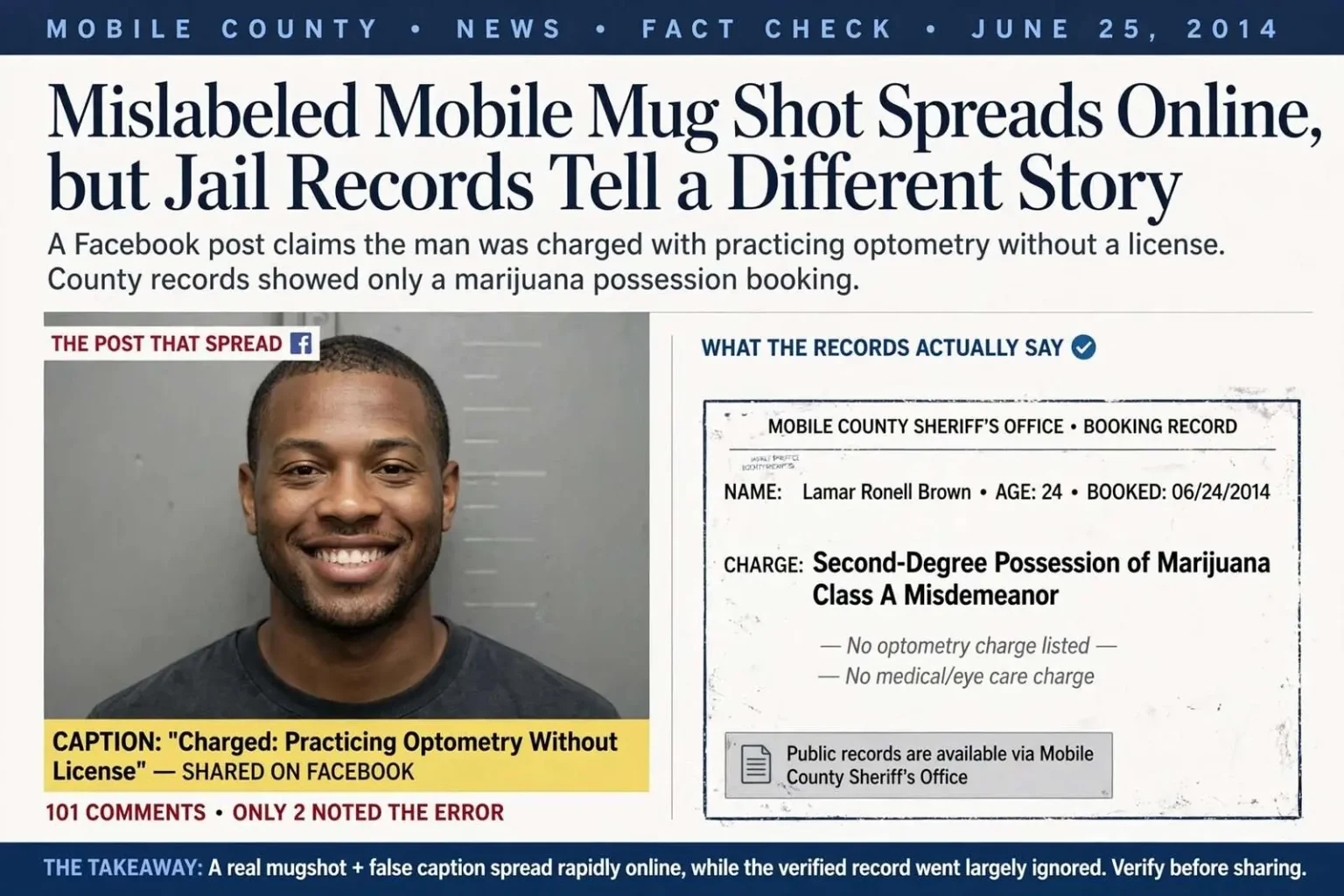
A Mobile County Metro Jail booking photo circulated on Facebook this week with a false claim that the man was charged with practicing optometry without a license. Records showed a different charge entirely.
A single booking photograph became one of the most talked-about images in Mobile this week, not because of the charge it carried, but because of the charge it did not.
On Tuesday night, June 24, 2014, a mug shot pulled from the Mobile County Metro Jail began circulating on social media accompanied by a claim that the man pictured had been charged with practicing optometry without a license.
The image, shared on a Facebook page that reposts local arrest photos, drew a rapid response. By 12:45 p.m. Wednesday, more than 100 comments had piled up beneath the post. Yet of those 101 remarks, only two noted a crucial detail: the caption did not match the county’s own records.
That ratio — two accurate observations out of a hundred and one — is the number that makes the story worth telling. The page’s audience reacted with jokes and alarm, tagged friends, and argued about a charge that had never existed, while the correction sat in the thread unnoticed. Nothing about the case required specialized knowledge to verify; the county’s booking records were public. Nobody in the crowd thought to look.
The episode illustrates the peculiar economy of arrest-photo pages. They trade on real photographs, real names and real trouble, and their audiences arrive primed to believe the caption because the face above it is undeniably real. The pairing of a genuine image with invented text defeats the ordinary skepticism readers bring to text alone.
What the records actually said
According to the Mobile County Sheriff’s Office, the man in the photo, 24-year-old Lamar Ronell Brown, had in fact been booked on a single count of second-degree possession of marijuana. There was no optometry charge. Nothing in the jail’s paperwork referenced the unlicensed practice of medicine or eye care of any kind.
Commenters, unaware of the discrepancy, reacted to the fictional charge with a mix of alarm and amusement. Several joked about never letting the man near their eyes, while others wondered aloud whether a person could really be arrested for what one described as playing doctor. The smiling expression in the photo only fueled the online chatter.
The smile became part of the story’s spread. Mug shots carry expectations of visible distress, and a grinning face attached to a bizarre charge read, to the commenters, as confirmation of something. In reality the expression had nothing to do with either the real charge or the invented one — but by the time the thread had run its course, the image and the fake caption had fused into a single memorable joke at a real man’s expense.
For Brown, the damage worked in both directions at once. The fabricated charge made him a punchline; the charge he actually faced never even entered the conversation. A booking record is public by design, but it is not supposed to be a screenplay that strangers can rewrite.
A case of ‘screen scrubbing’
Lori Myles, a spokeswoman for the sheriff’s office, explained that the mistake almost certainly originated with the way the third-party page gathered its information. The site, she said, had been screen scrubbing the agency’s website, a practice in which an outside operator uses automated tools to pull booking data directly from the county’s public pages and republish it elsewhere.
The problem, Myles said, was that the automated grab did not reliably capture what the sheriff’s office was actually posting. As a countermeasure, the agency had begun scrambling some of the information on its site to discourage the practice.
“What they’re grabbing isn’t what we’re putting out there,” Myles said. “We warned them that when they kept doing this to our website we were going to scramble things. If you’re taking our information, you need to go back and make sure the information you’re getting is correct.”
The scrambling is a defensive technique with an honest admission built into it: the office cannot stop a scraper from copying its pages, so it degrades the copy. What the automated tool harvests is no longer quite the truth, which means any page republishing it unchecked publishes an error. The method pushes the responsibility back where Myles insisted it belonged — on the operators who take the county’s data and redistribute it without verification.
She encouraged residents who wanted accurate, up-to-date information on recent arrests to consult the sheriff’s office directly rather than relying on secondhand reposts.
“If you want to look at it all day, look at it all day,” she said of the official records.
The message to the public was a familiar one from law enforcement agencies in the social media era. The official site is free, current and authoritative; the reposting pages add nothing except distance from the source. The optometry mug shot gave the argument an example nobody would forget.
The charges, and the penalties
The distinction mattered legally as well as reputationally. Under Alabama law, practicing optometry without a license is a misdemeanor that can carry a fine of up to $1,000. Second-degree possession of marijuana, the charge Brown actually faced, is a Class A misdemeanor punishable by a maximum jail sentence of 12 months.
The two offenses sit in different corners of the criminal code. Unlicensed practice of a regulated profession is a regulatory offense, prosecuted rarely and usually against someone actually presenting themselves to the public as a practitioner. Possession of marijuana in the second degree is among the most common charges in Alabama’s misdemeanor dockets. The joke that circulated — about an eye doctor run afoul of the law — described a case type the courts see a handful of times in a generation, while the man in the photo faced one they see every week.
Neither charge, it should be said plainly, had anything to do with eyes.
The lesson of the mislabeled mug shot
The episode offered a small but pointed lesson about the speed at which misinformation can travel online, particularly when it is stitched to a real photograph of a real person.
A booking image lends an air of authenticity to whatever text accompanies it, and in this case the text was simply wrong. By the time the correction filtered through the comment thread, the mislabeled post had already been seen by a wide audience.
The correction’s reach could never match the error’s. One hundred and one readers had already reacted to the fictional version; each reaction displayed the post to another circle of friends; and the joke’s second life in shares and screenshots carried it beyond the page entirely. The two commenters who checked the records corrected the record for an audience that had already moved on.
For the sheriff’s office, the incident reinforced a message it had been repeating to residents and to the operators of automated arrest pages alike: verify before sharing, because the caption is only as reliable as its source.
And for the man in the photograph, the week carried a harder lesson still — that a public record, a deadpan caption and a laughing comment section can combine into a story about a person that is entirely false, seen by everyone, and correctable by almost no one.
Alabama’s booking records and the pages that reuse them
Arrest records occupy a strange place in American public life. Every state makes booking data public in the interest of transparency, and every county sheriff’s office in Alabama posts recent arrests where anyone can read them. The openness is intended to let citizens watch their government; the arrest-photo pages repurpose it as content, wrapping public data in advertising and the social dynamics of a comment section.
The business model requires volume, and volume requires automation — which is exactly where the Mobile County case went wrong. A page that publishes every booking it can scrape has no human checking each entry against the source, so an error in the grab becomes an error in print. The operators Myles addressed were asked to do the one thing their business model discourages: slow down and verify.
Alabama readers should also understand what a booking is and is not. An arrest is an accusation, not a conviction; charges are often reduced, dismissed or resolved in ways that never reach the people who shared the mug shot. The comment section beneath an arrest photo rarely hears the ending of the story, which is one more reason the republication of booking photos carries weight that the underlying paperwork does not.
The sheriff’s office position
The Mobile County Sheriff’s Office posts its booking information for the same reason agencies everywhere do: the public is entitled to see who is held in its county jail and why. Myles’s statements made clear the office does not object to being watched. It objects to being copied badly — and to private pages profiting from data they have scrambled or garbled.
The warning that preceded the scrambling is worth noting for anyone who runs such a page. The office told the operators what would happen if the scraping continued, the scraping continued, and the scrambling followed. The optometry post was the predictable result of an operation that had been told its data was unreliable and published anyway.
The episode also handed the office a talking point it could not have scripted. Deputies can lecture about verification all day and reach only the people who already follow them; a story about a fake optometry charge reaches the comment section itself. By week’s end, the mislabeled mug shot had done more to illustrate why the county’s own pages matter than any public service announcement could.
Whether the scraping pages changed their practices is another matter. The economics that reward volume over accuracy did not change with one corrected post, and the tools that scrape booking sites do not read warnings. What changed was the county’s data — deliberately degraded to poison the grab — and the burden of accuracy now sits, more visibly than ever, with whoever chooses to republish it.
For Mobile readers, the takeaway survives long after this particular photo has scrolled away: when a booking photo arrives with a strange story attached, the county’s own records are one click away. Two people out of a hundred checked. The other ninety-nine shared a fiction about a real man’s worst week.