A SWAT Team, an Armed Father and a Son Who Could Not Leave: What Happened at Maison DeVille Apartments
A SWAT team was called to Maison DeVille Apartments on Berwyn Drive South after Mobile police say an armed man refused to let his son leave the home. Officials said the man was experiencing a mental episode.
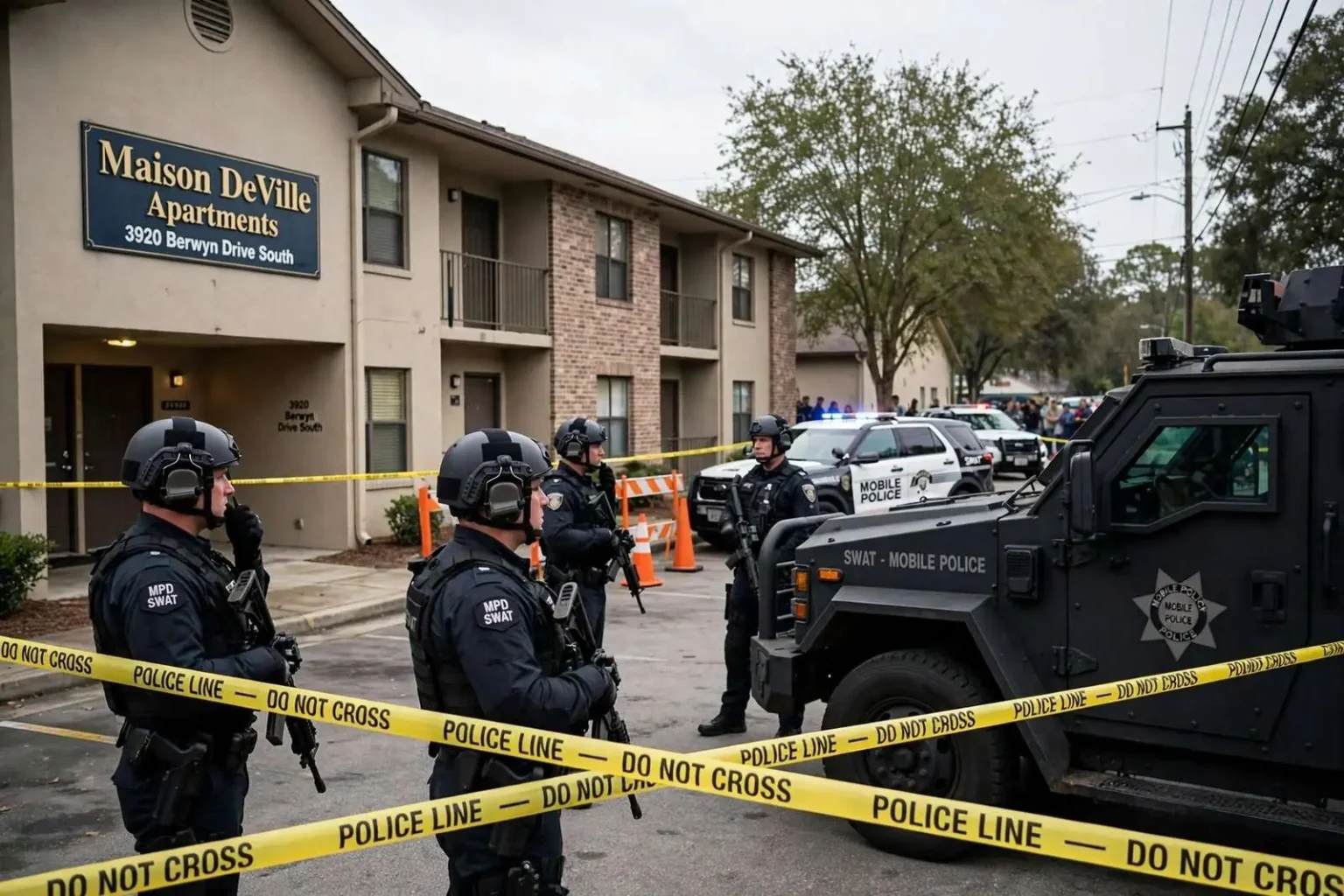
What began as a call about a father refusing to let his son leave an apartment ended Monday afternoon with a SWAT team on scene and a 45-year-old Mobile man in handcuffs. The episode, resolved without injury, offers a window into how Mobile police handle the kind of volatile, uncertain calls that fall somewhere between a family dispute and a barricade situation.
Mobile Police Department officers were sent to the Maison DeVille Apartments at 3920 Berwyn Drive South just after 2:30 p.m. on Monday. The initial report was straightforward enough: a man was not allowing his son to leave the residence. Calls like that arrive at dispatch centers regularly, and in most cases officers separate the parties, sort out what happened and clear the scene within the hour.
When officers arrived, the situation changed. They learned the man inside was armed with a gun. The presence of a firearm transformed what might have been a routine domestic disturbance into something far more dangerous, both for the person reportedly being kept inside and for the officers standing in the parking lot.
SWAT Responds, Then a Peaceful Arrest
With a firearm confirmed inside the apartment, MPD called in its SWAT team. Officers were ultimately able to detain the man at the scene without anyone being hurt. Police identified him as 45-year-old Dwayne Hawkins. He was charged with second-degree unlawful imprisonment and taken to Mobile County Metro Jail, where he was booked roughly four hours after the first call came in.
The roughly four-hour span between the initial call and the booking reflects the pace of a negotiated resolution rather than a forced entry. In barricade situations, trained negotiators and tactical officers work to bring the person out voluntarily, sometimes over hours, precisely because a rushed approach dramatically raises the risk that someone is hurt. That the incident ended with a quiet arrest, no shots fired and no injuries recorded will read to policing professionals as the desired outcome, however dramatic the presence of armored personnel and a cordon looked from the street.
Officials Point to a Mental Episode
Mobile police said Hawkins was experiencing what officials described as a “mental episode,” and that the episode led to the incident. The characterization matters, both for how the case will move through the courts and for how the department documented its response. Encounters between police and people in mental health crises have become a defining challenge for departments nationwide, and Mobile is no exception; officers are trained to recognize crisis behavior and, where possible, route people toward evaluation and treatment rather than jail alone.
It is not clear how long the child was kept inside the residence before officers arrived. What is clear from the timeline is that the boy was safe once police took the scene, and that the arrest occurred the same afternoon the first call came in.
The Charge and What It Carries
Second-degree unlawful imprisonment is a misdemeanor under Alabama law. If convicted, Hawkins could face up to three months in jail and a fine of up to $500. The offense, defined in the state’s criminal code, covers knowingly restraining another person so substantially as to interfere substantially with their liberty, without the aggravating factors that elevate the crime to first-degree unlawful imprisonment, such as holding someone under conditions that create a risk of serious physical injury or moving them a substantial distance.
Prosecutors weigh those distinctions carefully in cases that begin with a standoff. A charge that starts as second-degree unlawful imprisonment can be amended as the facts develop, and the presence of a firearm, the duration of the confinement and the age of the person restrained all figure into charging decisions. As of this week, a criminal complaint had not yet been filed against Hawkins in Mobile County District Court, meaning the case remained at an early stage where prosecutors were still reviewing the evidence gathered at the scene.
Why the Response Was So Large
The size of the police response, a SWAT callout for what became a misdemeanor charge, reflects standard practice rather than the eventual charge. Once officers confirm a firearm is present in a barricaded situation involving a person who will not come out and a person who cannot leave, departments escalate to specialized units trained to resolve the standoff without gunfire. The charge that eventually gets filed is almost an afterthought at that point; the tactical decision is made on the facts officers know in the moment, not on what a judge will ultimately weigh.
SWAT units exist for exactly this middle ground. Most of their callouts nationwide involve barricaded subjects, warrant service in dangerous circumstances and similar situations rather than the active-shooter scenarios that dominate public imagination, and their mandate is containment and negotiation. The unit’s presence on Berwyn Drive South bought time and options: perimeter officers kept neighbors at a distance, negotiators kept a channel open, and no one had to make a split-second decision at the front door.
In this case, that approach worked. No shots were fired, and no one was reported injured. The child involved was out of the apartment and safe, the father was in custody without a physical confrontation, and the scene was cleared the same afternoon.
The Mental Health Dimension
Incidents that begin in mental health crisis pose some of the hardest questions in American policing, and Mobile has seen its share of them. Departments across the country have responded with crisis intervention training, co-responder models that pair officers with mental health professionals, and expanded use of the national 988 Suicide and Crisis Lifeline, which gives people in distress and their families a place to call before a situation escalates to the point where armed officers are the only option left.
Whether a case like Monday’s ends in prosecution, diversion or treatment often depends on coordination among prosecutors, mental health providers and the courts. Mobile County’s judicial system, like many across Alabama, has seen growing attention to how misdemeanor cases involving mental illness are handled, with officials weighing whether jail time serves any purpose when the underlying issue is untreated illness. A conviction carrying up to three months in jail and a $500 fine gives judges a range of options, and in cases with a documented crisis component, outcomes short of jail are common.
For the neighbors who watched the afternoon unfold, the sight of a SWAT team at a quiet apartment complex was jarring, and questions about why so many officers responded to a single apartment are understandable. The answer lies in the uncertainty of the moment: police did not know the man’s state of mind, they knew a gun was inside, and they knew a child could not leave. Under those conditions, no department sends two officers to knock on the door and hope for the best.
What Happens Next
The legal process from here moves at the usual pace of misdemeanor justice. If a complaint is filed in Mobile County District Court, Hawkins would face an initial appearance, and the case would move through arraignment and, potentially, trial. District Court in Mobile handles misdemeanors and preliminary matters in felony cases, and its docket turns over far faster than the circuit courts above it.
Anyone facing a mental health crisis, or worried about a family member, can reach help by calling or texting 988, the national Suicide and Crisis Lifeline, which connects callers to trained counselors around the clock. In situations where someone’s safety is in immediate danger, 911 remains the right call, but crisis lines exist so that Monday’s outcome, a peaceful arrest and a child walking out unharmed, does not have to depend on a SWAT team arriving in time.
For now, the Maison DeVille Apartments incident stands as the kind of ending police departments hope for in these encounters: no shots, no injuries, a child safe and a case handed to the courts, where decisions about punishment and treatment can be made with time and information the officers on Berwyn Drive South did not have.
The Maison DeVille Apartments, like many complexes in west Mobile, house a mix of families, working tenants and longtime residents, and incidents of this kind ripple through a close-quartered community in ways a press release cannot capture. Children in the complex saw the perimeter, neighbors were kept from their homes for part of an afternoon, and the questions that follow an armored vehicle onto a residential street tend to linger longer than the scene itself. Departments that handle these moments well, with communication after the fact, tend to keep the community’s trust; departments that treat them as routine lose it.
Monday’s call also illustrates the range of work demanded of patrol officers before any specialized unit arrives. The first officers on Berwyn Drive South made the initial assessment, confirmed the firearm, established a foothold near the apartment and began the communication that ultimately set up the peaceful resolution. SWAT units get the headlines, but the first fifteen minutes of a call like this, when a single misstep can turn a family dispute into a tragedy, belong to the patrol officers standing closest to the door.
As the case moves into Mobile County District Court, the mental health dimension documented by police will be part of the record prosecutors and judges consider. Whatever the disposition, the afternoon’s outcome, a four-hour negotiation ending in a quiet booking at Metro Jail and an unharmed child, is what successful crisis policing looks like when everything goes right.