Hillcrest Road Will Pause Thursday Afternoon as Mobile County Escorts Sam Cochran to His Final Resting Place
The Mobile County Sheriff's Office has announced the funeral procession route for former Sheriff Sam Cochran, who served 47 years in law enforcement. Drivers along Hillcrest Road should expect delays Thursday afternoon.
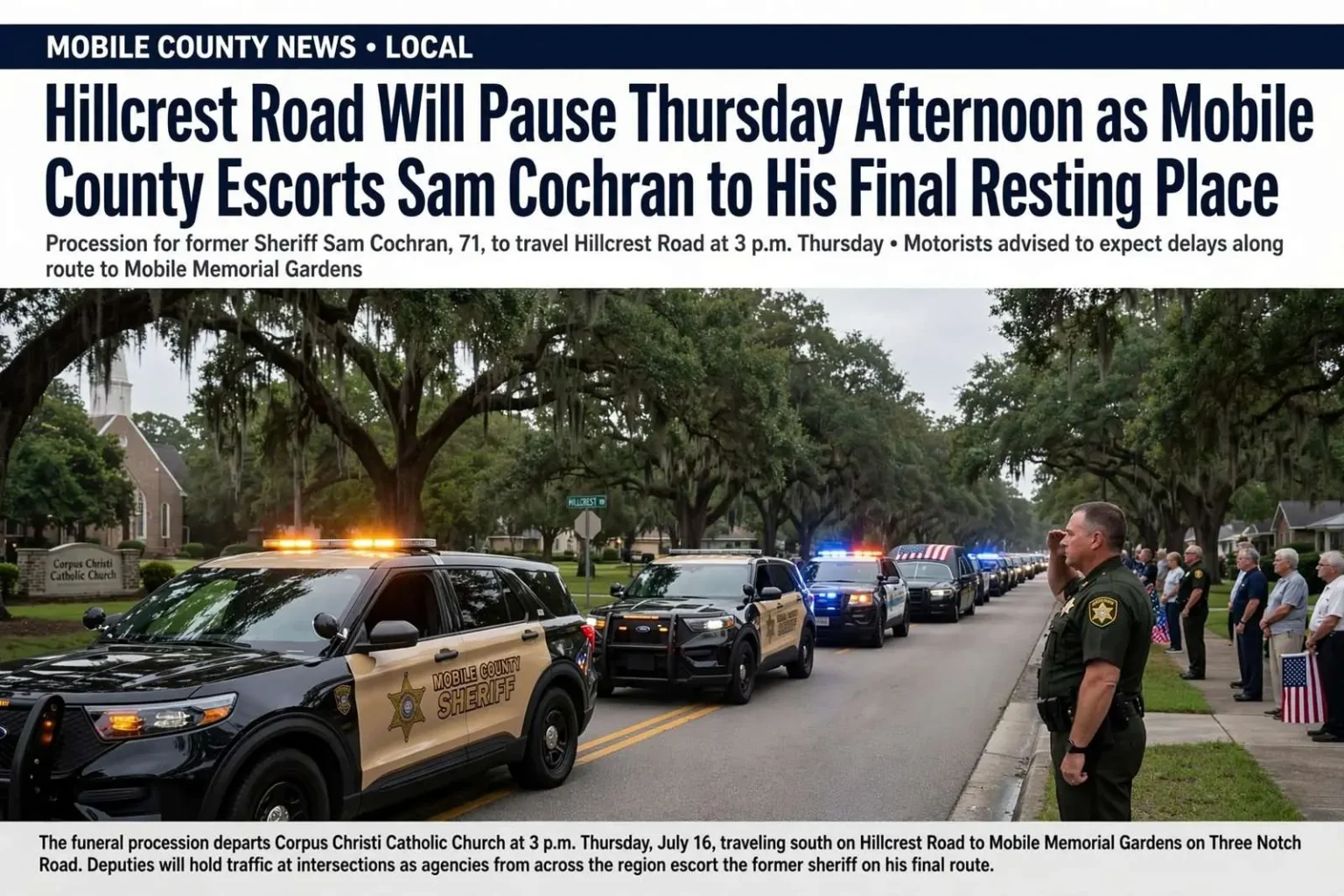
Drivers who use Hillcrest Road on Thursday afternoon should plan for a delay. The Mobile County Sheriff’s Office has released the route for the funeral procession of former Sheriff Sam Cochran, and it will move through one of the busier corridors on the west side of Mobile.
The procession is set to begin on Thursday, July 16, at 3 p.m., immediately following the Mass of Christian Burial. Deputies said the procession will depart from Corpus Christi Catholic Church, travel south on Hillcrest Road, and conclude at Mobile Memorial Gardens on Three Notch Road. Motorists in the area should expect a temporary delay while the procession passes. Traffic is typically held only briefly at intersections along the route, but drivers with time-sensitive appointments may want to build in a cushion or choose an alternate path Thursday afternoon.
Hillcrest Road carries some of the heaviest everyday traffic in west Mobile, threading between residential neighborhoods, schools and the commercial clusters that serve them, and the sheriff’s office asks drivers to treat the procession with the patience the corridor rarely requires. Deputies and escort units will manage the intersections, holding cross traffic briefly as the procession moves through.
Forty-Seven Years in Mobile County Law Enforcement
Cochran died on July 6 at the age of 71. His career in law enforcement spanned 47 years, nearly all of it in Mobile County. He served as sheriff of the Mobile County Sheriff’s Office from 2006 to 2022, and before that spent decades rising through the ranks of local policing, building the institutional knowledge that made him one of the most familiar figures in Alabama law enforcement.
His tenure covered a long stretch of change in the county — from the growth of the suburbs north and west of the city to shifts in how the department handled everything from hurricane response to school safety. Mobile County’s population spread steadily outward during his years in office, stretching the sheriff’s patrol districts across new subdivisions and new miles of road, and the office grew and reorganized around that expansion.
Storm years tested that organization repeatedly. Gulf Coast hurricanes have repeatedly put the sheriff’s office at the center of the county’s emergency response — search and rescue, curfew enforcement, checkpoint security and the coordination with state and federal agencies that follows every landfall — and Cochran’s tenure included some of the most demanding recovery periods in the county’s modern history.
School safety was another defining thread. The sheriff’s office runs resource and programs across the county’s schools, and Cochran was a visible presence in that work, treating the relationship between deputies and students as an investment the office made every school year rather than a program it administered.
Current Sheriff Paul Burch, who succeeded him, has spoken publicly about the difficulty of the loss for the agency. Burch worked under Cochran before winning the office, and the transition between the two men was framed on both sides as continuity — a passing of the badge within the same institution rather than a change of direction.
What to Expect Thursday
Law enforcement funerals of this scale typically draw agencies from well beyond the county line, and the procession may be longer than residents expect. Deputies, municipal officers, state troopers, federal agents and firefighters from across the region commonly form up for a colleague’s final ride, and the line of vehicles can stretch for miles at funeral speed.
Members of the public who wish to pay their respects often gather along the route. Anyone planning to do so is asked to stay on the sidewalk, follow the direction of officers managing the intersections, and avoid stopping on the roadway itself. The tradition of watching a procession pass — hand over heart, flag in hand — is one deputies take care to accommodate safely, and the corners along Hillcrest Road offer the vantage points.
The procession’s destination, Mobile Memorial Gardens on Three Notch Road, sits just south of the Hillcrest corridor, so the route is a short one by procession standards — but every intersection along it will pause as the county says goodbye to the man who led its largest law enforcement agency for sixteen years.
For the sheriff’s office itself, the week’s ceremonies close a chapter that began when Cochran first pinned on a badge in the 1970s. The honors — the formal mass, the procession, the agencies sending delegations — are the profession’s way of marking what 47 years of service means. For the drivers on Hillcrest Road Thursday afternoon, the delay is measured in minutes. The career it honors was measured in decades.
Cochran’s path to the sheriff’s office ran through nearly every level of Mobile County law enforcement. He came up through the ranks of local policing at a time when the department he joined was far smaller than the agency it would become, and the assignments he held along the way gave him the ground-level credibility that later defined his leadership. Colleagues from those years describe a command style built on the same habits he learned in patrol work: know the territory, know the people, and show up when it matters.
He was elected sheriff in 2006 and re-elected repeatedly, serving until his retirement in 2022 — a tenure that made him one of the longest-serving sheriffs in Mobile County’s modern history. Sixteen years at the top of a county agency means steering through economic cycles that shaped the budget, technology shifts that transformed records, communications and body-worn systems, and the generational changeover of a workforce that grew up entirely after he had started wearing a badge.
The county he patrolled changed around him as well. Mobile County’s growth pushed its population outward along the corridors west and north of the city, and each new subdivision added miles to the patrol map. The sheriff’s office expanded its marine and rural operations, its warrant and court security functions, and its partnerships with the municipal departments that share the county’s jurisdiction — the web of agencies that Cochran was known for working with rather than around.
Hurricane response, in particular, became a signature of his later years in office. The Gulf Coast’s storm seasons put the sheriff’s office on the front line of evacuation support, search operations, looting prevention and the long recovery tail that follows major landfalls. Residents of south Mobile County and the bay communities saw those deployments firsthand, and the agency’s planning for the next storm was built on the lessons of each previous one.
His visibility in the community extended well beyond enforcement. Cochran appeared at civic club meetings, church gatherings, school assemblies and neighborhood association forums across the county, maintaining a habit of explaining the office’s work in person. In an era when sheriff’s offices increasingly communicate through press releases and social media, he remained a fixture of the in-person kind of policing that rural Alabama counties especially have long expected from their sheriff.
Burch’s succession in 2022 came through an election in which both men emphasized the office’s stability. The current sheriff has continued the programs his predecessor championed, and the agency’s public tributes this week have described Cochran’s influence as still present in its procedures and its culture — the institutional memory of a man who spent 47 years in the same line of work, most of them in the same county.
Thursday’s procession, beginning at 3 p.m. from Corpus Christi Catholic Church, gives the county its formal chance to return that service. The route south on Hillcrest Road passes through the neighborhoods where the sheriff’s office has patrolled for decades, and the officers managing the intersections along it will be doing for Cochran what he organized for others: a dignified, careful passage. Motorists should expect the hold-ups, plan around them, and — if they choose to stop — step onto the sidewalk and let the line of badges and flag-draped vehicles pass on its final run to Three Notch Road.
Funeral processions for senior law enforcement figures follow a choreography the public rarely sees assembled. Escorts from multiple agencies rehearse the traffic plan, funeral home staff coordinate the order of vehicles, and the sheriff’s office typically assigns honor guard members to the church, the route and the cemetery. The pace is deliberately slow — procession speed is measured so that the column never breaks apart at signals — which is why even a short route can occupy an intersection for several minutes.
The agencies that travel in for the service represent the reach of a 47-year career. Officers who served with Cochran in his early years, sheriffs from neighboring counties, and representatives of state and federal partners all commonly attend, and the visiting vehicles join the motorcade behind the family and the honor guard. For the deputies of the Mobile County Sheriff’s Office, the day carries a particular weight: they are not only mourning a former leader but executing the ceremony that their agency’s traditions require of them.
Residents along Hillcrest Road who want to pay respects should pick their spot in advance and arrive early enough to park legally. The intersections that deputies manage will be busy, and stopping a vehicle on the roadway itself — even briefly — creates the kind of hazard the escort is there to prevent. A position on the sidewalk, a hand over the heart as the hearse passes, is the gesture the family and the agency both expect and welcome.
For drivers with no connection to the day, the request is simpler: patience. The delay on Hillcrest Road will be measured in minutes, the route is marked, and alternate corridors are available for anyone on a tight schedule. In a county that Sam Cochran served for nearly half a century, Thursday afternoon’s pause in traffic is a small price for the farewell — and a fitting one, on the very road his deputies have patrolled through every storm and shift of his long career.