Red Dresses, a Senator’s Breakfast and the Endless Question of Downtown Parking
A heart association fundraiser at the Battle House put local officials on a fashion runway, Alabama's senior senator prepared to address a business forum, and downtown Mobile revisited its most persistent complaint.
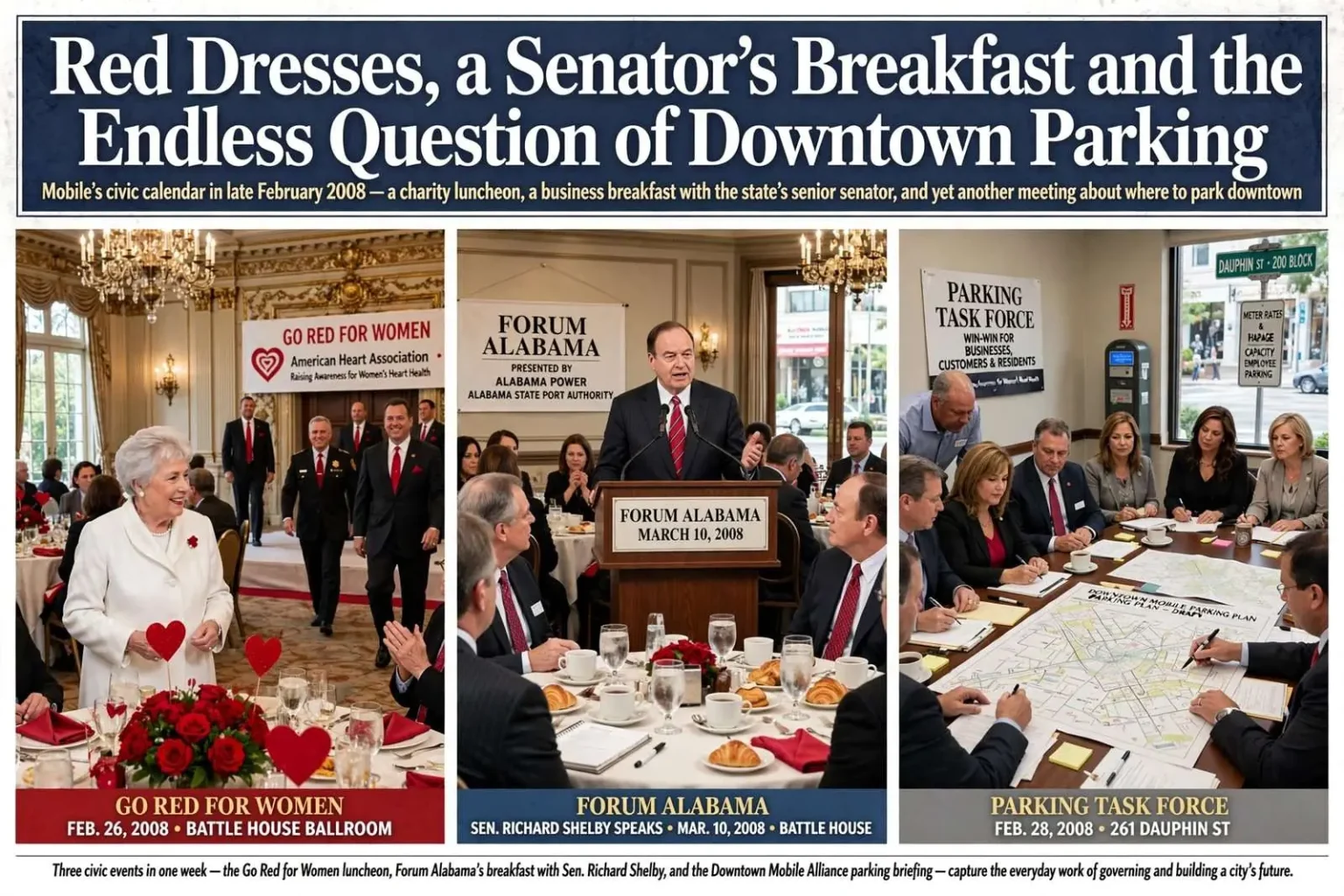
Mobile’s civic calendar in late February 2008 offered a study in the ordinary business of a city: a charity luncheon, a business breakfast with the state’s senior senator, and yet another meeting about where to park downtown.
Go Red for Women
Alabama’s first lady, Patsy Riley, headlined the “Go Red For Women” luncheon at the Battle House, a fundraiser for the American Heart Association that organizers described as the most successful in its three-year history, at least by turnout. State Rep. Jamie Ison chaired the event, drawing on the kind of cross-section of Mobile’s civic leadership that such luncheons specialize in assembling.
The program’s central conceit was a runway show in which local dignitaries — nearly all of them men, and nearly all of them politicians — modeled the latest in menswear. The models included state Reps. Chad Fincher, Victor Gaston, Jim Barton and James Gordon; state Sen. Ben Brooks; Mobile City Councilman John Williams; Mobile County Sheriff Sam Cochran; Mobile County Commissioner Stephen Nodine; a local television sports reporter; a local radio personality; and several radio station staffers.
The sight of the county’s sheriff and a row of legislators strutting a runway in new suits gave the crowd its entertainment, but the stunt was built to do more than amuse. By putting the community’s most recognizable men in red-accented finery, the organizers made a point about who the disease affects: not a niche audience, but husbands, fathers, sons and the public officials themselves.
Beneath the spectacle was a serious message. Go Red for Women was built around the finding that heart disease, long treated in the popular imagination as a man’s illness, was the leading cause of death among American women — and that its symptoms in women were frequently missed. Women’s heart attacks often present without the classic crushing chest pain, and the national campaign has worked to teach both patients and physicians to recognize the quieter warning signs.
The program included a talk by a physician on the use of a defibrillator, a practical addition aimed at the workplaces and gathering places where a cardiac emergency is most likely to occur. A final accounting of the money raised was still pending, though the turnout alone had already made the luncheon the campaign’s local high-water mark.
Shelby to speak at Forum Alabama
Forum Alabama scheduled its next meeting for Monday, March 10, from 7:30 to 9 a.m. at the Battle House Hotel, with U.S. Sen. Richard Shelby as the featured speaker. The event was sponsored by Alabama Power and the Alabama State Port Authority. Tickets were $17 per person, or $170 for a table of 10.
Shelby’s appearance carried weight beyond the usual. As the ranking Republican on the Senate Banking Committee and a member of the Appropriations Committee, he was among the most powerful figures in Washington on questions that mattered to the Alabama coast: port funding, shipbuilding contracts and the refueling tanker competition then reaching its climax.
Each of those files mattered to Mobile in concrete terms. The port’s channel deepening and terminal projects depended on federal appropriations; the shipyards drew on Navy and Coast Guard contracts that move through the Senate’s funding process; and the aerial refueling tanker contest — pitting a Northrop Grumman-led team in Mobile against Boeing — promised thousands of assembly jobs at the city’s Brookley field if Alabama won. A breakfast Q&A with the senator who chairmans and rankings much of that money was, for Mobile’s business community, less a speech than a status report from the front lines of federal spending.
For the senator, likewise, a room full of port officials, bankers and shipyard suppliers was a useful audience. Shelby’s seniority on the Banking and Appropriations committees gave him influence over the transportation and housing money that shapes Gulf Coast development, and Forum Alabama’s morning sessions had become a standing channel between Washington’s agenda and Mobile’s business leadership. The $17 ticket put the event within reach of small-business owners and civic volunteers as well as executives, keeping the series among the most accessible forums in the city’s public life.
Parking, again
The Downtown Mobile Alliance scheduled a breakfast briefing for 8 a.m. Tuesday, Feb. 28, at 261 Dauphin St., on the subject that had vexed downtown since the streets were laid out: parking. The mayor’s working parking task force was developing a plan intended to create, in the sponsors’ phrase, “a win-win” for businesses, customers and the city. Admission was free for Alliance members and $5 for guests.
The problem was structural. Downtown Mobile had spent two decades reviving itself — restaurants and bars along Dauphin Street, offices in restored buildings, the Saenger and the convention center drawing evening crowds — without ever resolving how thousands of additional people were supposed to leave their cars.
Every stakeholder wanted something different from the same curb space. Merchants wanted turnover in the metered spaces in front of their doors, so that each customer found a spot without driving past the block twice. Employees wanted somewhere affordable to park all day, close enough that a walk back to the car after a restaurant shift felt safe. Residents of the historic districts wanted their curbs back, tired of circling their own blocks after a workday’s worth of visitors had filled them. Every proposed solution favored one group at the expense of another.
Overlaying all of it was the arithmetic of a downtown grid laid out in the 19th century, when nobody imagined a stadium crowd or a Friday-night restaurant queue. Older cities across the country have faced the same squeeze as their centers revived: success arrives in the form of cars, and the streets that made the district charming were never sized for it.
A parking task force could not manufacture space. What it could do was reprice and redistribute what existed — adjust meter rates and hours to push long-term parkers off the best curb spaces, expand lots and garages, and enforce the rules consistently enough that turnover actually happened. Each piece of that agenda has political costs, which is why the Alliance’s briefing promised a plan intended to balance interests rather than satisfy them.
The ordinary business of a city
Read together, the three events sketch how a mid-sized Southern city actually runs. The Go Red luncheon mobilized the same officials who would later vote on the parking plan; the Forum Alabama breakfast connected local priorities to the federal money that funds them; and the parking briefing tackled the unglamorous logistics that determine whether downtown’s revival holds. None of it was front-page news, and all of it was government and civic life in its most common form: breakfasts, luncheons, committees and task forces, working through the details that accumulate into a city’s future.
It was, in other words, a problem that would still be under discussion years later — the kind of civic argument a growing downtown earns by succeeding. And the week’s calendar made the point plainly: the same community leaders who turned out for charity and senatorial updates would spend the rest of the year arguing about meters, garages and curb space, because a downtown that draws crowds has to decide where to put them.
The Battle House’s second act
Both luncheon and breakfast unfolded in the Battle House, the downtown hotel whose own restoration was part of the downtown revival story unfolding around it. The 1852-vintage hotel, rebuilt after a fire early in the 20th century and restored to operation in 2007 after decades of sitting dark, had quickly reclaimed its role as the city’s premier venue for civic functions. Its reopening gave Mobile’s luncheons, breakfasts and galas a grand stage again, and events like the Go Red luncheon and Forum Alabama were among the first to fill its ballrooms.
That setting mattered to the message of both events. A charity luncheon in a restored landmark, a senator’s breakfast in the same building and a parking briefing a few blocks away all trace the same arc: a downtown with enough restored venues, busy restaurants and relocated offices to generate traffic — and the problems that come with it.
Heart health as a public campaign
The Go Red for Women luncheon was one stop in a national campaign launched by the American Heart Association in 2004 to reframe cardiovascular disease as a women’s issue. The red dress became the symbol; local luncheons like Mobile’s became the fundraising engine; and the educational message — know your numbers, recognize symptoms, learn CPR and defibrillator use — became the substance beneath the fashion show format. For the local chapter, the formula worked: a room full of business and political leaders, a memorable stunt and a message each attendee could carry home to a spouse or employee.
The defibrillator talk reflected an increasingly common element of such programs. Automated external defibrillators in offices, churches and public buildings have sharply improved survival odds when a cardiac arrest strikes outside a hospital, but only when bystanders know where the devices are and how to apply them. Training a ballroom of civic leaders doubled as training for the workplaces they oversee.
Mobile’s stake in the tanker fight
The tanker competition Shelby would likely be asked about had become the defining economic story of Mobile in that era. The Air Force contest would award a contract worth tens of billions of dollars to build aerial refueling aircraft, and Mobile had assembled a bid centered on the Brookley industrial field, betting that the work would anchor a new aerospace cluster on Mobile Bay. Local officials estimated the winning plant would bring thousands of direct jobs and a supply chain of suppliers to follow. The Chamber’s breakfast series gave the city’s leadership a regular opportunity to hear, directly from the senator who monitored the competition’s funding and politics, where things stood — and what Washington’s mood meant for Mobile’s bid.