One Mobile Family’s Ordeal Reflects Wider Violence Along Webb Avenue
A string of shootings and a suspicious fire have devastated one Mobile family, as police label the Webb Avenue area a crime hot spot.
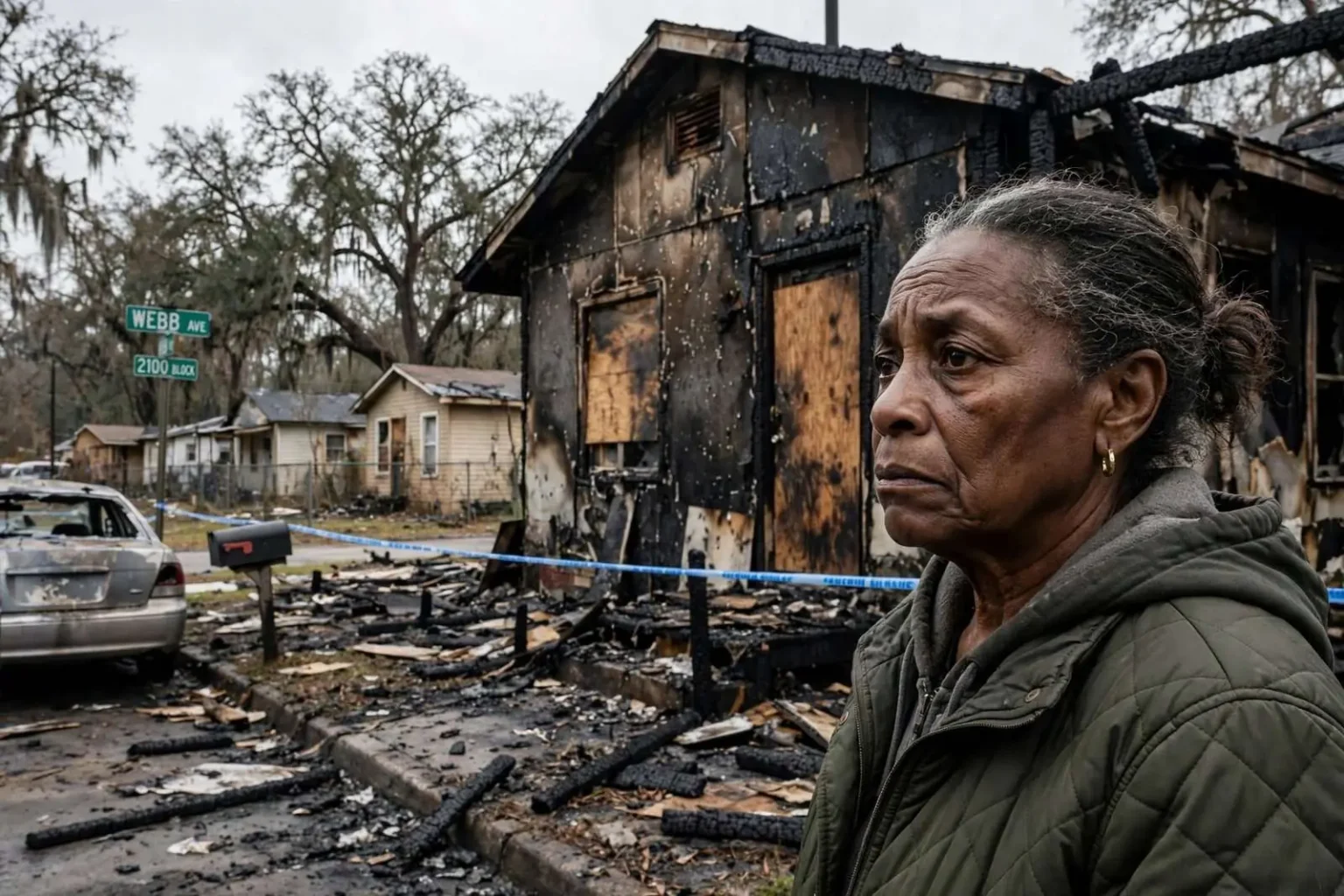
Recent violence around Webb Avenue in Mobile has upended the lives of one family in particular, whose matriarch says she has lived on the street for 15 years without ever imagining the toll the past six months would take. In that span, one of her sons was fatally shot, another was arrested in connection with a separate killing, and a suspicious fire tore through her home. The sequence of losses has left one household grieving, displaced and afraid, on a block where neighbors say they are struggling to recognize the place they have lived for years.
“I wouldn’t have imagined all this amount of stuff that has been put on us the last few months,” she said. “There’s been nothing but disaster.”
Webb Avenue sits in a working-class stretch of Mobile where modest homes and apartment complexes sit blocks apart, the kind of neighborhood where families stay for decades and know one another by name. That familiarity is part of what makes the recent wave of violence so jarring for the people who live there. Longtime residents describe a street that had its troubles, like any neighborhood, but nothing approaching what has unfolded over the past several months.
A killing that remains unsolved
The trouble began in earnest in December 2013, when one of her sons was fatally shot at an apartment complex near Webb Avenue, in a case that remains unsolved. She acknowledged her son had ties to street life but said that didn’t change how she felt about him. For a mother, the distinction between what a child did and what a child was worth never blurred, and she has carried that conviction through an investigation that has produced no arrest.
Unsolved homicides are a familiar frustration across Mobile. Police work fatal shootings as aggressively as staffing allows, but witnesses in neighborhoods where gunfire has become routine are often reluctant to come forward, and cases stall for lack of testimony. Families are left with unanswered questions, and months pass without anyone being held accountable.
She recalled seeing him for the final time the night before he died, when she met him briefly to hand over a house key — the only item investigators were later able to return to her. A single key, in the end, was all that came back from a life, a detail that captures how little closure these cases tend to leave behind for the people left standing.
The day before that shooting, her son had served as a pallbearer at the funeral of a close friend who had himself been fatally shot on Webb Avenue in a case still before a grand jury. The friend’s sister said she believes her brother’s emotional reaction at that funeral, where he was seen crying and screaming, may have contributed to his own death days later. Whether or not that theory proves true, it reflects a fear that families in the neighborhood have learned to voice: that visible grief itself can make a person a target.
A fire and more gunfire
More recently, a nighttime fire tore through the family’s home, causing an estimated $20,000 in damage and displacing the mother and another son, who is blind and often home alone in the evenings. She believes the fire may have been set intentionally, and police have said the fire’s origin remains under investigation. For a household already carrying one unexplained death and an arrest, the fire landed as one blow more than the family could absorb quietly.
Fires of suspicious origin are investigated jointly in Mobile, with fire investigators and police working to determine whether a blaze was accidental or deliberately set, and the distinction matters both for any criminal case and for families trying to understand what happened to them. Until an origin determination is made, questions hang over the property and the people it once sheltered.
The displacement has added practical hardship on top of grief. A blind adult son who spent evenings alone in the home now lives somewhere else, and his mother worries about his safety and routine in equal measure. Households disrupted by fire face a cascade of smaller losses — furniture, documents, medications, the quiet assumptions of a familiar floor plan — and those losses compound when the fire’s cause is still unknown.
Around the same time, gunfire struck the home of her sister next door, and a third man was fatally shot while sitting in a car nearby. The violence was not confined to one property or one grievance; it spread across the block and pulled several households into the same circle of loss within a matter of months.
A different son was later arrested in connection with that shooting and is currently held in custody out of state. The mother said she has heard rumors that he could face danger if he returns to Mobile. She said she now sometimes wears a disguise and drives a rental car when she returns to check on the property, out of concern for her own safety. A woman who has lived on the same street for 15 years now returns to it only in disguise, which may be the clearest single measure of how the neighborhood has changed for her.
The pattern of one family absorbing so many separate blows — a homicide, an arrest, an arson investigation, shots fired into a relative’s home — illustrates how violence in a single corridor can cascade through the households nearest to it. Each incident draws in police, investigators and reporters, and each leaves the family with new costs: funeral expenses, legal fees, repairs and the constant strain of waiting for the next phone call.
Police crack down on the corridor
Mobile police have designated the Webb Avenue corridor a crime hot spot, conducting raids and making multiple arrests, largely targeting low-level drug activity that officers say has fueled much of the unrest. Hot-spot policing concentrates patrols and investigative resources on the small number of blocks where a disproportionate share of a city’s crime occurs, a strategy departments across the country have adopted after research showed that crime clusters tightly in space and time.
The approach has visible effects in the neighborhood: marked units on the corners, unmarked cars circling the blocks, and periodic raids on houses that residents say have drawn complaints for months. Arrests come in bunches, and the department has publicized the effort as a sign of commitment to the corridor.
But residents, including the grieving mother and the friend’s sister, are skeptical that drugs alone explain the violence. “No one piles up at one house,” the sister said. “This is not drug activity.” The mother agreed, saying the street had never seen this level of violence before this year.
Their skepticism points to a debate that plays out in neighborhoods across Mobile and cities like it. Officers see the drug trade as the engine behind retaliatory shootings, and dismantling open-air markets is their most direct lever. Residents living on those blocks often see something more tangled — personal disputes, retaliation cycles and grievances that no drug arrest will resolve — and they doubt that the people being arrested are the people driving the killing.
Both things can be true at once. Low-level narcotics enforcement can calm a corridor for a time, and communities do report relief when chronic problem houses are shut down. But the underlying conflicts that produce shootings frequently outlast any single raid, and the people closest to the violence tend to measure progress not in arrest numbers but in whether the shooting stops.
A stretch unlike any other
Police activity in the area continues, even as families along Webb Avenue try to make sense of a stretch of months unlike any they can remember. The mother buries one son with no arrest in his case, waits on word about a fire she suspects was set, and counts the days until legal proceedings determine whether another son comes home — or whether it is safe for him to.
What has happened on Webb Avenue is not happening in isolation. Mobile, like cities across Alabama and the Southeast, has spent years wrestling with gun violence that clusters in a handful of neighborhoods, and the corridor around Webb Avenue has been a repeated flashpoint. The city’s response — raids, hot-spot designations, targeted arrests — reflects the tools a police department has. What it cannot quickly restore is the sense of safety that families lose when violence keeps finding the same street.
What families are left to carry
For the matriarch and her neighbors, the immediate questions are practical ones. Whether the fire was deliberately set may determine what aid is available and whether anyone is ever charged. Whether the investigation into her son’s December 2013 killing produces an arrest may depend on whether someone who saw something finally decides to talk. Whether the son held out of state can eventually return to Mobile safely is a question no court proceeding will answer directly.
Community advocates in Mobile have long argued that neighborhoods in this position need more than enforcement: witness protection and support for families willing to cooperate, violence interruption programs that get between disputes before they turn fatal, and follow-up with the households that a single shooting can destabilize. Those programs exist in various forms around the city, run by churches and nonprofit groups, and their reach rarely matches the need.
The funeral home visits, the insurance adjusters, the landlord conversations and the police interviews all fall on the same small circle of people. In this family’s case, that circle has been juggling all of them at once for half a year, while also trying to protect a blind son and a frightened mother who no longer feels safe walking her own street without a disguise.
Waiting for the street to quiet
Neighbors say they hope the heavier police presence marks a turning point rather than a temporary surge. Historically, sustained attention to a hot-spot corridor has brought stretches of calm, and residents along Webb Avenue would welcome even that. But the memories of the past six months — the pallbearer shot days after burying his friend, the fatal gunfire into a parked car, the blaze that put a family out of its home — do not fade with a few quiet weeks.
The mother’s account of her son’s last night stands as the family’s own marker of the whole ordeal: a brief meeting to hand over a house key, a gesture of ordinary trust between a mother and her grown son, and then the shooting that turned that key into the only piece of his life she would get back. It is the sort of detail that no arrest statistics or enforcement tally can weigh, and it is the one the family carries most heavily.
For now, the corridor remains under watch, the investigations remain open, and the families on Webb Avenue keep waiting for a stretch of months they can describe as ordinary. After the year they have had, ordinary would be enough.