Mobile Police Find No Evidence to Support Reported Assault at Local Hospital
Mobile investigators say a review turned up no evidence to substantiate a woman's report that she was attacked while under anesthesia at a local hospital.
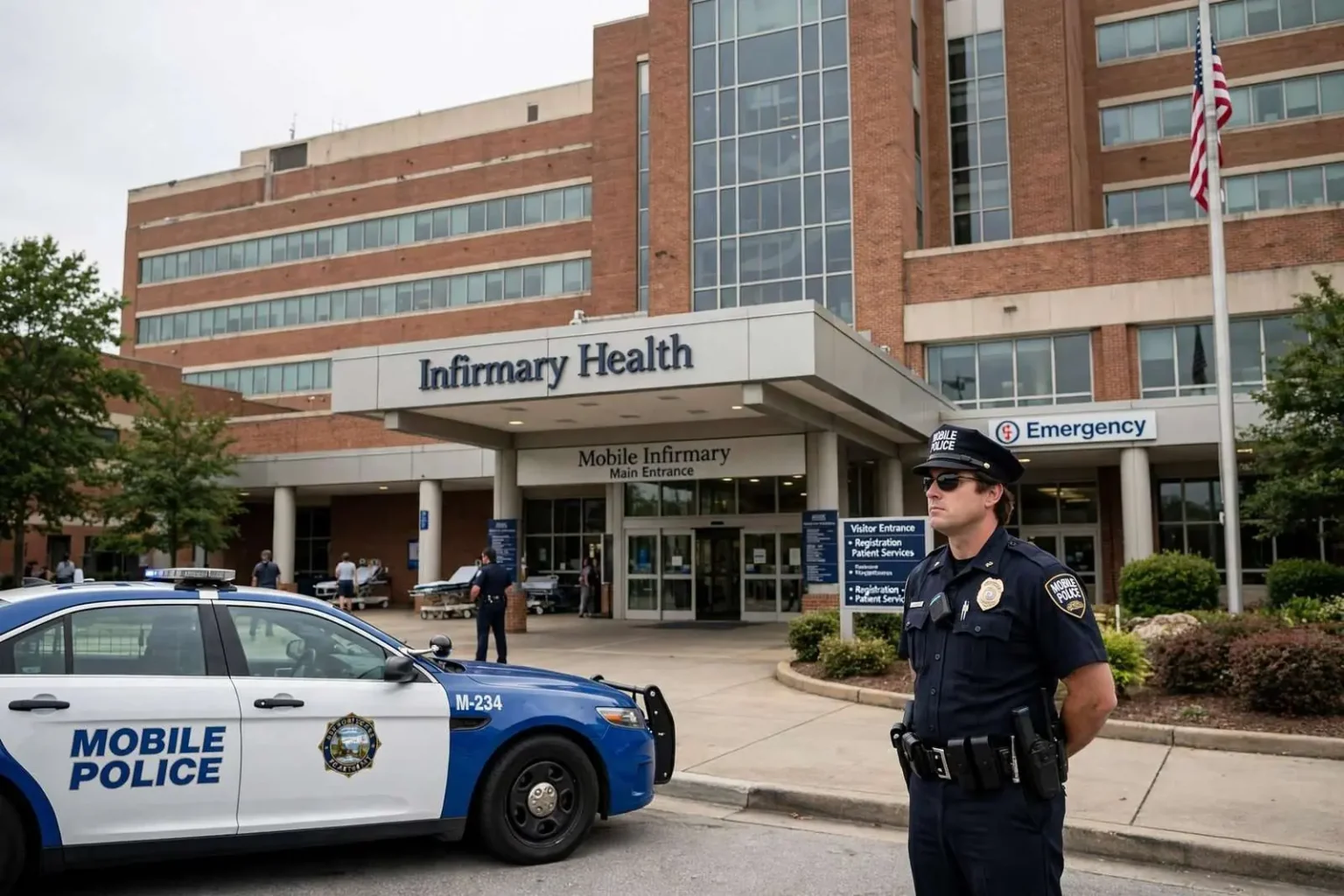
Mobile police say an investigation into a troubling report from late June has closed without turning up evidence to support the claim. Officers were called to Mobile Infirmary after a patient told hospital staff and responding officers that a stranger had entered her room and attacked her while she was still under the effects of anesthesia following a medical procedure.
The woman’s account, relayed to officers on June 26, described waking to find an unfamiliar person in her hospital room. Given the seriousness of the allegation, the Mobile Police Department opened an investigation, working with hospital staff to review the circumstances surrounding the report.
By early July, investigators said they had been unable to find physical evidence or witness accounts that would confirm an assault took place. A department spokesperson said detectives treated the report seriously from the outset, but that the facts developed during the inquiry did not support the initial claim.
The course the investigation followed is the standard one for allegations inside a medical facility. Detectives reviewed the hospital’s records and security materials, canvassed for staff and visitors who would have been in the area during the relevant window, and worked with medical personnel to establish what the patient’s condition actually was at the time she described the encounter. When none of that produced corroboration, the case closed without charges, and no suspect was ever identified or sought.
Police officials noted that emergence from anesthesia can occasionally produce vivid, disorienting sensations for patients, sometimes described by medical professionals as a kind of temporary confusion as the body clears sedative drugs from its system. The department’s spokesperson said officers have encountered a handful of similar reports tied to post-anesthesia recovery over the years, though he added that this was the first such case he personally had been involved in reviewing, underscoring how uncommon these situations are for local law enforcement.
Why Anesthesia Can Blur What Patients Remember
The confusion the spokesperson described is a recognized phenomenon in medical care. Sedation and general anesthesia affect the brain’s ability to form and store memories during and shortly after a procedure, and patients waking in an unfamiliar room, with monitors attached and staff moving in and out, can piece fragments of sensation into experiences that feel entirely real. Recovery nurses are trained to expect some disorientation in the first minutes and hours, and hospital protocols place patients in monitored recovery areas precisely because those early moments are unpredictable.
Anesthesia researchers distinguish between several related experiences, including emergence agitation, where a waking patient thrashes or panics, and postoperative delirium, which can include hallucinations and distorted perceptions of time and place. Neither implies any fault by the patient or the hospital; both are documented effects of powerful drugs wearing off unevenly. The practical consequence for investigators is that a report made in the hours after a procedure has to be weighed against what the patient was physiologically experiencing when the memory was formed — which is why detectives in this case worked with hospital staff to reconstruct her medical timeline before drawing conclusions.
Medical literature and law enforcement experience converge on the same guidance: hospitals and police take every such report seriously, document it fully, and investigate it without treating the reporter’s account as either an accusation to be prosecuted or a confusion to be dismissed. Reports of this kind occasionally do reveal real incidents of hospital-based crime, which is why departments do not screen them out at intake. The investigation’s length — roughly two weeks between the report and its closure — reflects that careful middle path.
The Hospital Setting
Mobile Infirmary, the flagship of the Infirmary Health system, is among the oldest and largest hospitals in the state, and its campus operates around the clock with hundreds of patients in residence on any given day. Facilities of that scale present a security picture that differs from almost any other public building: hundreds of staff, contractors, patients, and visitors move through the corridors at all hours, and the patient population includes many people whose judgment is compromised by illness, medication, or sedation. Hospitals manage that reality with visitor policies, secured units, camera coverage of key areas, and security staff who work in close partnership with municipal police.
Reports from patients are handled within that framework. When a patient describes an assault, staff document the account, notify security and administration, and call police so that the investigation begins while evidence is freshest. The collaboration described in this case — detectives working alongside hospital staff — is the normal relationship, not an extraordinary one, and hospitals in the Mobile area have standing protocols with the police department for exactly these situations.
Because the investigation did not substantiate a crime, no charges were filed and no suspect was identified or sought. Mobile police said the case remains an example of how seriously the department treats reports of assault inside medical facilities, even when an investigation ultimately does not confirm the initial account.
Closing a Case Without Charges
An investigation that ends without corroboration does not end without documentation. Detectives compile the interviews, records, and physical evidence they gathered, and the file preserves what was checked and what it showed — a record that matters both for the reporting patient, whose account is preserved rather than brushed aside, and for any future inquiry that might surface new information. Police spokespeople in cases like this one typically emphasize that a lack of supporting evidence is different from a finding that the report was false; it means the investigation could not establish what happened, one way or the other.
The distinction matters for the patient as well. People who report incidents that later cannot be corroborated are sometimes assumed to have lied, but investigators and medical professionals are careful to separate deliberate fabrication from inaccurate perception. A patient who genuinely experienced what she describes as an attack, during a period when anesthesia was still clearing from her system, falls into the second category in the eyes of most detectives — a witness whose memory was shaped by a pharmacological state, not a witness making things up. The department’s public language in this case, crediting the seriousness of the initial response, tracked that understanding.
Hospital administrators at Mobile Infirmary did not issue a separate public statement on the matter, and the facility deferred to police on questions about the investigation.
The spokesperson’s remark about similar reports over the years points to a category of calls that most patrol officers and detectives handle only a few times in a career. Post-anesthesia confusion can produce reports that range from mistaken identity — a patient who believes a nurse or technician was a stranger — to elaborate scenarios involving people who were never present. Departments that encounter them treat the medical timeline as the first piece of evidence, because it establishes what the patient could plausibly have perceived and remembered during the window in question.
Detectives also weigh the physical possibilities the hospital setting allows or forecloses. Patient rooms sit along monitored corridors; staff move through on predictable schedules; entry to units is controlled by staff and, on many floors, by badge access. Reconstructing who could have been in a room, and when, is a tractable exercise in a hospital in a way it might not be in a private home, which is part of why an investigation like this one can reach a conclusion within weeks rather than months.
Guidance for Patients and Families
Episodes of waking disorientation are common enough that hospitals prepare patients for them. Discharge and pre-surgical instructions typically advise patients that their memories of the procedure day may be patchy or distorted, and family members are encouraged to stay with patients through recovery whenever possible — partly for support, and partly because a familiar face helps orient someone emerging from sedation. Patients who wake frightened or confused are urged to tell staff immediately, so that a nurse can reassure them and document what happened.
For families, the practical steps are simple: ask the care team what sedation was used and what after-effects to expect, keep visits coordinated so someone is present during the riskiest hours, and raise any concern about room security with the charge nurse rather than letting it wait. Hospitals in the Mobile area can restrict room access, adjust staffing, and involve their security teams quickly when a patient or family raises a specific worry.
And if a patient does report something like an assault, the response should be the same one this case received: report it to police immediately, preserve the timeline, and let the investigation run. The Mobile Police Department’s handling of the June report — a full investigation, cooperation with hospital staff, and a conclusion stated in careful terms rather than a rush to judgment — illustrates the process working as it is designed to, even in a case where the evidence never came together.
The case is now closed in the department’s records, with no charges filed, no suspect sought, and no further action anticipated unless new information surfaces. For the hospital and the police department alike, the episode ends as the kind they hope to see rarely: an unsettling report, taken seriously, investigated thoroughly, and resolved by evidence rather than assumption.