Mobile and Baldwin County Health Departments Step Up Mosquito Spraying This Summer
Health officials in Mobile and Baldwin counties are running nightly spray missions and asking residents to dump standing water as mosquito activity rises.
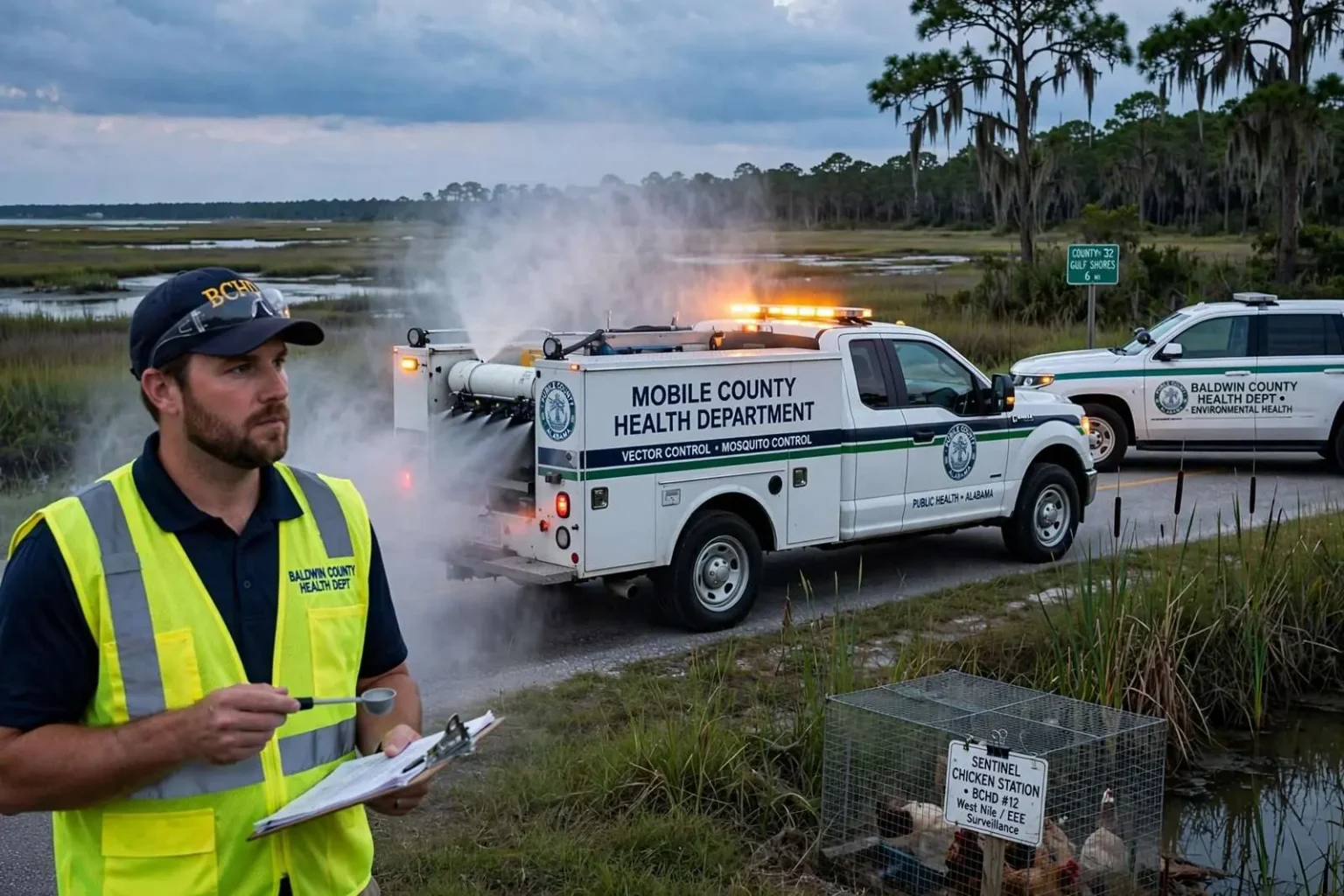
Health departments in Mobile and Baldwin counties have expanded mosquito spraying operations as warm, wet weather fuels a jump in mosquito activity across the region. Crews from both county health departments have been running spray missions on most evenings recently, taking advantage of a stretch of favorable conditions to get ahead of the problem before it becomes unmanageable.
A senior public health environmentalist with the Baldwin County department said the team has been spraying every chance it gets, describing recent weeks as a full-on effort to knock back mosquito populations. Baldwin County’s geography — a mix of tidal flats, pine woods, and fast-growing suburbs stretching from the Mobile Bay shore to the Florida line — gives mosquitoes plenty of habitat, and a wet summer multiplies the breeding sites faster than nature’s usual checks on the population.
On the Mobile County side, the vector control director explained how the departments track activity in the first place. Inspectors regularly check ditches, swampy areas and other standing water for mosquito larvae, mapping where breeding is heaviest so spray routes can be targeted rather than scattered. The surveillance work happens year-round, but it intensifies as temperatures climb and hatch cycles shorten.
The departments also rely on an early warning system that few residents ever notice: flocks of sentinel chickens kept at stations around the two counties are tested periodically for West Nile virus and Eastern equine encephalitis, the two most serious mosquito-borne illnesses that circulate on the Gulf Coast. Because chickens develop telltale antibodies when bitten by an infected mosquito without becoming seriously ill themselves, a positive test gives health officials advance notice that dangerous virus activity is moving through the local mosquito population — weeks before a human case might appear.
Timing matters, especially around big events
Timing is a science of its own. Around major outdoor gatherings — festivals, ball tournaments, weddings, and community celebrations that draw crowds to parks and fairgrounds — crews adjust their normal nighttime spraying schedule and instead head out in the early morning hours, finishing before people are out and about with food and drinks. Treating an event site in the pre-dawn hours knocks down adult mosquitoes that gathered overnight and gives the insecticide time to dissipate before vendors and families arrive.
The coordination between event organizers and spray crews has become a routine part of hosting large outdoor functions on the Gulf Coast. Organizers who contact the health departments in advance can often get a site treated the morning of the event, a courtesy that makes the difference between an evening nobody remembers for the wrong reasons and one where the bug spray stays mostly in the bag.
Mobile County is also deploying aircraft to treat marshy coastal areas that trucks can’t reach. The aerial missions target salt marsh mosquitoes, the aggressive species that hatch in overwhelming numbers in the tidal marshes along Mobile Bay and the Gulf. Unlike the container-breeding mosquitoes that live in neighborhoods, salt marsh mosquitoes can travel miles from their hatching grounds, descending on inland communities in clouds dense enough that people can be bitten repeatedly just walking from a house to a car.
Aerial spraying covers in hours what would take ground trucks weeks, dropping ultra-low-volume treatments across the marshes when weather and wind conditions allow. The flights are timed to catch hatches when the mosquitoes have just emerged, and residents along the coast have learned to read the low-flying aircraft as a sign that the season’s worst swarms have arrived.
Spraying only kills what’s flying
Despite the spraying, officials stressed that chemical treatments only kill adult mosquitoes already in the air. Any standing water left sitting in yards, gutters, buckets, flower pots, or old tires will keep producing new generations of larvae regardless of how often spray trucks come through. A single bottle cap of stagnant water can hatch mosquitoes in a matter of days in summer heat, which is why the departments pair their spray missions with a constant public message: dump the containers.
With Mobile County’s health department alone responsible for monitoring roughly 1,200 square miles, officials said they simply don’t have the staff to go property to property emptying containers. The county’s territory runs from downtown Mobile and the industrial waterfront out to rural communities near the Mississippi line, encompassing thousands of ditches, storm drains, retention ponds, and private yards. Inspectors hit the known trouble spots, but the departments depend on residents to handle the breeding sites that no inspector will ever see.
Health officials recommend a simple weekly routine that matches the mosquito life cycle. Empty and scrub anything that holds water — birdbaths, pet bowls, wheelbarrows, trash can lids, kiddie pools. Keep gutters clear so rain drains instead of pooling. Store buckets, tires, and boats upside down or under cover. Fill tree holes and repair leaky outdoor faucets. For ornamental ponds, mosquitoes-eating fish or larvicide tablets provide control without harming other wildlife. Residents with large properties or drainage problems can report standing water to the health departments, which add the locations to inspection routes.
Personal protection remains part of the equation as well. The mosquitoes that carry West Nile virus and Eastern equine encephalitis are most active from dusk to dawn, so health officials advise limiting outdoor activity during those hours, wearing long sleeves and pants when practical, and using insect repellents registered with the Environmental Protection Agency. Repairing torn window screens keeps the problem out of the house, where the biggest share of mosquito bites actually happen after dark.
The stakes of the surveillance and control work are not trivial. West Nile virus, which arrived in Alabama in the early 2000s, produces flu-like illness in most people who catch it but can cause severe neurological disease in the elderly and those with weakened immune systems. Eastern equine encephalitis is rarer but far more lethal, with one of the highest fatality rates of any mosquito-borne disease in North America. The sentinel chicken program, run cooperatively between the state and county health departments, has become the Gulf Coast’s most cost-effective radar for both diseases.
The two counties’ programs trace their history to decades of public health work along the Gulf. Salt marsh mosquitoes were once severe enough to throttle tourism and outdoor work along the coast, and organized mosquito control became a fixture of local government generations ago. Today’s operations blend that legacy with modern tools: GPS-mapped spray routes, larval surveillance data, laboratory testing, and coordinated aerial missions timed to weather and tide.
Officials in both counties emphasize that the recent expansion is a response to conditions, not an alarm. Warm, wet stretches are normal on the Gulf Coast, and the departments scale their operations up and down with the weather every year. What makes heavy activity years demanding is arithmetic: mosquito breeding cycles run as short as a week in peak summer heat, so every rain event resets the clock, and populations can rebound within days of a successful spray mission.
For residents, the takeaway from both departments is the same. The trucks and planes will keep flying and rolling on most evenings while conditions favor mosquitoes, the sentinel flocks will keep testing, and the inspectors will keep walking the ditches — but the single most effective square mile of mosquito control in either county is the one made up of residents’ own backyards. Emptying the containers that collect rain after every Gulf Coast downpour does more to cut the region’s mosquito population than any single night of spraying, and it costs nothing but a few minutes of labor.
The division of labor between the two counties reflects their different geographies. Baldwin County, stretching across a wide band of bays, rivers, and tidal marshes between Mobile Bay and the Gulf, leans heavily on coordinated ground routes and aerial treatment of its salt marshes, where hatches can strand whole neighborhoods in biting swarms overnight. Mobile County’s program, larger and more urban, combines truck-mounted spraying across the city of Mobile and its suburbs with inspection teams that work the storm drainage network where urban mosquitoes breed year-round in warm months.
Both departments answer to the Alabama Department of Public Health, which coordinates the disease surveillance side of the work. Positive sentinel chickens, positive mosquito pools, and confirmed equine cases all flow into the state’s tracking system, which issues advisories when virus activity crosses thresholds that warrant heightened public warnings. Horse owners in both counties are reminded that Eastern equine encephalitis is as dangerous to animals as to people, and veterinarians recommend vaccinations as part of standard care for horses kept outdoors on the Gulf Coast.
The evening spray missions themselves are carefully engineered. The trucks dispense an ultra-low-volume mist calibrated to drift through neighborhoods at night, when mosquitoes are flying and people are indoors. The insecticide breaks down quickly in sunlight, and the doses used are far below levels that affect people, pets, or gardens. Officials still recommend that residents with chemical sensitivities keep windows closed when they hear the spray trucks, and beekeepers are advised to notify the departments so hives can be shielded during nearby missions.
As long as the warm, wet pattern holds, residents in both counties should expect the same rhythm: spray trucks on most evenings, aircraft over the marshes when hatches demand it, inspectors wading the ditches each week, and the quiet sentinel flocks standing watch for the viruses that make mosquitoes more than a nuisance. The departments’ message pairs with every mission — the professionals will do their part from the trucks and the air, and the region’s best defense starts at home with a bucket turned upside down.