University of South Alabama Mobile
Whooping Cough Cases Climb in Mobile County, Health Officials Urge Vaccination
Mobile County health officials report a sharp rise in whooping cough cases in 2014 and urge families to get vaccinated.
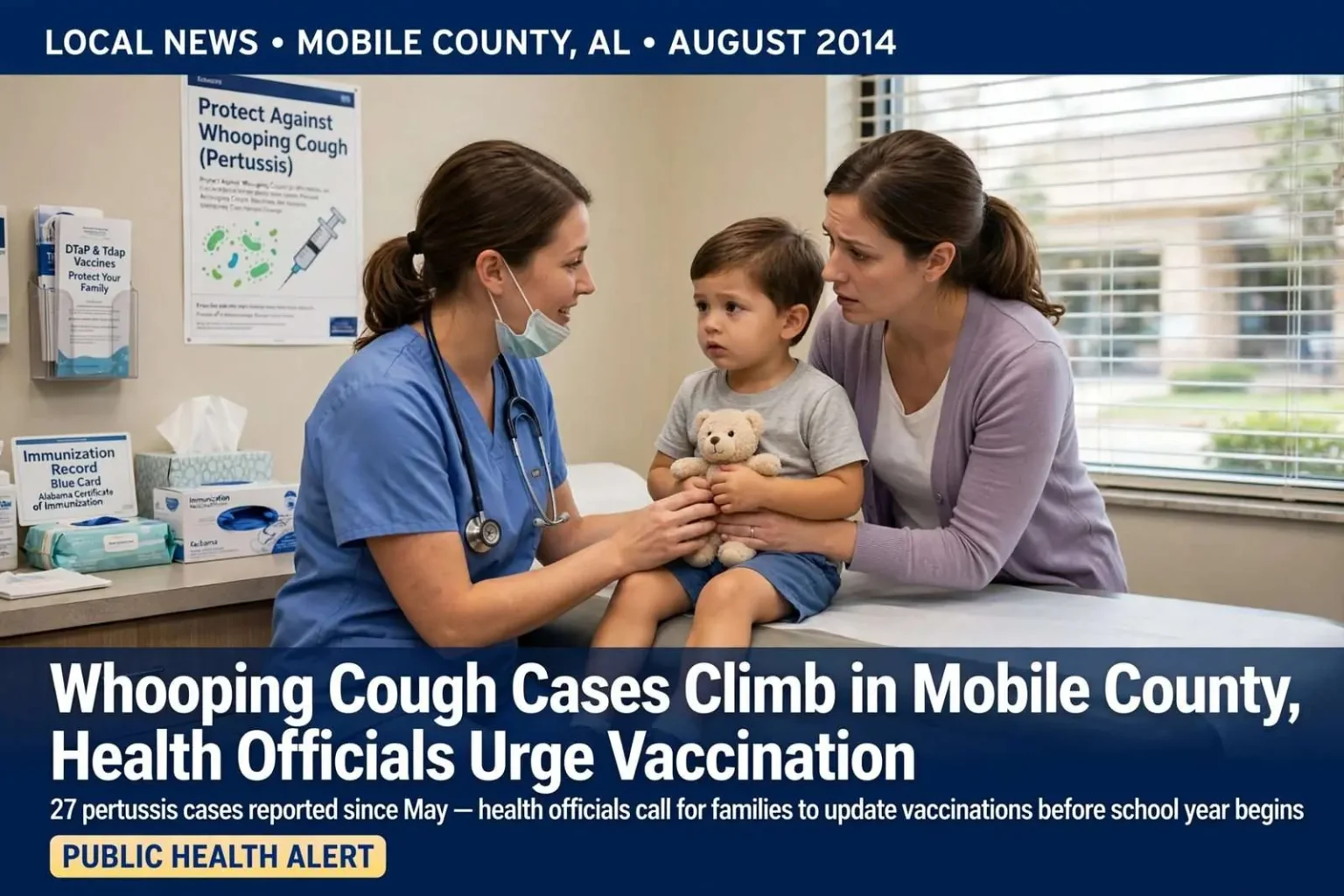
Mobile County health officials have confirmed a growing number of pertussis, or whooping cough, cases this summer, prompting renewed calls for families to make sure their children are up to date on vaccinations. The increase comes at the worst possible point on the calendar, in the weeks before students return to classrooms, when respiratory infections that circulate easily among children can spread quickly once school doors open.
Case counts rising through the summer
According to the Mobile County Health Department, 27 pertussis cases were recorded between the start of May and July 1, up from 25 cases reported just two weeks earlier on June 20. Of those 27 cases, 14 have been formally confirmed, with additional suspected cases still under investigation.
Health department officials say the county has now logged 31 pertussis cases for all of 2014 combined, a dramatic jump compared with just eight confirmed and probable cases recorded in the entire 2013 calendar year. The fourfold difference between the two years is the kind of swing that public health agencies watch closely, because pertussis outbreaks tend to build in waves, with each undetected case capable of producing clusters in households, daycare centers and schools.
Dr. Paola Maurtua-Neumann, a pediatrician affiliated with the University of South Alabama Children’s Medical Center, has diagnosed the majority of this year’s cases, according to the health department. That concentration at a single pediatric practice gives investigators a useful thread to follow, since each diagnosis triggers a public health response: interviewing the family, identifying close contacts and arranging preventive antibiotics for anyone who may have been exposed.
Pertussis is a reportable disease in Alabama, meaning physicians and laboratories are required to notify the health department of suspected and confirmed cases. That reporting system is what allows the county to track the summer’s increase case by case rather than discovering an outbreak after it has already spread through a school.
A disease that hits youngest children hardest
Whooping cough is a highly contagious respiratory illness that causes severe, uncontrollable coughing fits that can make it difficult to breathe. The name comes from the characteristic whooping sound some patients make as they gasp for air between coughing fits, though infants may not make the sound at all — a feature that makes the disease harder to recognize in the group most at risk.
The Centers for Disease Control and Prevention notes the disease is especially dangerous, and can be fatal, for infants younger than one year old. Babies with pertussis may develop apnea, pauses in breathing that send them to the hospital before a full cough even develops, and most pertussis deaths occur in infants too young to have completed their initial vaccination series.
The illness typically begins with cold-like symptoms — runny nose, low fever, mild cough — for a week or two before progressing to the severe coughing stage, which can last six weeks or longer. Antibiotics can shorten the period of contagiousness and may reduce the severity of the illness if given early, but by the time the classic coughing fits appear, they often do little to change the course of the disease.
Health officials stress that once a pertussis case is confirmed, everyone living in the same household as the infected person should be treated with antibiotics as a precaution, regardless of their vaccination history, since the disease spreads so easily among close contacts. The bacteria travel through droplets released by coughing and sneezing, and household members, who spend hours in close quarters with an infected person, face the highest exposure risk of anyone around a case.
That household approach — treating the whole family rather than only the patient — is called prophylaxis of close contacts, and it is a standard tool for containing pertussis. Vaccinated people can still carry and spread the bacteria, which is why the health department does not rely on vaccination status alone when it decides who should receive preventive treatment after an exposure.
Vaccination requirements and where to get shots
Alabama has required a Tdap vaccine, which protects against tetanus, diphtheria and pertussis, for students entering sixth grade since the 2010-11 school year. The requirement was adopted in response to a well-documented problem: immunity from the pertussis vaccines given in early childhood fades over time, leaving adolescents susceptible during the middle school and high school years, when they can then pass the infection to infants at home.
Younger children follow a different schedule, receiving the DTaP vaccine — the same three protections in a formulation for young immune systems — in a series of five shots at ages two months, four months, six months, 15 through 18 months, and four through six years. The sixth-grade Tdap requirement is the booster that picks up where that series leaves off, and Alabama’s immunization rules are enforced through the certificate system schools check at enrollment.
With classes starting back up soon, the Mobile County Health Department is offering free or low-cost immunizations throughout the summer to help parents secure updated immunization certificates before the first day of school. Alabama families will recognize the certificate in question — the blue card that documents a child’s required vaccinations and must be on file with the school before attendance.
Health department clinics generally accept walk-ins as well as scheduled appointments for routine immunizations, and families who are unsure whether their child needs a booster can bring existing records to a clinic for review. Parents who cannot locate their child’s vaccination history can often obtain a complete record through the state’s immunization registry, which tracks shots administered by participating providers across Alabama.
Beyond school requirements, health officials recommend that adults who spend time around infants stay current on pertussis protection as well. The strategy, sometimes called cocooning, is built on a simple chain of logic: because babies cannot be fully vaccinated until they are several months old, the best protection for a newborn is to make sure every adult and older child around the baby — parents, grandparents, caregivers — cannot carry the infection to them.
Expectant mothers are also part of that strategy. Vaccination during the third trimester of pregnancy allows a mother to pass protective antibodies to her baby before birth, covering the vulnerable window between delivery and the infant’s first shots. The recommendation has become a standard part of prenatal care guidance, and health departments across the country promote it during pertussis outbreaks.
Why outbreaks come in cycles
Pertussis has never disappeared from the United States, despite decades of vaccination. Cases rise and fall in cycles of roughly three to five years, a pattern driven by waning immunity, gaps in booster coverage and the disease’s constant circulation among adolescents and adults, who often experience it as nothing more than a persistent cough and never realize they are spreading a reportable disease.
The 2014 increase in Mobile County fits that broader pattern, but the comparison with 2013 — eight confirmed and probable cases versus 31 — is the kind of jump that prompts health departments to issue public reminders. Nationally, the CDC recorded tens of thousands of pertussis cases in peak years, and states across the Southeast have seen summer upticks that carry into the fall school term when children return to close quarters.
Public health officials also point out that better awareness improves detection. When a pediatric practice knows an outbreak is underway, physicians test more patients with suspicious coughs, and more of the true case count shows up in the numbers. Some portion of any increase reflects heightened vigilance rather than new spread, though both tend to move together during an outbreak.
What families should watch for
The health department’s guidance to families is straightforward. Anyone with a cough that lasts more than two weeks — particularly a cough that comes in fits, ends in gagging or vomiting, or is followed by a whooping sound — should be evaluated by a physician and mention any known pertussis exposure. Infants with any coughing illness, pauses in breathing or difficulty feeding warrant immediate medical attention rather than a wait-and-see approach.
Families with a confirmed case in the household should complete the full course of preventive antibiotics as directed, keep the sick person away from infants and pregnant women, and follow the health department’s instructions about returning to school or work. Patients with pertussis are generally considered contagious until they have finished five days of appropriate antibiotics, which is why exclusion periods apply to school-age children.
Local providers, including pediatric practices connected to the University of South Alabama Children’s Medical Center, work directly with the health department when cases are identified, so families can expect follow-up calls from public health staff if their child is exposed at school, daycare or another setting. Those contact investigations are routine and confidential, and they remain the most effective tool for stopping transmission chains before they reach an infant.
The bottom line from county health officials as the summer count climbs: check vaccination records now, before the school year fills calendars, and use the health department’s free and low-cost clinics if a booster is missing. A mid-summer vaccination visit is a far easier errand than a household-wide course of antibiotics after a case arrives — and for families with newborns, it is the step that matters most.